How Does a Vibratory Hammer Work in Pile Driving:
A 2026 Technical Analysis of Kinetic Energy Transfer
“DECODING THE MECHANICAL RESONANCE AND SOIL FLUIDIZATION PROCESS”
“The efficacy of a vibratory hammer is rooted in its ability to induce transient soil liquefaction through vertical harmonic oscillation. By neutralizing the effective stress between soil particles, the equipment achieves penetration rates that traditional impact methods cannot match.”
01. Core Mechanics: Vertical Harmonic Oscillation
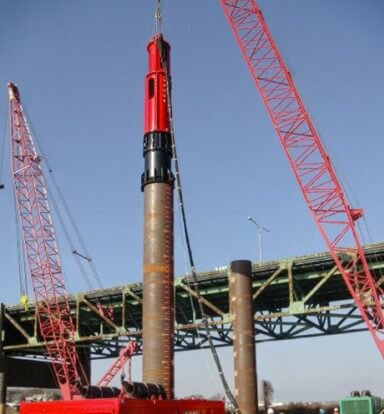
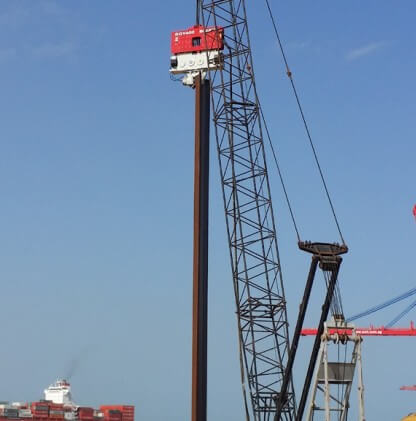
To understand how a vibratory hammer works in pile driving, one must master the principle of counter-rotating eccentric weights. Inside the gearbox, pairs of heavy eccentrics are driven by high-pressure hydraulic motors. These weights spin in opposite directions — a configuration that cancels horizontal vibrations while magnifying vertical oscillation. Consequently, the resulting centrifugal force is transmitted directly into the pile via the hydraulic clamping system, driving the pile downward through the soil profile.
TECHNICAL FOUNDATION
Before diving into step-by-step processes, review the Full Meaning and Mechanics of Vibration Technology in our core technical pillar.
SGV Series — Centrifugal Force and Frequency Range
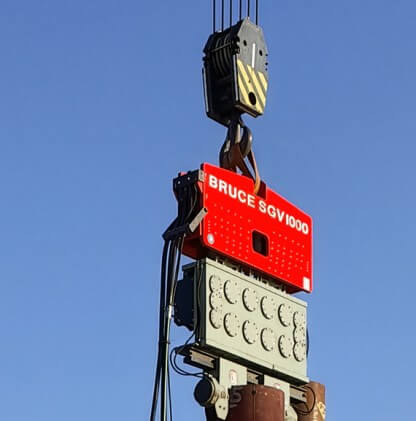
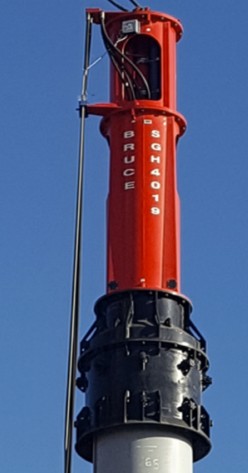
The BRUCE SGV crane-suspended series covers eccentric moments from 11.5 kgm (SGV-80) to 220 kgm (SGV-2000) and centrifugal forces from 510 kN to 4,610 kN. Operating frequency ranges from 1,380 vpm to 2,000 vpm depending on the model — with the excavator-mounted SGV series reaching frequencies of 3,100 to 3,300 vpm. Furthermore, balanced double-side eccentric weights ensure purely vertical oscillation, protecting crane boom integrity and preventing interlock damage in cofferdam sheet pile work. New factory-calibrated equipment maintains this harmonic balance from first deployment, while pre-owned equipment with worn gear tooth profiles develops harmonic drift — causing frequency drop under load that stalls penetration in resistive strata.
Remote Control Pendant — Real-Time Centrifugal Force Management
The remote control pendant includes a flow adjust dial that allows operators to vary the hydraulic pump flow to the motor in real time — directly adjusting centrifugal force and amplitude during the drive cycle. This is the primary operational tool for managing soil liquefaction state across variable soil profiles. Reducing flow reduces centrifugal force and amplitude near sensitive receptors, while increasing it drives through denser soil horizons. Furthermore, emergency stop and automatic cut-off circuit breaker functions are standard on all BRUCE SGV models — protecting both the machine and the operator during abnormal load conditions.
02. The Physics of Soil Liquefaction in 2026 Piling
The actual penetration is achieved through transient soil liquefaction. As the hammer oscillates at high frequency, it induces rapid pressure fluctuations in the pore water of the soil strata. This temporarily nullifies the effective stress between soil particles — transforming dense sand or silt into a viscous fluid state that offers minimal resistance to pile penetration.
Soil Type and Model Selection — Liquefaction Efficiency
Liquefaction efficiency depends on matching the hammer’s centrifugal force and frequency to the specific soil type. In granular soils — sands, gravels, and silts — high-frequency operation maintains liquefaction efficiently with lower centrifugal force. In cohesive stiff clays, high eccentric moment is required to break cohesive particle bonding before liquefaction can be achieved. As a documented selection rule, centrifugal force should be at least 15 times the pile weight. Furthermore, for US and UK projects, this selection is confirmed against the project soil bore log at the design tip elevation before order placement — preventing under-specification that leads to pile stall and over-specification that wastes capital.
This fluidization reduces skin friction significantly. Consequently, the pile advances under the combined influence of its own static weight and the hammer’s downward centrifugal force. For industrial projects in the United States and United Kingdom, achieving this liquefaction state efficiently is the key to maintaining strict project timelines.
“We focus exclusively on NEW equipment because the precise harmonic resonance required for soil liquefaction is lost in used machinery due to bearing wear and eccentric shaft imbalance — causing frequency drop under load that collapses the liquefaction state at depth.”
03. Engineering the Components for Maximum ETR
The energy transfer ratio (ETR) is the metric that separates standard hammers from elite foundation tools. In 2026, the performance of a vibro hammer depends on three high-performance engineering groups — each of which must be specified and maintained correctly for the machine to deliver consistent centrifugal force at its rated frequency throughout the drive cycle.
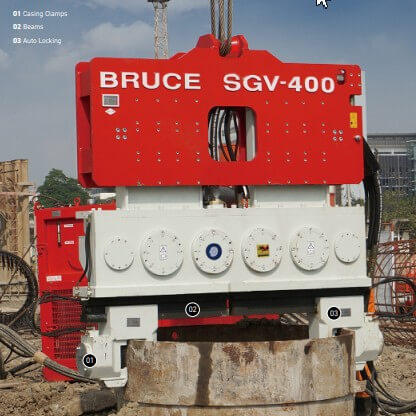
- 1. Balanced Gearbox Synchronization: Counter-rotating synchronized eccentric weights cancel horizontal forces and produce purely vertical oscillation. Alloy steel eccentric weight construction provides extended gear service life — field documentation from BRUCE SGV deployments records gear service life exceeding 20 years with correct maintenance.
- 2. Elastomer Suppressor Assembly: High-grade elastomer rubbers with mechanical stops mechanically decouple the vibrating gearbox from the crane hook. This protects the crane structure from eccentric forces and, for excavator-mounted models, provides a minimum of 90% vibration isolation — protecting the carrier machine during operation. Mechanical stops prevent elastomers from over-stretching during extraction, extending service life.
- 3. Hydraulic Clamping System: The clamp cylinder grips the pile head with hydraulic force confirmed at order stage against the specific pile profile. The built-in clamp check valve maintains clamping pressure even in case of hose damage — preventing pile drop during driving and extraction. Universal Sheet Pile Clamps (60U to 320U) and Casing Pile Clamps (2x40D to 4x160D) cover the full range of standard US and UK pile profiles.
Elastomer Maintenance — ETR Preservation
The suppressor elastomers are the highest-frequency maintenance item in the vibratory hammer system. The operation manual specifies inspection before each shift and hours-based replacement intervals — as degraded elastomers transmit vibration directly to the crane structure and reduce vibration isolation performance progressively. Consequently, maintaining elastomers in specified condition is the primary maintenance action for preserving both the machine’s ETR and the crane structure’s service life across the project duration.
04. Hydraulic Sync: Carrier to Hammer Integration
A vibro hammer is only as effective as the hydraulic flow (lpm) and pressure (bar) provided by its carrier. The hammer’s rated motor demand must be confirmed against the carrier’s auxiliary circuit output before mobilization. Furthermore, the case drain line must be routed directly from the hammer motor to the hydraulic tank — not to the return line — as per the installation diagram in the operation manual. A mismatched carrier or incorrectly routed case drain is the most common cause of motor shaft seal failure on first deployment and results in immediate unplanned downtime on active project sites.
Excavator-Mounted Models — Direct Hydraulic Connection
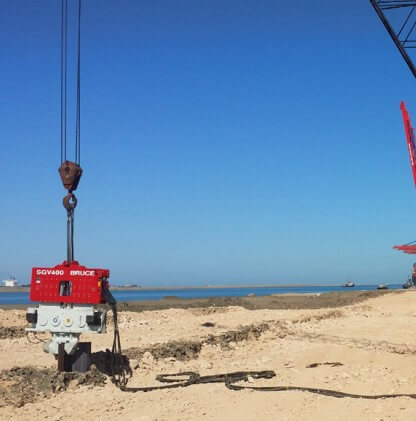
The BRUCE SGV excavator-mounted series (SGV-40, SGV-60, SGV-80E) connects directly to the host excavator’s auxiliary hydraulic circuit without a separate power pack. Required oil flow ranges from 210 lpm to 350 lpm depending on the model. Additionally, tilting models (SGV-40T, SGV-60T) provide 360° hydraulic rotation and 90° hydraulic tilt — allowing a single operator to pick up the pile from the ground, tilt it vertical, and drive it without a secondary crane. Consequently, the excavator-mounted series reduces total procurement and deployment cost for confined urban cofferdam and shoring projects where crane access is restricted.
Amplitude Control for Urban UK and US Sites
For contractors in urban hubs like London or New York, the remote pendant’s flow adjust function allows real-time amplitude reduction near sensitive structures — maintaining penetration rate while keeping Peak Particle Velocity within BS 5228 and local noise ordinance limits. This variable amplitude control is managed through the hydraulic pump flow rate, not through electronic frequency modulation, making it a mechanical system that operates reliably across the full range of soil resistance conditions encountered in urban US and UK foundation projects.
Technical FAQ
Q: Can a vibratory hammer extract piles as efficiently as it drives them?
“Yes — pile extraction is one of the primary operational advantages of vibratory hammers over impact methods. By applying upward crane tension while vibrating, the hammer breaks the skin friction bond through the same liquefaction principle.”
The clamp check valve maintains clamping pressure during extraction even in case of hose damage — preventing pile drop. Furthermore, the mechanical stops in the suppressor design prevent elastomers from over-stretching under the higher loads generated during extraction compared to driving, extending service life and maintaining isolation performance throughout the project.Q: What is the correct centrifugal force for my pile weight and soil type?
“Centrifugal force should be at least 15 times the pile weight as a baseline selection rule — with upward adjustment for stiff clay, dense gravel, or long-standing piles requiring higher extraction force.”
The SGV model selection chart in the engineering catalogue maps pile weight and driving depth to specific model recommendations. Confirming selection against the project soil bore log N-values at the design tip elevation is the primary pre-mobilization engineering step — preventing both under-specification that leads to pile stall and over-specification that wastes capital on unused centrifugal force capacity.Q: Why is harmonic drift in used equipment a critical failure risk?
“Worn bearings and degraded gear tooth profiles cause frequency to drop progressively under soil load — collapsing the liquefaction state at depth and stalling the pile before design tip elevation is reached.”
When frequency drops below the threshold for soil liquefaction, the operator must apply additional crane line pull to compensate — creating a combination of reduced vibration and increased static tension that is the primary cause of pile fracture at weld joints during extraction. New factory-calibrated equipment with verified bearing specifications eliminates this failure mode entirely from first site deployment.Q: How does the case drain line connection affect hammer performance?
“The case drain line must be routed directly to the hydraulic tank — not to the return line. An incorrectly routed case drain causes back-pressure on the motor shaft seal, leading to seal failure on the first day of operation.”
This is the most common installation error on first deployment of excavator-mounted vibratory hammers. The installation diagram in the operation manual specifies the exact routing and the required hydraulic fittings for the specific SGV model. Verifying this connection before first operation is a non-negotiable commissioning step that prevents unplanned downtime and expensive motor seal replacement on active project sites.