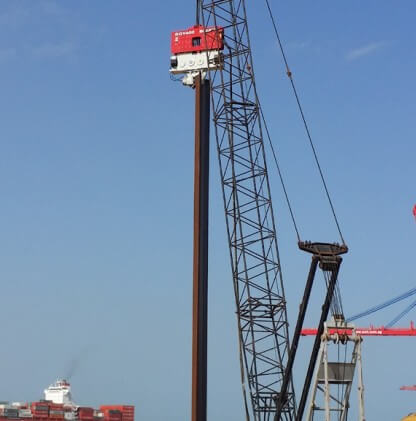
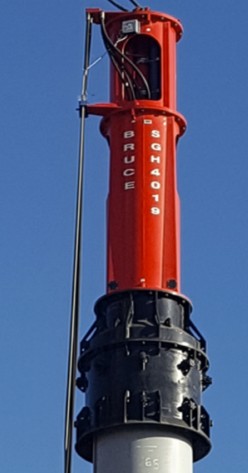
Vibro Hammer Performance:
US Construction Standards Guide
“THE DEFINITIVE RESOURCE FOR PILING EQUIPMENT EFFICIENCY AND ASTM COMPLIANCE”
“US infrastructure projects in 2026 demand a symbiotic relationship between machine frequency and soil resonance. A high-performance vibratory hammer is measured not just by raw centrifugal force, but by its energy transfer consistency under the high-strain dynamic testing required by federal DOTs.”
01. US Piling Taxonomy & Strategic Overview
A vibro hammer is a high-frequency hydraulic instrument designed for the installation and extraction of various pile profiles in US construction. Unlike traditional impact piling, this system utilizes harmonic motion to temporarily neutralize skin friction — allowing the pile to advance toward tip elevation without the percussive noise and structural shock of diesel hammers. Across North America, vibro hammer performance is measured by penetration rate, centrifugal force stability under load, and verifiable energy transfer consistency.
TECHNICAL PILLAR HUB
Does your project face extreme spatial constraints? Explore the Side Grip Vibratory Hammer Technology Guide for Urban Shoring.
SGV Series — US Application Range and Model Selection
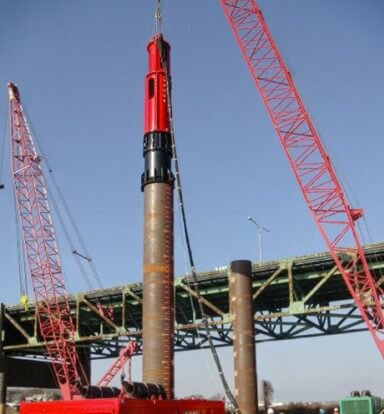
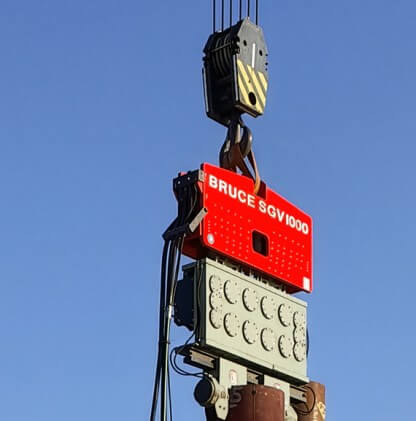
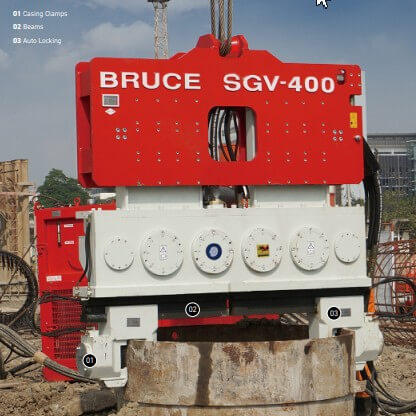
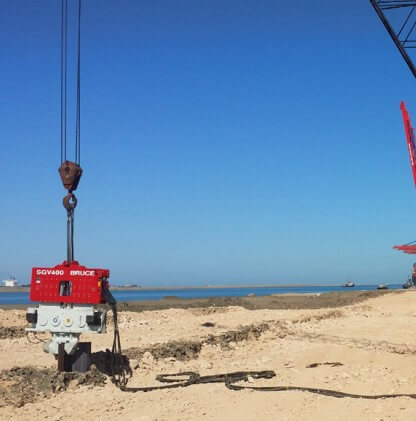
The BRUCE SGV crane-suspended series spans eccentric moments from 11.5 kgm (SGV-80) to 220 kgm (SGV-2000) and centrifugal forces from 510 kN to 4,610 kN. As a documented selection rule, centrifugal force should be at least 15 times the pile weight. Furthermore, the SGV excavator-mounted series (SGV-40, SGV-60, SGV-80E) connects directly to the host excavator’s hydraulic auxiliary circuit without a separate power pack — reducing total procurement cost for US contractors operating on confined urban cofferdam sites in Texas, Virginia, and Washington. Pre-owned assets often suffer from mechanical fatigue in synchronization gears, causing frequency drop under load that stalls penetration in over-consolidated strata. New factory-calibrated equipment eliminates this failure mode from first deployment.
Clamp Selection — US Pile Profile Compatibility
Universal Sheet Pile Clamps (60U to 320U) cover the full range of Larssen and Z-profile sheet piles used on US cofferdam and flood defense projects. Casing Pile Clamps (2x40D to 4x160D) cover round steel casing piles for US bridge and port foundation work. Additionally, the built-in clamp check valve maintains clamping pressure even in case of hose damage — preventing pile drop in the demanding tidal and marine environments of the US East Coast and Gulf Coast where repositioning a dropped pile causes significant schedule and cost risk.
02. The Physics of Controlled Soil Liquefaction
The mechanical advantage of a vibratory hammer lies in its gearbox. Inside, pairs of eccentric weights rotate in opposite directions to cancel horizontal forces while magnifying vertical oscillations. This creates a powerful harmonic pulse that induces soil liquefaction — causing inter-granular friction to collapse temporarily in granular soils and allowing the pile to advance toward design tip elevation. When the vibration ceases, the soil reconsolidates around the pile, recovering a significant proportion of its bearing capacity.
Remote Pendant Flow Control — Real-Time Amplitude Management
The remote control pendant’s flow adjust dial allows operators to adjust centrifugal force and amplitude in real time from the rig cab without stopping the drive cycle. In variable US soil profiles — alternating between soft alluvial layers and denser gravel or clay horizons — this real-time amplitude control is the primary tool for maintaining penetration rate while protecting adjacent structures from ground-borne vibration. Consequently, the remote pendant is the primary compliance tool for urban US projects where noise and vibration ordinances apply simultaneously with production schedule requirements.
Pile Extraction — The Unique Operational Advantage
Vibratory hammers uniquely enable pile extraction — allowing temporary cofferdam sheet piles and casing piles to be recovered after the works phase, reducing material costs on US urban infrastructure projects. The clamp check valve maintains clamping pressure during extraction, and the suppressor assembly’s mechanical stops prevent elastomers from over-stretching under the higher loads generated during pile extraction compared to driving. Additionally, biodegradable hydraulic oil compatibility is increasingly required on US coastal and waterfront extraction projects under EPA permit conditions for tidal zone operations.
03. Regional US Soil Dynamics: Ground Truth
The diversity of American geography requires specific technical calibrations. Consequently, model selection must always be confirmed against the project soil bore log at the design tip elevation — soil type determines whether eccentric moment or frequency is the dominant performance parameter for the specific project conditions.
Midwest (Kansas Clay Belt)
Stiff over-consolidated clays require high eccentric moment models to overcome cohesive particle bonding at depth. The remote pendant’s real-time flow control allows progressive centrifugal force increase as the pile passes from softer upper horizons into stiffer clay at depth — preventing over-vibration in upper strata while achieving sufficient force for final set.
Pacific Northwest (Washington Till)
Abrasive glacial till across Washington State contains erratic boulders and variable gravel horizons that create sudden shock loads during driving. Precision-machined alloy steel eccentric weights and synchronized gearbox assemblies in factory-certified new units withstand these shock loads without the gear tooth fatigue that accumulates in pre-owned equipment over extended heavy-use operation.
Gulf Coast and Florida Coastal Sands — High-Frequency Priority
In the saturated granular soils of the Gulf Coast and Florida Atlantic coast, high operating frequency is the dominant selection parameter — maintaining soil liquefaction efficiently with lower centrifugal force than stiff clay conditions require. The BRUCE PQ-V series power packs are designed for operation from -30°C to above 40°C, ensuring stable hydraulic performance in the extreme summer heat of Texas and Florida Gulf Coast construction seasons. Furthermore, all BRUCE hydraulic components are confirmed compatible with biodegradable hydraulic oils — satisfying EPA coastal permit conditions for piling near sensitive US estuarine and tidal ecosystems.
“Operating in the 100°F+ heat of the Gulf Coast requires a hammer that stays within its hydraulic operating range. We strictly provide NEW equipment because pre-owned units often carry hydraulic contamination that accelerates seal degradation in high-temperature continuous driving conditions.”
04. ASTM Standards & Federal Compliance
Compliance with ASTM D4945 (High-Strain Dynamic Testing) is mandatory for large-scale US infrastructure projects requiring driven pile bearing capacity verification. A vibro hammer must deliver consistent compressive energy to the pile head — allowing Pile Driving Analyzer (PDA) sensors to accurately calculate ultimate bearing capacity and soil resistance distribution. Pre-owned equipment with bearing wear and degraded hydraulic circuits generates inconsistent energy delivery that produces unreliable PDA data, leading to re-testing requirements and project approval delays.
IEA System — Federal DOT Energy Documentation
The optional IEA (Impact Energy Analysis) System — developed by BRUCE and adopted as a standard monitoring system by the Hong Kong Housing Government — records real-time energy at every blow on SGH hydraulic impact hammer deployments. Field measurements on SGH-1015 and SGH-1415 confirmed energy transfer rates of up to 90%, providing the verifiable energy baseline required by DOT structural auditors for AASHTO LRFD bridge pile capacity certification. Including the IEA system in the initial procurement specification consolidates the monitoring requirement into a single factory-direct purchase rather than sourcing separate third-party instrumentation.
Documented US Federal Bridge Performance References
BRUCE has documented performance on multiple major US DOT-funded bridge projects. The SGH-4719 drove 72-inch diameter steel casing piles to over 200 feet on the Sakonnet River Bridge (Rhode Island) — the largest single contract in RI DOT history at USD 163.7M, cited in Providence Journal and confirmed by official RI DOT announcement. The SGH-3013 drove 60-inch precast concrete cylinder piles on the Hathaway Bridge (Florida), documented in a Florida State University engineering thesis. Furthermore, the SGH-2015 was used by SKANSKA USA on the Williamsburg Bridge (Virginia) and by American Bridge Company on the Chincoteague Channel Bridge (Virginia), with the latter published in Pile Driving Association Magazine.
US Technical FAQ
Q: Does BRUCE equipment meet US ASTM piling standards for federal highway work?
“Yes — BRUCE SGH and SGV series equipment has been deployed on FHWA and State DOT-funded projects in Rhode Island, Florida, and Virginia, with documented performance on record.”
The optional IEA system on the SGH impact series provides the verifiable energy transfer log required for ASTM D4945 compliance on federally funded structural pile installations. Furthermore, the SGV series’ real-time pendant amplitude control and biodegradable oil compatibility satisfy environmental permit conditions on US coastal DOT contracts.Q: What centrifugal force model should I select for Texas alternating clay-sand profiles?
“Select a high eccentric moment model — centrifugal force should be at least 15 times the pile weight, with upward adjustment for stiff clay horizons at the design tip depth.”
For Texas alternating clay-sand profiles, eccentric moment is the dominant parameter for penetrating stiff clay lenses. The remote pendant’s real-time flow adjust allows centrifugal force management across the variable soil layers without stopping the drive cycle. Confirming the specific SGV model selection against the Houston project soil bore log before mobilization prevents pile refusal on US Gulf Coast federal contracts.Q: Why should I avoid used hammers for US residential and urban construction projects?
“Pre-owned hammers with worn synchronization gears generate lateral oscillation and frequency drop under load — creating ground-borne vibration that triggers noise ordinance stop-work notices on US urban construction sites.”
New factory-calibrated equipment with balanced double-side eccentric weights produces purely vertical oscillation from first operation. Furthermore, BRUCE hydraulic vibratory systems produce no smoke and significantly lower noise than diesel hammers — directly reducing EPA and local ordinance monitoring burdens in high-density US residential zones in Virginia, Florida, and California.Q: What is the most important maintenance check before deploying a vibro hammer on a US coastal project?
“Confirm biodegradable hydraulic oil fill and verify elastomer condition — both are mandatory before deploying on US EPA-permitted coastal and tidal piling sites.”
All BRUCE SGV hydraulic components are confirmed compatible with biodegradable hydraulic oils, satisfying EPA coastal permit conditions for piling near sensitive US estuarine and tidal ecosystems. Additionally, suppressor elastomers must be visually inspected before each shift — degraded elastomers transmit vibration directly to the crane structure and increase ground-borne vibration in the surrounding tidal zone during active pile driving.