Vibratory Hammer Standards in United States Deep Foundation Engineering
AN ANALYSIS OF US-SPECIFIC SOIL MECHANICS, ASTM D4945 COMPLIANCE, AND FIELD PERFORMANCE
1. US Piling Terminology & Context
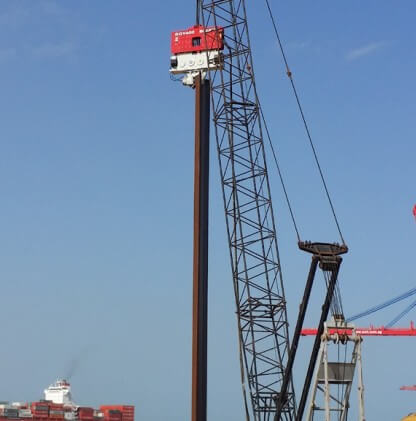
In the United States heavy construction sector, the term vibratory hammer is often used interchangeably with vibratory pile driver or sheet piler. For a vibratory hammer in the United States to be considered high-performance, it must integrate seamlessly with local carrier systems — whether crane-suspended or excavator-mounted — and deliver consistent centrifugal force across the full range of US regional soil conditions, from Houston clay to New York harbor silt.
Crane-Suspended vs. Excavator-Mounted — US Application Range
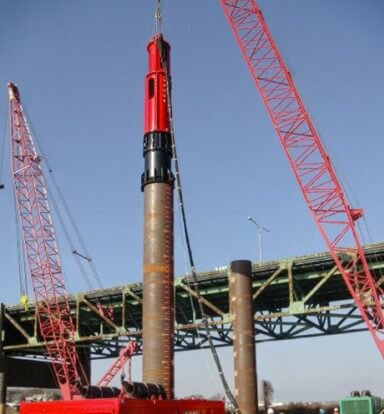
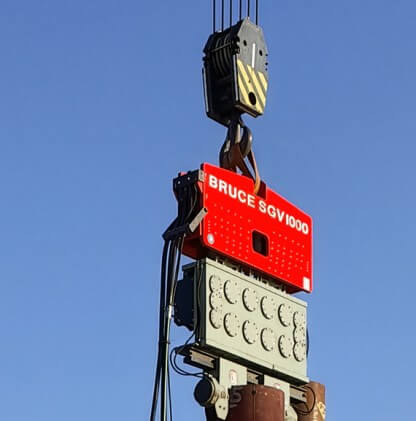
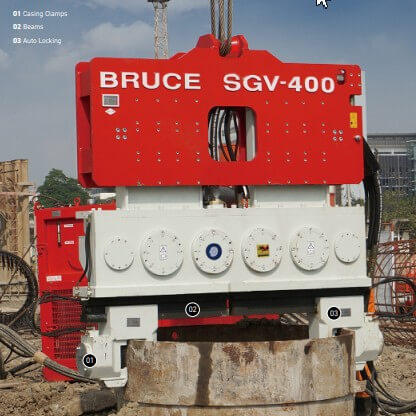
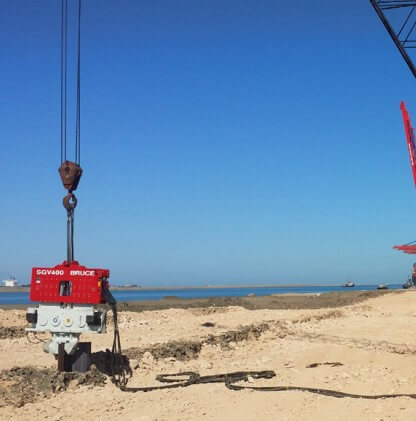
The SGV crane-suspended series covers eccentric moments from 11.5 kgm (SGV-80) to 220 kgm (SGV-2000) and centrifugal forces from 510 kN to 4,610 kN — suitable for major US coastal bridge foundations, port expansion piling, and large-diameter casing work. The SGV excavator-mounted series (SGV-40, SGV-60, SGV-80E) connects directly to the host excavator’s hydraulic auxiliary circuit without a separate power pack — reducing total procurement cost for US contractors deploying on confined urban cofferdam sites in Texas, California, and New York. Furthermore, the tilting models (SGV-40T, SGV-60T) provide 360° hydraulic rotation and 90° hydraulic tilt, allowing a single operator to pick up the pile from the ground, tilt it vertical, and drive it without a secondary crane.
The deployment of piling equipment in America is governed by the need for high-frequency driveability to overcome diverse ground impedance. Contractors in Texas often use these hammers for H-pile foundation work, while those in New York’s harbor districts rely on them for temporary cofferdam installation and extraction. Consequently, clamp jaw selection — Universal Sheet Pile Clamps (60U to 320U) for sheet piles and H-beams, and Casing Pile Clamps (2x40D to 4x160D) for round pipe piles — must be confirmed against the specific pile profile before mobilization.
2. Vibratory Pile Driver Mechanisms
The mechanical synchronization of a vibratory hammer involves a dual-shaft counter-rotating eccentric weight system. Counter-rotating balanced weights cancel horizontal force components, producing purely vertical oscillation — the configuration that prevents lateral pile dancing and protects interlock integrity in US cofferdam construction. This vertical harmonic pulse induces soil liquefaction, temporarily neutralizing inter-granular friction in granular soils and allowing the pile to advance toward tip elevation.
Remote Pendant Flow Control — Real-Time Amplitude Management
The remote control pendant’s flow adjust dial allows operators to adjust centrifugal force and amplitude in real time without stopping the drive cycle. In the variable-profile soils of US river basins — alternating between soft alluvial layers and denser gravel horizons — this real-time amplitude control is the primary tool for maintaining penetration rate while protecting adjacent structures from excessive ground-borne vibration. Furthermore, the clamp check valve maintains clamping pressure even in case of hose damage, preventing pile drop in demanding US tidal and marine environments.
“Engineering success in US soil profiles is a direct result of amplitude management. A high-frequency vibratory hammer provides the necessary centrifugal force to break the static grip of dense sands and silts found in American river basins.”
Consequently, selecting the best vibro hammer brands becomes a strategic decision for US contractors who must balance power with precision to prevent pile refusal in abrasive strata.
3. FHWA & Federal Piling Standards
The Federal Highway Administration (FHWA) provides the reference framework for piling operations on US highways and bridges. Vibro hammer performance in the United States must satisfy ASTM D4945 (High-Strain Dynamic Testing of Deep Foundations) for energy transfer verification on federally funded structural pile installations. These standards ensure that the vibratory energy does not adversely affect the integrity of the pile material — whether steel casing or prestressed concrete.
IEA Energy Monitoring — ASTM D4945 Documentation Tool
Because of these stringent federal regulations, customer reviews consistently highlight verifiable energy transfer documentation as the most important manufacturer capability for US DOT-funded projects. The optional IEA (Impact Energy Analysis) System — developed by BRUCE and adopted as a standard monitoring system by the Hong Kong Housing Government — records real-time energy at every blow. Field measurements on SGH-1015 and SGH-1415 deployments confirmed energy transfer rates of up to 90%, providing the verifiable baseline that DOT structural auditors require for pile capacity certification.
Documented US Federal Bridge Project References
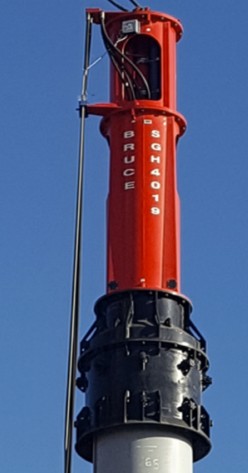
BRUCE has documented performance on multiple major US federally funded bridge contracts. The SGH-4719 drove 72-inch steel casing pipes to over 200 feet on the Sakonnet River Bridge (Rhode Island) — the largest single contract in RI DOT history at USD 163.7M, confirmed by official RI DOT announcement. The SGH-3013 drove 60-inch precast concrete cylinder piles on the Hathaway Bridge (Florida), documented in a Florida State University engineering thesis. Additionally, the SGH-2015 was used by American Bridge Company on the Chincoteague Channel Bridge (Virginia), published in Pile Driving Association Magazine, and by SKANSKA USA on the Williamsburg Bridge (Virginia).
4. Geological Resistance by State: TX, CA, NY
Texas: The Houston Sand & Clay Challenge
In Texas, especially around Houston, contractors face alternating layers of stiff over-consolidated clay and dense sand. This requires a vibratory hammer with a high eccentric moment to maintain penetration speed through clay horizons, and sufficient frequency to induce liquefaction in the intervening sand layers. The remote pendant’s real-time flow adjust enables amplitude management across these variable layers without stopping the drive cycle — reducing the total pile installation time on Houston-area cofferdam and foundation projects.
California: Seismic Retrofitting & Low-Vibration Operation
California projects frequently involve seismic retrofitting of bridge columns and construction near existing structures in dense urban areas of Los Angeles and San Francisco. High-frequency vibratory hammers minimize ground-borne vibrations during pile installation — protecting adjacent bridge columns and building foundations from construction-induced damage. Furthermore, all BRUCE SGV hydraulic components are compatible with biodegradable hydraulic oils, satisfying EPA coastal permit requirements on California waterfront and Bay Area projects where non-toxic hydraulic fluids are required.
New York: Harbor Conditions and Abrasive Silts
New York harbor piling involves driving steel casing and sheet piles through abrasive marine silts and hard glacial deposits. The internal synchronizing gears of the hammer must be precision-engineered to withstand constant back-pressure from dense Atlantic seabed strata. Furthermore, the clamp check valve — which maintains clamping pressure even in case of hose damage — is a critical safety feature for New York harbor tidal operations, where dropped piles create significant safety and schedule risks on active waterfront construction sites.
How to Optimize Vibratory Hammer Efficiency in the US
1. CONFIRM CENTRIFUGAL FORCE SELECTION PER SOIL BORE LOG
Confirm the selected SGV model’s centrifugal force against the project soil bore log at the design tip elevation. As a documented selection rule, centrifugal force should be at least 15 times the pile weight. For Texas alternating clay-sand profiles, eccentric moment is the dominant parameter; for Florida coastal sands, operating frequency is the priority. Furthermore, conducting a pre-mobilization driveability analysis using the SGV model specification catalogue prevents pile refusal caused by under-specified equipment selection on US federal contracts.
2. MONITOR AND ADJUST AMPLITUDE IN REAL TIME
In the Midwest clay belt and variable US river basin soil profiles, use the remote pendant’s flow adjust dial to manage centrifugal force in real time as soil resistance changes at depth. If penetration rate drops in a denser layer, increase flow to maintain centrifugal force before manually increasing winch line pull — which increases extraction stress on the elastomers. Additionally, inspect suppressor elastomers before each shift to confirm they are maintaining vibration isolation between the gearbox and the crane hook.
3. CONFIRM CARRIER HYDRAULIC COMPATIBILITY BEFORE MOBILIZATION
For US urban construction in California and New York where rapid mobilization is required, confirm the excavator’s auxiliary flow (lpm) and pressure (bar) match the SGV model’s rated motor demand before deployment. Furthermore, confirm the case drain line can be routed directly to the hydraulic tank — not the return line — and verify this connection against the installation diagram in the operation manual. A mismatched carrier is the most common cause of motor seal failure on first deployment and results in immediate unplanned downtime on active project sites.
US Field Operations FAQ
Q: Is BRUCE vibratory hammer equipment eligible for FHWA bridge projects?
“Yes — BRUCE SGV series equipment has been deployed on FHWA and State DOT-funded projects in Rhode Island, Florida, and Virginia, with documented performance on record.”
The optional IEA system on the SGH impact series provides the energy transfer documentation required for ASTM D4945 compliance on federally funded structural pile installations. Furthermore, documented project references including the Sakonnet River Bridge (RI DOT), Hathaway Bridge (Florida DOT), and Chincoteague Channel Bridge (Virginia DOT) provide independently verified US federal performance credentials.Q: How does a vibro hammer work in California’s seismic zones?
“High-frequency vibratory hammers minimize ground-borne vibrations during pile installation — protecting adjacent bridge columns and buildings during seismic retrofitting in urban California.”
The remote pendant’s real-time amplitude control allows PPV management near existing structures without stopping the drive cycle. Additionally, biodegradable hydraulic oil compatibility satisfies California EPA coastal permit conditions for piling near Bay Area and Pacific coastline watercourses.Q: What is the benefit of a vibratory pile driver over a diesel hammer in urban US cities?
“Vibratory pile drivers produce no smoke and significantly lower noise than diesel hammers — directly reducing EPA permit monitoring burdens on urban US construction sites in Los Angeles, New York, and Chicago.”
Vibratory hammers also offer substantially faster installation in granular soils and unique pile extraction capability — allowing temporary cofferdam sheet piles and casing piles to be recovered after the works phase, reducing material costs on high-value US urban infrastructure projects.Q: What centrifugal force selection rule applies to US vibratory hammer projects?
“Centrifugal force should be at least 15 times the pile weight — with upward adjustment for stiff clay, dense gravel, or marine soil conditions.”
For the SGV series, centrifugal force ranges from 510 kN (SGV-80) to 4,610 kN (SGV-2000). Confirming model selection against the project soil bore log at the design tip elevation is the primary pre-mobilization step for US federal bridge and coastal foundation contracts — preventing under-specification that leads to pile refusal and over-specification that wastes capital on unused capacity.