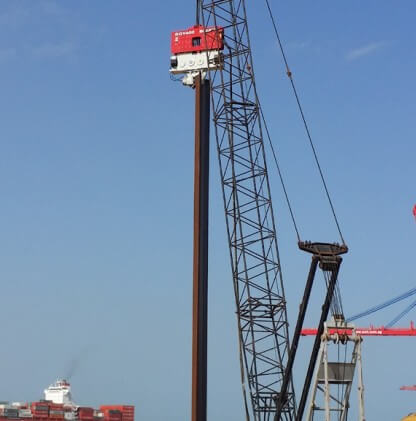
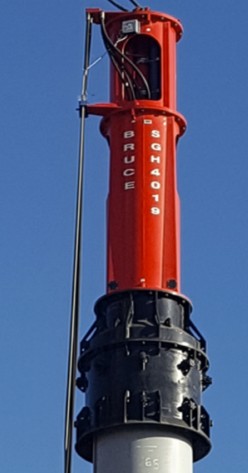
Vibro Hammer Performance:
England UK Construction Standards
“INTEGRATING BS EN 12699:2015 STANDARDS AND ICE CIVIL ENGINEERING SPECIFICATIONS”
“Engineering success in UK piling is defined by the hammer’s ability to maintain consistent vibrations per minute whilst complying with BS 5228 vibration limits. The goal is to maximise penetration rate without inducing ground-borne vibration in nearby Victorian heritage assets.”
01. British Piling Taxonomy & Strategic Context
In the United Kingdom, within the heavy construction sectors of England, the deployment of a vibro hammer is a critical engineering requirement for both temporary and permanent earth retention systems. Known locally as a vibratory pile driver, this piling equipment must adhere to the Institution of Civil Engineers (ICE) Specification for Piling. Consequently, for contractors in London and Birmingham, hammer selection directly determines compliance with BS 8004:2015, BS EN 12699, and BS 5228 — all of which apply simultaneously on major urban and rail infrastructure projects.
TECHNICAL PILLAR GUIDE
How does side-grip technology solve these UK urban constraints? Review the Side Grip Vibratory Hammer Technology for Urban Shoring.
Harmonic Drift in Pre-Owned Equipment — The Network Rail Risk
High-frequency hydraulic vibratory hammers have become the industry standard for UK urban and rail-adjacent piling, offering a superior alternative to traditional percussive impact methods in vibration-sensitive environments. Harmonic drift — where worn gearbox components cause the operating frequency to drop progressively under soil load — is the primary failure mode in pre-owned equipment on Network Rail track-side developments. Consequently, only new factory-calibrated equipment with verified eccentric weight balance provides the purely vertical oscillation required to satisfy NR/L2/CIV/003 monitoring standards throughout the drive and extraction cycle.
SGV Series — UK Urban Piling Capability
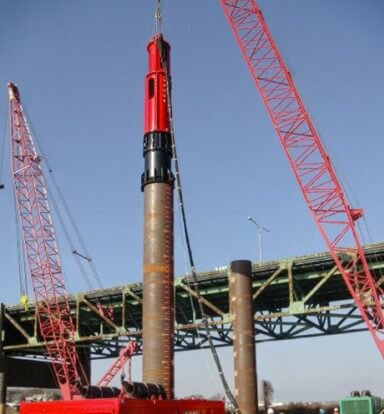
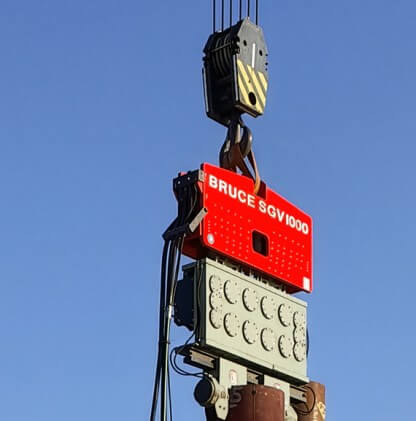
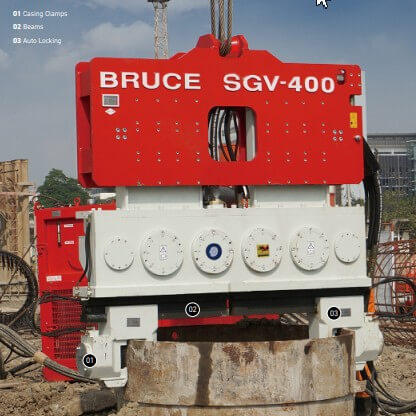
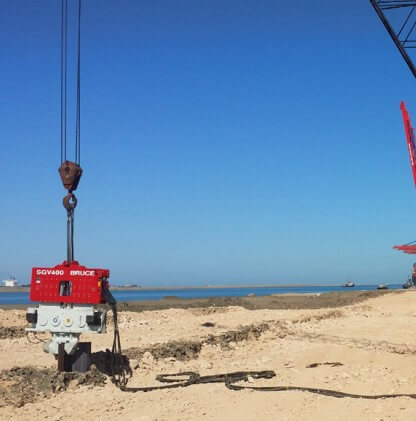
The BRUCE SGV crane-suspended series spans eccentric moments from 11.5 kgm (SGV-80) to 220 kgm (SGV-2000) and centrifugal forces from 510 kN to 4,610 kN. Universal Sheet Pile Clamps (60U to 320U) cover the full range of Larssen and Z-profile sections used on UK urban cofferdam and flood defence projects. Furthermore, all SGV models include a built-in clamp check valve that maintains clamping pressure even in case of hose damage — a critical safety feature for London clay extraction operations where dropped piles create significant HSE reporting obligations.
02. The Science of Soil Liquefaction in English Strata
The mechanical efficiency of a vibratory hammer is predicated on harmonic oscillation. By rotating counter-balanced eccentric weights at high speed, the equipment generates a vertical pulse that induces soil liquefaction — temporarily neutralizing inter-granular friction in granular soils and allowing the pile to advance smoothly toward tip elevation. In the abrasive tills and variable-profile clays of England, this process is the most effective method for achieving design depth without the percussive noise of drop hammers.
Remote Pendant Amplitude Control — The UK Urban Compliance Tool
The remote control pendant’s flow adjust dial allows operators to adjust centrifugal force and amplitude in real time from the rig cab. This is the primary technical feature for BS 5228 compliance on London and Birmingham urban sites — reducing vibration near sensitive receptors during start-up and initial pile embedment, then increasing centrifugal force progressively as the pile advances into deeper, denser strata. Furthermore, operating at frequencies above the natural resonance frequency of adjacent structures reduces transmitted ground-borne vibration — making high-frequency BRUCE SGV models the technically preferred solution for shoring adjacent to Victorian heritage buildings.
Elastomer Suppressor — Vibration Isolation Performance
The suppressor assembly’s high-grade elastomers with mechanical stops mechanically decouple the vibrating gearbox from the crane hook. This isolation protects both the crane structure from eccentric forces and reduces transmitted vibration to the ground surface — directly supporting BS 5228 Peak Particle Velocity (PPV) compliance on urban sites. Additionally, mechanical stops prevent elastomers from over-stretching during extraction, extending service life and maintaining consistent isolation performance across the project duration.
03. BS EN 12699 & HSE Safety Protocols
All piling equipment operated in England must satisfy the requirements of BS EN 12699:2015 for the execution of displacement piles. Furthermore, the Health and Safety Executive (HSE) mandates precise monitoring of ground-borne vibrations to protect underground utility assets — including Thames Water pipelines, London Underground tunnels, and Network Rail track foundations. High-frequency vibratory hammers are the preferred method for managing these vibration limits, as their operating frequency can be adjusted in real time via the remote pendant.
Section 61 Consent — Documentation Requirements
Section 61 of the Control of Pollution Act 1974 requires contractors to obtain prior consent from local authorities before commencing piling works in England that may exceed noise or vibration limits. The technical submission for Section 61 consent must include vibration predictions based on the specific hammer model’s frequency and amplitude — making the manufacturer’s technical specification sheets and operation manual essential compliance documents. Furthermore, the remote pendant’s documented amplitude control capability is a key feature cited in Section 61 submissions demonstrating the contractor’s ability to manage PPV in real time near sensitive receptors.
Biodegradable Oil and Environmental Permits
UK Environment Agency permit conditions for piling near watercourses increasingly require biodegradable hydraulic fluids. All BRUCE SGV series hydraulic components are confirmed compatible with biodegradable hydraulic oils — satisfying these permit requirements without post-procurement modification. Additionally, the SGV series produces no smoke during operation, reducing the air quality monitoring burden on urban and riverside construction permits where both vibration and air quality conditions apply simultaneously.
04. England’s Regional Geology: London Clay to Northern Till
UK site performance is heavily dependent on regional geological impedance. Consequently, hammer model selection must be confirmed against the project soil bore log at the design tip elevation before mobilisation — soil type determines whether eccentric moment or frequency is the dominant performance parameter for the specific project conditions.
London (Over-Consolidated Clay)
Stiff London Clay requires high eccentric moment models to overcome cohesive particle bonding and skin friction. New equipment delivers consistent centrifugal force at the rated frequency throughout the drive — preventing the frequency drop under load that causes pile stall in pre-owned equipment with worn gearbox components. As a selection rule, centrifugal force should be at least 15 times the pile weight, with an upward adjustment for deep stiff clay profiles.
Northern England (Glacial Till)
Glacial till across Yorkshire and the North West contains erratic boulders and variable gravel horizons that create sudden shock loads during driving. The clamp’s built-in check valve maintains hydraulic clamping pressure even in case of hose damage from impact shock — preventing pile drop in the unpredictable stall-and-surge driving conditions common in Northern English glacial deposits.
Hospital and Vibration-Critical Reference — Christchurch, New Zealand
The most directly comparable field reference for UK vibration-sensitive construction is the BRUCE SGV-40 deployment at Christchurch Public Hospital (New Zealand), where 6m sheet piles were driven and extracted in close proximity to MRI and brain scanner equipment — with zero vibration complaints from the hospital. This project is documented through a formal appreciation letter from Allied Construction Ltd, confirming that the SGV-40 outperformed competing Japanese excavator vibro hammers used by other contractors on the same site. For UK engineers specifying vibro hammer equipment near NHS facilities, London Underground assets, or rail infrastructure, this reference provides concrete evidence of suppressor system performance in the most demanding vibration-sensitive conditions.
Technical UK FAQ
Q: How do you manage BS 5228 noise and vibration limits in London?
“Use the remote pendant’s real-time flow adjust to reduce centrifugal force near sensitive receptors — maintaining penetration rate while keeping PPV within Section 61 consent limits.”
Additionally, the suppressor assembly’s high-grade elastomers decouple the vibrating gearbox from the crane hook, reducing transmitted ground-borne vibration. The BRUCE SGV series produces no smoke and significantly lower baseline noise than diesel hammers — reducing the environmental monitoring burden on urban London and Manchester construction permits simultaneously.Q: Why should I avoid pre-owned vibro hammers for Network Rail piling works?
“Pre-owned units with worn synchronization gears generate lateral oscillation that creates PPV exceedances near track-side assets — violating NR/L2/CIV/003 monitoring thresholds.”
New factory-calibrated equipment with balanced double-side eccentric weights provides purely vertical oscillation from the first day of operation — the only configuration that reliably satisfies Network Rail’s track-side vibration monitoring requirements throughout the drive and extraction cycle.Q: What documentation is required for Section 61 consent submissions in London?
“Section 61 submissions require the specific hammer model’s frequency, amplitude, and centrifugal force specifications — along with documented amplitude control capability via the remote pendant.”
BRUCE SGV series technical specification sheets, operation manuals, and brochures provide all required parameters for vibration prediction modelling. Furthermore, ISO 9001 certification documentation and biodegradable oil compatibility confirmation are available as supplementary compliance documents for complex urban permit submissions.Q: What suppressor maintenance is required on UK urban projects to maintain BS 5228 compliance?
“Elastomers must be visually inspected before each shift — degraded elastomers transmit vibration directly to the crane structure and increase PPV transmitted to adjacent ground.”
The operation manual specifies elastomer replacement intervals based on operating hours and extraction load cycles. Mechanical stops in the suppressor design prevent over-stretching during extraction — the highest-stress phase — extending service life compared to suppressors without this feature. Maintaining elastomers in specified condition is the primary maintenance action for ongoing BS 5228 vibration compliance on London urban shoring sites.