Cost to Purchase a New Vibratory Hammer:
The 2026 Definitive Industrial Procurement & ROI Report
“DECODING THE COMPLEX ECONOMICS OF NEW ASSET ACQUISITION, GEOLOGICAL ADAPTABILITY, AND TOTAL COST OF OWNERSHIP”
01. 2026 Global New Equipment Market Dynamics
The vibratory hammer market in 2026 is driven by global infrastructure resilience initiatives and the expansion of offshore renewable energy. Consequently, the cost to purchase a new vibratory hammer has become a central data point in long-term CAPEX planning for Tier 1 contractors bidding on high-stakes infrastructure projects in the United States and United Kingdom.
Need to finalize your 2026 project budget?
Review our Master Strategy for Infrastructure Bidding & Cost Estimation.
Why New Asset Procurement Outperforms Secondary Markets
Unlike the secondary market where used equipment often masks undocumented hydraulic fatigue and gearbox wear, the new asset market offers factory-verified hydraulic specifications, known consumable part schedules, and manufacturer warranty coverage from day one. Modern infrastructure bidding in the US and UK increasingly requires verifiable energy transfer data — a requirement that pre-owned machinery with incomplete maintenance histories cannot reliably satisfy. Furthermore, new equipment ships with compliance documentation that directly supports permit applications and federal contract submissions.
Demand Drivers — Coastal Resilience and Offshore Energy
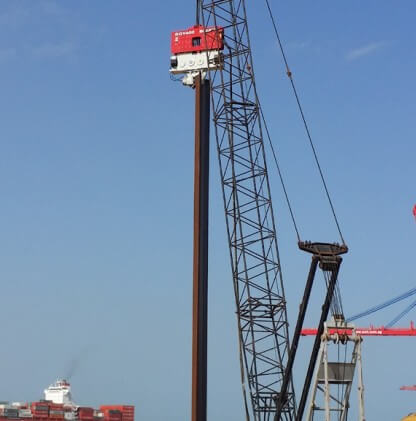
Coastal flood defense projects along the US Atlantic and Gulf coasts require large-diameter steel casing piles and sheet pile cofferdams at scale — driving demand for high-centrifugal-force crane-suspended vibratory hammers. Additionally, the offshore wind farm expansion along the Atlantic Seaboard requires crane-suspended SGV models capable of driving large-diameter monopile and casing piles in marine conditions. Both application sectors share the same procurement requirement: factory-certified equipment with documented marine-environment performance history.
02. Engineering Determinants of New Asset Pricing
When evaluating the cost to purchase a new hydraulic vibratory hammer, it is imperative to move beyond the sticker price and analyze the technical value drivers. The purchase cost of a vibratory hammer reflects three primary engineering factors — and understanding each prevents both over-specification and under-specification against the project’s actual requirements.
I. Centrifugal Force & Eccentric Moment
The purchase cost scales with centrifugal force capacity. Higher centrifugal force models require precision-machined alloy steel eccentric weights, a larger-displacement hydraulic motor, and a higher-output matched power pack. As a field selection rule, centrifugal force should be at least 15 times the pile weight. Consequently, over-specifying centrifugal force for light sheet pile work wastes capital on capacity that will never be utilized on the project.
II. Operating Frequency and Amplitude
Operating frequency (vpm) and amplitude (determined by eccentric moment) are the two parameters that determine soil liquefaction efficiency. Higher-frequency models maintain liquefaction in granular soils with lower centrifugal force — reducing energy consumption and carrier hydraulic load. In contrast, high-amplitude models are required for stiff clay, where frequency alone is insufficient to break cohesive particle bonding. Both parameters are adjustable via the remote control pendant’s flow adjust function on all BRUCE SGV models.
III. Suppressor Assembly and Elastomer Specification
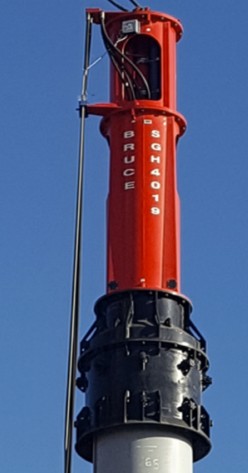
The suppressor assembly is the vibration isolation component that mechanically decouples the vibrating gearbox from the crane hook. High-grade elastomers with mechanical stops — as specified in BRUCE SGV models — prevent over-stretching during extraction, extending service life and reducing consumable replacement frequency. Furthermore, for excavator-mounted models, the suppressor provides a minimum of 90% vibration isolation — protecting the carrier machine from eccentric forces during operation. The elastomer specification directly affects both the machine’s urban compliance capability and its long-term maintenance cost.
03. Regional Compliance & Cost Drivers
Regional compliance requirements significantly influence the total procurement cost — not through fixed price premiums, but through the specific add-on components and documentation required before a machine can be mobilized on federally regulated or permit-controlled projects.
US Market — ASTM D4945 and IEA Monitoring
In the United States, the primary procurement consideration is ASTM D4945 compliance for federally funded bridge and highway projects. The optional IEA (Impact Energy Analysis) system — developed by BRUCE and adopted by the Hong Kong Housing Government — records real-time blow energy at every strike, providing the verifiable energy transfer documentation required by DOT structural auditors. Including the IEA system in the initial cost estimate consolidates the monitoring requirement into a single factory-direct procurement — rather than sourcing separate third-party monitoring equipment after contract award.
UK Market — BS EN 12699 and Urban Vibration Compliance
In the United Kingdom, the focus shifts to BS EN 12699 for displacement pile installation and HSE safety protocols for construction vibration. For sites in London, Manchester, or the M25 corridor, the remote pendant’s real-time amplitude control — which allows vibration reduction near sensitive receptors without stopping the drive — is a mandatory operational requirement. Additionally, biodegradable hydraulic oil compatibility (confirmed across all BRUCE hydraulic components) satisfies UK Environment Agency permit conditions for piling near watercourses without post-procurement modification.
Total Package Cost — What to Include in the Estimate
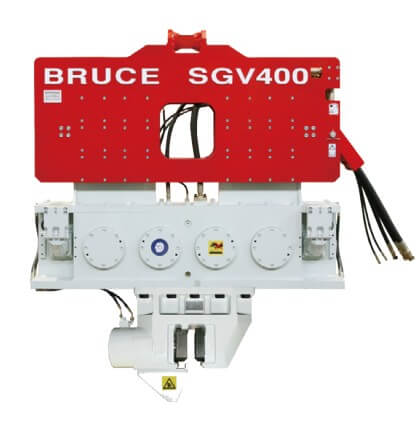
A complete vibratory hammer cost estimate covers the hammer body, matched PQ-V power pack, clamp type (Universal or Casing), hose bundle, remote control pendant, and CIF or FOB shipping terms. Furthermore, optional add-ons — IEA system for ASTM compliance, Silence Cap Housing for UK noise ordinances, or biodegradable oil specification for environmental permits — must be confirmed at order stage to reflect the true landed cost in the project CAPEX budget.
04. Total Cost of Ownership (TCO) vs. Initial CAPEX
Beyond the initial acquisition price, Total Cost of Ownership (TCO) is the metric that determines true project ROI. For industrial piling fleets, consumable replacement frequency, hydraulic maintenance intervals, power pack fuel consumption, and the cost of unplanned downtime all contribute to the long-term cost of operating a vibratory hammer fleet. Consequently, a TCO analysis often changes the procurement decision between adjacent model classes — the lower initial cost of a smaller model may be offset by higher consumable frequency under heavy use conditions.
Gearbox and Elastomer Lifecycle
The gearbox is the highest-cost component in a vibratory hammer. Field documentation from BRUCE SGV deployments records gear service life exceeding 20 years with correct maintenance — driven by alloy steel eccentric weight construction and precision gear machining. Furthermore, high-grade elastomers with mechanical stops in the suppressor assembly resist over-stretching during extraction, extending replacement intervals compared to standard rubber components. Both factors directly reduce the long-term consumable cost component of TCO.
Downtime Cost — The Hidden TCO Driver
Unplanned mechanical failures on a marine barge or confined urban site create compounding schedule delays — crane standby, subcontractor idle time, and penalty clause exposure all activate simultaneously. In contrast, new equipment with factory-calibrated hydraulics and verified gearbox specifications removes this risk from the project financial model. The clamp cylinder’s built-in check valve, which maintains clamping pressure even in case of hose damage, is a specific design feature that prevents pile drop and the associated unplanned stop costs on active project sites.
“We focus exclusively on NEW equipment procurement because the apparent savings from used machinery disappear rapidly when hydraulic contamination, gearbox wear, and energy transfer inconsistency are factored into the full project cost model.”
05. Geological Influence on Equipment Selection
An accurate new equipment cost estimate is only useful if the hammer is correctly matched to the regional soil conditions. In London’s over-consolidated clay, high eccentric moment — which generates the amplitude needed to break cohesive particle bonding — is the primary selection driver. In the sandy aquifers of the US Gulf Coast, operating frequency (vpm) becomes dominant, as higher frequency maintains the soil liquefaction state more efficiently in granular conditions. Furthermore, pile age and installation history affect extraction resistance — longer-installed piles require higher centrifugal force to break accumulated skin friction during withdrawal.
Driveability Analysis — The Cost Estimate Foundation
A professional cost estimate must be grounded in a driveability analysis — confirming that the selected model’s centrifugal force and eccentric moment are sufficient to achieve design tip elevation without pile refusal. The SGV model selection chart in the engineering catalogue maps pile weight and driving depth to specific model recommendations — for example, a 3.5-ton sheet pile at 20m in medium-dense sand corresponds to the SGV-300 with 92 tons of centrifugal force. Consequently, procurement engineers can use the catalogue to confirm model selection before submitting a quote request, reducing iteration with the engineering desk.
Marine and Offshore Conditions
For offshore and marine applications, tidal submersion increases the resistive load on the hydraulic motor as hydrostatic pressure acts on the vibrating body. Consequently, models deployed in marine conditions must have sufficient motor power reserve to maintain stable operating frequency under this additional load — frequency drop collapses the soil liquefaction state and stalls the pile. The BRUCE SGV series power packs are designed for operation from -30°C to above 40°C, ensuring stable hydraulic performance across the temperature extremes encountered in both Arctic-adjacent and equatorial marine construction environments.
Industrial Procurement FAQ
Q: What are the primary cost drivers when purchasing a new vibratory hammer?
“The three primary cost drivers are centrifugal force capacity, operating frequency range, and the matched PQ-V power pack specification — all of which must align with the project’s pile weight, soil conditions, and carrier hydraulic output.”
Furthermore, clamp type, hose bundle length, mounting configuration, and optional compliance equipment (IEA system, Silence Cap) contribute to the total package cost. A complete quote must include all these elements to reflect the true landed cost and prevent scope inflation during project execution.Q: How does ASTM D4945 compliance affect the purchase cost?
“ASTM D4945 compliance requires the optional IEA energy monitoring system — including it upfront consolidates monitoring into a single procurement rather than separate third-party equipment costs later.”
The IEA system records real-time blow energy and provides the verifiable energy transfer log required by DOT structural auditors. It has been adopted as a standard system by the Hong Kong Housing Government and applied on major US bridge projects. Consequently, including it in the initial cost estimate eliminates a procurement gap that commonly surfaces after contract award on federally funded projects.Q: What is included in a complete new vibratory hammer package cost?
“A complete package covers the hammer body, matched PQ-V power pack, clamp type, hose bundle, remote control pendant, and CIF or FOB shipping terms confirmed at order stage.”
Optional additions include the IEA energy monitoring system, biodegradable hydraulic oil specification, and technical commissioning support. Furthermore, ISO 9001 certification documents and compliance technical documentation are included in the export package at no additional charge — supporting permit submissions and federal procurement documentation requirements.Q: How does geological soil type affect the cost of the correct vibratory hammer selection?
“Stiff clay requires a high eccentric moment model. Granular sand requires a high-frequency model. Selecting incorrectly for the soil type leads to pile refusal or over-specification — both of which represent avoidable procurement cost.”
The SGV model selection chart maps pile weight and driving depth to specific model recommendations. Centrifugal force should be at least 15 times the pile weight as a baseline rule. However, soil type additionally determines whether eccentric moment (amplitude) or frequency is the dominant performance parameter — a distinction that only a driveability analysis grounded in the project soil bore log can reliably confirm.