Unbiased Reviews of Popular Vibro Hammer Companies:
A 2026 Engineering Critique
“WRESTLING WITH TRUTH IN THE DEEP FOUNDATION MARKET: US & UK FIELD INSIGHTS”
“To truly vet a piling equipment company, one must look past the glossy brochures and audit their energy transfer reliability and field project record. A top-tier manufacturer in 2026 provides verifiable harmonic data and documented deployments — not just theoretical centrifugal force specifications.”
01. Myth vs. Mechanics: Defining a ‘Top’ Company
In the high-stakes world of deep foundation, an unbiased review of a vibro hammer company is rare. Most marketing collateral focuses on peak centrifugal force — a number that looks impressive on a datasheet but often fails when facing the high side-skin friction of stiff clay at depth. A top-tier manufacturer in 2026 is one that understands the fundamental physics of mechanical vibration and integrates the hydraulic power pack and the hammer into a coherent system — with matched flow, pressure, and frequency specifications confirmed before the machine leaves the factory.
GLOBAL RANKING HUB
How do these engineering critiques translate into final ratings? Review the Best Vibratory Hammer Brands 2026 User Reviews & Ratings.
What Separates a Leading Manufacturer from the Rest
Geotechnical auditors increasingly prioritize companies that provide real-time frequency data and documented project references across multiple countries and soil types. Specifically, manufacturers with ISO 9001 certification, government-level recognition, and published third-party project references demonstrate a level of accountability that catalog-only suppliers cannot match. Furthermore, the ability to provide a complete system — hammer, matched power pack, clamp, and compliance documentation — in a single factory-direct transaction reduces procurement risk and eliminates compatibility issues that arise from multi-supplier assembly.
The Verifiable Benchmark — IEA Energy Monitoring
The most objective benchmark for auditing a vibro hammer company is the optional IEA (Impact Energy Analysis) System — developed by BRUCE and adopted as a standard energy monitoring system by the Hong Kong Housing Government. Consequently, companies that can document real-world energy transfer performance across government-certified projects occupy a fundamentally different credibility tier from those relying solely on theoretical specifications in product brochures.
02. The US Verdict: Driven by ASTM D4945 Data
In the United States, the reputation of piling equipment companies is established on DOT bridge projects. Field audits from Houston to the Virginia Tidewater point to one critical filter: ASTM D4945 compliance. If a vibro hammer manufacturer cannot provide verifiable energy transfer documentation for federal work, it is effectively disqualified from the most significant infrastructure contracts in the US market.
Documented US Bridge Project References
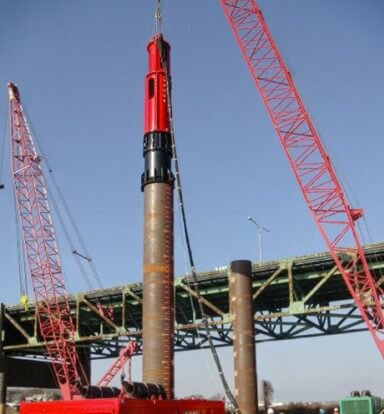
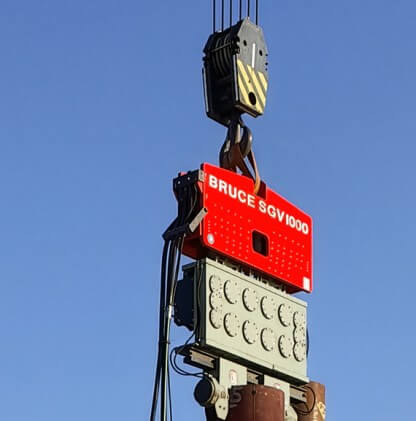
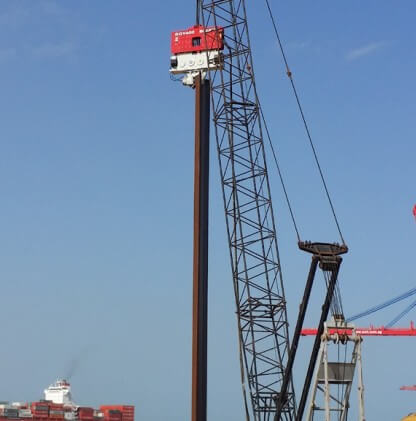
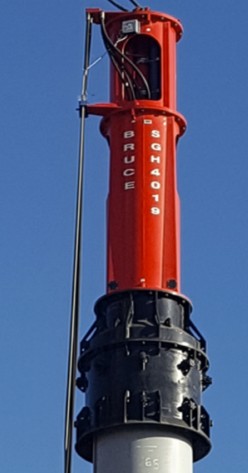
The most credible review evidence in the US market is documented project performance on major bridge contracts. BRUCE has delivered the SGH-4719 on the Sakonnet River Bridge (Rhode Island) — the largest single contract in RI DOT history at USD 163.7M, cited in Providence Journal and confirmed by official RI DOT announcement. Additionally, the SGH-3013 drove 60-inch precast concrete cylinder piles on the Hathaway Bridge (Florida), documented in a Florida State University engineering thesis. Furthermore, the SGH-2015 was used by SKANSKA USA on the Williamsburg Bridge (Virginia) and published in Pile Driving Association Magazine — independently verifying performance in US coastal conditions.
Clamp Reliability — The US Field Contractor Priority
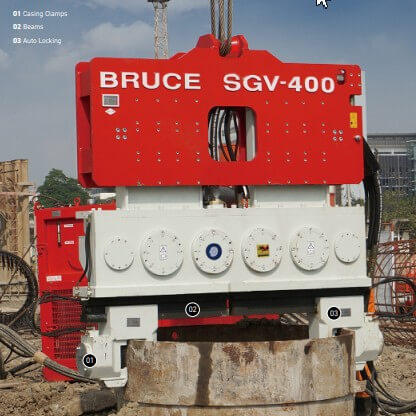
US contractors are consistently vocal about clamp reliability in marine and tidal environments. The BRUCE clamp cylinder includes a built-in check valve that maintains clamping pressure even in case of hose damage — preventing pile drop and unplanned site stops in demanding marine environments. In addition, high-grade alloy steel jaw inserts maintain grip on wet, algae-covered, and salt-corroded pile surfaces — a field performance requirement that used equipment with worn jaw inserts cannot reliably satisfy.
03. The UK Verdict: Urban Silence & BS 5228
In the United Kingdom, specifically the London M25 corridor and Manchester, unbiased reviews shift focus toward vibration management capability. Under BS 5228, vibration and noise levels during construction operations near existing structures must remain within permitted limits. Consequently, companies that provide remote pendant amplitude control — allowing real-time reduction of centrifugal force near sensitive receptors — are increasingly preferred over those offering only fixed-frequency systems.
Elastomer Suppressor — The UK Urban Compliance Component
The suppressor assembly’s elastomer rubbers mechanically decouple the vibrating gearbox from the crane structure — protecting both the crane and adjacent buildings from transmitted vibration during urban shoring operations. Furthermore, mechanical stops in the suppressor design prevent elastomers from over-stretching during extraction, extending service life and maintaining consistent isolation performance across the project duration. This documented design feature is a key differentiator in UK urban construction permit submissions that require vibration impact assessments.
Hospital-Adjacent Field Reference — Christchurch, New Zealand
The most compelling field reference for UK urban vibration performance is the SGV-40 deployment at Christchurch Public Hospital (New Zealand), where 6m sheet piles were driven and extracted in close proximity to MRI and brain scanner equipment — with zero vibration complaints from the hospital. This project is documented through a formal appreciation letter from Allied Construction Ltd, confirming that the SGV-40 outperformed competing Japanese excavator vibro hammers used by other contractors on the same site. For UK engineers specifying equipment near NHS facilities, underground utilities, or historic structures, this reference provides concrete evidence of suppressor system performance under the most demanding vibration-sensitive conditions.
“We focus exclusively on NEW machinery because second-hand hammers often suffer from eccentric drift — creating lateral vibration that violates UK noise ordinances and can damage sensitive foundations in dense urban environments.”
How to Audit a Manufacturer Before Purchase
1. ANALYZE HYDRAULIC POWER DENSITY AND COOLING
Request the power pack specification — engine output (HP/kW), maximum oil flow (lpm), and operating pressure (bar) — and confirm it matches the hammer’s rated motor demand. Additionally, verify that the power pack includes a cooling system specified for the anticipated ambient temperature range of the project. BRUCE PQ-V series power packs are designed for operation from -30°C to above 40°C — ensuring stable hydraulic performance in extreme environments without cavitation risk.
2. VERIFY GEARBOX SYNCHRONIZATION AND ECCENTRIC WEIGHT DESIGN
Audit the gearbox design for balanced double-side eccentric weight configuration. Counter-rotating balanced weights cancel horizontal force components and produce purely vertical oscillation — which is mandatory for protecting the crane structure from lateral vibration loads. Furthermore, ask for the gear material specification — alloy steel eccentrics with precision machining, as used in the BRUCE SGV series, provide significantly longer service life than standard steel components and maintain frequency stability under heavy soil load.
3. CHECK CONSUMABLE PARTS AVAILABILITY AND DOCUMENTATION
Confirm that consumable parts — elastomers, clamp cylinder seals, hydraulic fittings — are specified by part number in the operation manual and available from qualified suppliers. Additionally, verify that the operation manual covers case drain line installation, elastomer inspection intervals, and gearbox lubricant replacement schedules in sufficient detail for field maintenance without factory engineer involvement. A manufacturer that cannot provide this documentation is not prepared for the long-term support requirements of a professional construction fleet.
Technical FAQ
Q: What credentials should I verify when reviewing a vibro hammer company?
“Verify ISO 9001 certification, documented project references across multiple countries, and the availability of verifiable energy transfer data from field deployments.”
Furthermore, confirm that the manufacturer holds relevant trade certifications — such as Specialized Trading Company designation and trade association membership — as these indicate established export infrastructure and accountability. Government-level recognition such as the Presidential Citation (2021) and Prime Minister Citation (2017) from Korea also serve as credibility indicators for procurement submissions on government-funded contracts.Q: Do excavator-mounted vibro hammer companies satisfy US DOT requirements?
“Excavator-mounted models are suited for sheet piling and temporary works — final bearing verification on DOT bridge projects typically requires a hydraulic impact hammer with IEA energy monitoring.”
For DOT-funded projects requiring ASTM D4945 compliance, the optional IEA system on the SGH hydraulic impact series provides the real-time energy transfer documentation required by structural auditors. Consequently, the most effective fleet for US federal work combines excavator-mounted vibro hammers for initial penetration and impact hammers for final set and compliance documentation.Q: How does a company’s suppressor design affect BS 5228 compliance in the UK?
“The suppressor’s elastomer specification determines the level of vibration isolation from the crane structure — and consequently the transmitted vibration to adjacent buildings during urban shoring.”
High-grade elastomers with mechanical stops mechanically decouple the vibrating gearbox from the crane hook. The remote pendant’s real-time amplitude control further allows vibration reduction near sensitive receptors without stopping the drive cycle. Both features must be documented in the technical submission for BS 5228 vibration impact assessments on UK urban construction permits.Q: Why is there a large credibility gap between companies with documented project references and those without?
“Documented project references provide independently verifiable evidence of real-world performance — something brochure specifications and theoretical data cannot replace.”
References published in trade publications such as Pile Driving Association Magazine, cited in engineering theses, or confirmed by government DOT announcements occupy a fundamentally different credibility tier. Furthermore, references that include the specific model deployed, pile type driven, project scale, and independent verification — as the BRUCE US bridge project record demonstrates — allow procurement engineers to draw direct parallels to their own project conditions.