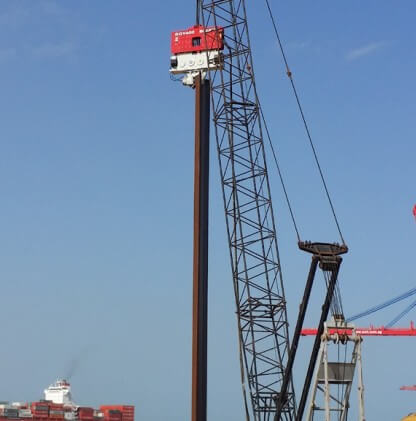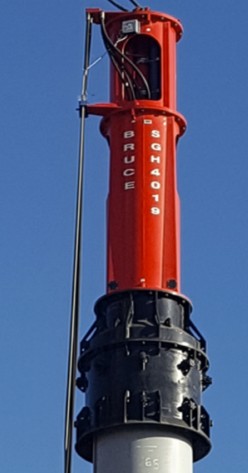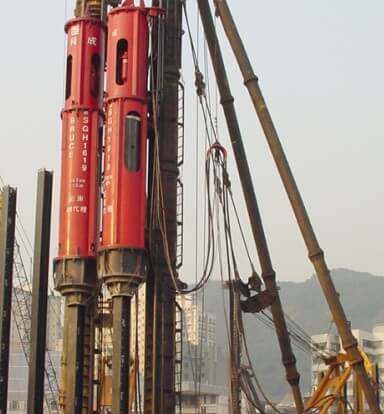
Leading Hydraulic Pile Hammer Products:
2026 Engineering Reliability Audit
“EVALUATING IMPACT ENERGY EFFICIENCY AND STRUCTURAL INTEGRITY IN GLOBAL DEEP FOUNDATIONS”
“Impact efficiency in 2026 is measured by terminal velocity control and energy transfer consistency. The difference between a leading product and a mediocre one is found in the repeatability of the kinetic stress wave delivered to the pile head at every blow.”
01. Vetting Criteria: Mechanical Pulse Consistency
In the 2026 industrial landscape, reviews of leading hydraulic pile hammer products must move beyond static kNm ratings. For project managers, a hammer is an investment in kinetic precision. A leading product must deliver consistent energy transfer to satisfy the requirements of dynamic pile monitoring — where inconsistent blow energy produces inaccurate capacity readings and triggers expensive site re-testing.
BRAND COMPARISON HUB
How do these impact audits compare to global vibratory rankings? Review the Best Vibratory Hammer Brands 2026 User Reviews & Ratings.
Key Performance Parameters — What the Audit Covers
A credible product audit covers ram weight, maximum stroke, rated energy (kNm or ton.m), blow rate (bpm), and the drive cap configuration’s compatibility with the pile profile. Furthermore, the accumulator assembly’s role in maintaining consistent ram speed across the full stroke length is a critical performance variable — the accumulator assists in absorbing hydraulic shocks and ensures the hammer delivers its rated energy at every blow, not just under ideal conditions.
IEA Monitoring — The Objective Performance Benchmark
The most objective method for auditing hydraulic pile hammer performance is the optional IEA (Impact Energy Analysis) System — developed by BRUCE and adopted as a standard monitoring system by the Hong Kong Housing Government. Field measurements on SGH-1015 and SGH-1415 deployments confirmed energy transfer rates of up to 90%. Consequently, this data provides the verifiable benchmark that distinguishes leading products from budget alternatives in structural audit documentation.
02. US Market: Impact Energy vs. ASTM D4945
In the United States, reviews of hydraulic pile hammers for federal bridge foundations hinge on ASTM D4945 verification. Leading hydraulic hammers produce a consistent compressive stress wave that allows accurate pile capacity assessment. In contrast, used units with worn ram guide bushings and degraded hydraulic circuits produce inconsistent energy delivery — creating unreliable dynamic testing data that triggers expensive site approval delays.
US Project Performance References
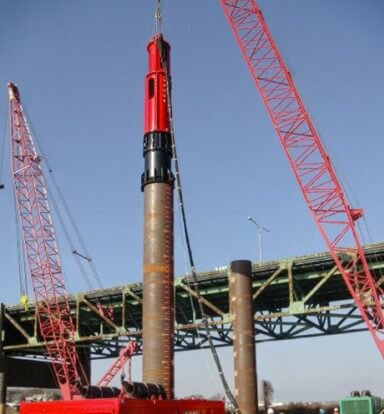
Leading hydraulic pile hammer products are validated by real-world US deployment records. The BRUCE SGH-4719 drove 72-inch diameter steel casing pipes to over 200 feet below river bottom on the Sakonnet River Bridge (Rhode Island) — the largest single contract in RI DOT history at USD 163.7M. The SGH-3013 drove 60-inch precast concrete cylinder piles on the Hathaway Bridge (Florida), documented in a Florida State University engineering thesis. Furthermore, the SGH-2015 was used by SKANSKA USA on the Williamsburg Bridge (Virginia) and published in Pile Driving Association Magazine — independently verifying performance in demanding US coastal conditions.
Remote Control and Adjustable Stroke — US DOT Compliance
US contractors emphasize that a leading product must support real-time stroke adjustment via remote control. The BRUCE SGH series remote control system allows adjustment from minimum stroke to maximum, dwell control, digital blow counter, automatic cut-off circuit breaker, and emergency stop — all from the rig cabin at distance. Additionally, biodegradable hydraulic oil compatibility is increasingly required on US coastal and marine projects under EPA permit conditions, and leading products ship with confirmed compatibility from the factory.
03. UK Standards: Stroke Modularity & Noise Compliance
The United Kingdom market demands surgical precision in urban foundation work. Reviews from Manchester and London urban sites highlight that driving precast concrete piles near sensitive utilities requires precise ram stroke control. Under BS EN 12699, protecting the pile head from spalling during initial driving near existing structures is a key performance requirement — achievable through real-time stroke reduction from the remote control box at the start of each drive.
BS 5228 Noise Management — Silence Cap Housing Option
For UK urban sites where BS 5228 noise limits are critical, the optional Silence Cap Housing Kit — available on the BRUCE SGH series — reduces noise emissions considerably during operation. This is a factory-specified optional component, not a field modification, ensuring the noise reduction specification is verified before deployment. Furthermore, compared to traditional diesel hammers, BRUCE hydraulic impact hammers produce no smoke and significantly lower noise levels as a baseline — before the Silence Cap option is applied.
“In urban clay environments such as London, maintaining consistent ram stroke at the correct energy level — not maximum energy — is the primary driver of pile head integrity and programme adherence on restricted sites.”
How to Calibrate for Peak Driveability
1. VERIFY ACCUMULATOR CONDITION AND PRE-CHARGE
Confirm the accumulator pre-charge pressure against the specification in the operation manual before each project start. The accumulator assists in absorbing hydraulic shocks and maintaining consistent ram speed — a degraded or incorrectly charged accumulator reduces energy delivery consistency and increases hose vibration stress. Additionally, in high-temperature environments such as the US South, hydraulic fluid temperature must be monitored during initial operation to ensure the system stabilizes within the rated operating range before full-load driving commences.
2. AUDIT DRIVE CAP CUSHION CONDITION
Inspect the drive cap cushion material before each project deployment. Micarta or nylon cushion inserts absorb the initial peak impact force and transmit a controlled stress wave into the pile shaft. Degraded cushions lose their energy-transmitting properties progressively — reducing effective energy transfer to the pile head and increasing the risk of pile head spalling on concrete sections. Consequently, replacement intervals should be tracked by blow count as specified in the operation manual, not by calendar time.
3. CONFIRM HYDRAULIC FLOW AND CARRIER MATCHING
Match the carrier’s auxiliary flow (lpm) and pressure (bar) to the hammer’s rated motor demand. Over-flow causes cavitation and accelerated seal wear. Under-flow reduces blow rate and energy output. Furthermore, confirm the case drain line is routed directly to the hydraulic tank — not to the return line — before first operation. This connection is non-negotiable and must be verified against the manual’s installation diagram to prevent motor shaft seal failure on the first day of site deployment.
Technical FAQ
Q: Are hydraulic pile hammers suitable for urban sites with strict noise limits?
“Yes — hydraulic pile hammers produce significantly lower noise than diesel hammers as a baseline, and the optional Silence Cap Housing Kit on the SGH series reduces noise emissions further.”
BRUCE hydraulic impact hammers produce no smoke and substantially lower noise levels compared to traditional diesel hammers. Additionally, the optional Silence Cap Housing Kit is available as a factory-specified option on the SGH series for projects with the most stringent BS 5228 noise requirements. Furthermore, real-time stroke adjustment via the remote control allows energy reduction near sensitive receivers without stopping the drive cycle.Q: What makes a hydraulic pile hammer compliant with ASTM D4945 requirements?
“Compliance with ASTM D4945 requires verifiable energy transfer data at every blow — provided by the optional IEA (Impact Energy Analysis) System.”
The IEA system records real-time impact energy at every blow, providing the energy transfer log required for structural auditing on federally funded bridge and highway projects. Consequently, including the IEA system in the procurement specification from the outset consolidates the monitoring requirement into a single factory-direct purchase.Q: How does the drive cap cushion affect pile head integrity during hard driving?
“The drive cap cushion absorbs the initial peak force and transmits a controlled stress wave — protecting the pile head from spalling while maximizing energy delivery to the pile shaft.”
Degraded cushion material loses its energy-transmitting properties progressively. As a result, peak impact force reaches the pile head directly rather than through a controlled cushion — causing spalling on concrete sections and increasing the risk of pile head damage in hard driving conditions. Cushion replacement intervals are specified by blow count in the operation manual.Q: What pile types and sizes can a leading hydraulic pile hammer handle?
“The SGH series handles round, square, and octagonal precast concrete piles, steel casing piles, H-beam piles, and sheet piles — across ram weights from 7 tons to 47 tons.”
Drive cap configurations are matched to the specific pile head geometry and material. The SGH-4719 (47-ton RAM, 89.3 ton.m) has driven 72-inch diameter steel casing piles to over 200 feet on the Sakonnet River Bridge, while the SGH-3013 (30-ton RAM, 39 ton.m) drove 60-inch precast concrete cylinder piles on the Hathaway Bridge. Consequently, the full range of foundation pile types and sizes for bridge, offshore, and building foundation projects is covered within a single product line.