Vibro Hammer Company Brochure &
Technical Catalogue 2026 Guide
“ADVANCED TECHNICAL RESOURCES FOR DEEP FOUNDATION PROCUREMENT AND SITE AUDITS”
“A 2026 technical catalogue is more than a list of models; it is a geotechnical roadmap. For infrastructure leaders, verifying eccentric moment and hydraulic flow rates through factory-certified documentation is the foundation of sound equipment procurement.”
01. Strategic Value of a Certified Company Catalogue
For the 2026 industrial piling sector, the vibro hammer company brochure catalogue is more than a sales tool — it is a critical engineering audit document. For project managers in the United States and United Kingdom, verifying eccentric moment and hydraulic flow requirements is the first step in ensuring carrier compatibility. Consequently, reviewing these technical parameters enables precise driveability analysis and reduces the risk of equipment mismatch at mobilization.
TECHNICAL FOUNDATION
Before auditing spec sheets, understand the fundamental physics in our guide: What is Vibro? Meaning, Mechanics, and Industrial Applications.
Manufacturer Credentials — What the Brochure Confirms
A credible company brochure documents the manufacturer’s certification status, global project track record, and quality management standards. For BRUCE Piling Equipment, the brochure confirms ISO 9001 certification (awarded 2004), a 27-year manufacturing history, and documented deployments across more than 80 countries. Additionally, government-level recognition — including the Presidential Citation (2021) and Prime Minister Citation (2017) from the Korean government — is available as supporting E-E-A-T documentation for formal technical submissions.
Catalogue Data for Municipal Tender Submissions
Accessing a comprehensive technical catalogue from the manufacturer becomes essential for satisfying the technical submission requirements of municipal and federal tenders. These resources provide the verifiable centrifugal force data, power pack matching specifications, and clamp compatibility tables that procurement officers require. Furthermore, the selection rule — centrifugal force should be at least 15 times the pile weight — is documented in the catalogue with model-specific values, allowing procurement teams to confirm specification without engineering desk consultation.
02. US Market: ASTM D4945 Data Integrity
In the United States, the vibro hammer fleet must align with federal ASTM D4945 dynamic testing protocols on federally funded bridge and highway projects. A professional company brochure details the hammer’s energy output consistency — a metric that DOT inspectors use to verify terminal pile capacity. For US contractors, therefore, choosing a manufacturer that provides high-fidelity mechanical data in their catalogue is essential for satisfying pile dynamic testing requirements without project-stalling restrike requirements.
IEA System — US Compliance Documentation
For hydraulic impact hammers on ASTM-regulated projects, the optional IEA (Impact Energy Analysis) System provides the real-time blow energy data required for structural auditing. Developed by BRUCE and adopted by the Hong Kong Housing Government as a standard system, the IEA has been applied on major US projects including the Sakonnet River Bridge (Rhode Island) and the Hathaway Bridge (Florida). Field measurements confirmed energy transfer rates of up to 90% on SGH series models — data that directly satisfies the energy transfer documentation requirements of federal highway contracts.
US Project References in the Catalogue
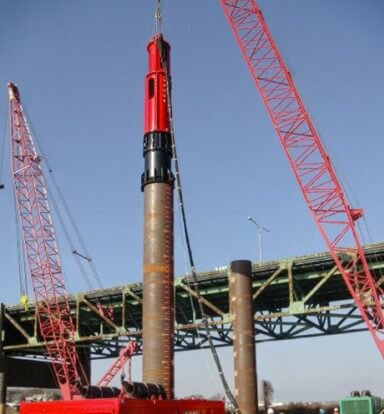
The BRUCE catalogue includes documented US project references that support the E-E-A-T requirements of federal procurement submissions. Key references include the SGH-4719 on the Sakonnet River Bridge (RI DOT’s largest single contract at USD 163.7M), the SGH-3013 on the Hathaway Bridge (Florida), the SGH-2015 on the Chincoteague Channel Bridge (Virginia, published in Pile Driving Association Magazine), and the SGV-200 referenced in Piledriver Magazine at the PDCA Project of the Year.
“The engineering precision found in a 2026 vibro hammer manual determines the project’s bottom line. If the synchronization gears aren’t rated for the abrasive sands of the Carolinas, the lowest bid becomes the most expensive mistake.”
03. UK Standard: BS 5228 Urban Silence
For United Kingdom piling firms operating in Manchester, Birmingham, or the London M25 corridor, BS 5228 noise and vibration ordinances are the primary gatekeepers for urban construction permits. A professional company brochure specifies the elastomer suppressor assembly — the primary vibration isolation system that decouples the vibrating gearbox from the crane structure — and confirms its performance characteristics for compliance submissions.
Remote Pendant Amplitude Control — BS 5228 Compliance Tool
The remote control pendant’s flow adjust dial enables operators to reduce centrifugal force and amplitude in real time when approaching sensitive receivers — existing buildings, buried utilities, or rail infrastructure. This capability is specifically relevant to BS 5228 compliance, where permitted vibration limits must be respected without stopping the drive cycle. Furthermore, operating at frequencies above the natural resonance frequency of adjacent structures reduces transmitted vibration, making high-frequency vibratory hammers the preferred technical solution for urban shoring in UK city centres.
Hospital and Rail-Adjacent References
A real-world reference supporting UK urban compliance is the SGV-40 deployment at Christchurch Public Hospital (New Zealand), where 6m sheet piles were driven and extracted in close proximity to MRI and brain scanner equipment with zero vibration complaints from the hospital. This case — documented through a formal appreciation letter from Allied Construction Ltd — demonstrates the suppressor system’s performance in vibration-critical environments. In addition, the BRUCE catalogue notes that the Christchurch deployment outperformed competing Japanese excavator vibro hammers used by other local contractors on the same project.
How to Audit Vibro Hammer Specifications
1. CROSS-REFERENCE ECCENTRIC MOMENT AND CENTRIFUGAL FORCE
Consult the technical catalogue to match the model’s centrifugal force (kN) to your pile weight and soil conditions. As a documented selection rule, centrifugal force should be at least 15 times the pile weight. For example, a 3.5-ton sheet pile in medium-dense sand at 20m depth corresponds to the SGV-300 with 92 tons of centrifugal force. Confirm the matched power pack (PQ-V series) is also specified at this stage.
2. VERIFY CARRIER HYDRAULIC COMPATIBILITY
Check the flow (lpm) and pressure (bar) requirements in the brochure against the host carrier’s auxiliary circuit output. Furthermore, confirm that the case drain line connection is accessible and can be routed directly to the hydraulic tank — not to the return line. Mismatched hydraulic specifications are the primary cause of motor seal failure in newly deployed equipment, and this check must be completed before mobilization.
3. AUDIT THE SUPPRESSOR ELASTOMER SPECIFICATION
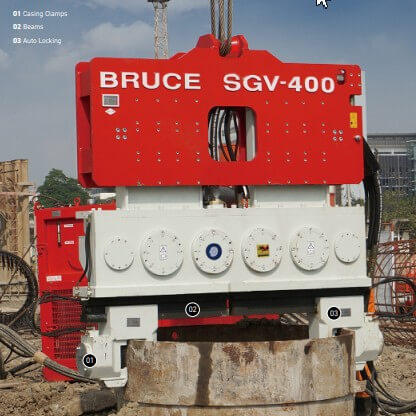
Review the vibration isolation specification in the catalogue. High-grade elastomer rubbers with mechanical stops are the standard on BRUCE SGV models — the mechanical stops prevent over-stretching during extraction, extending elastomer service life and reducing crane wire rope wear. Confirm that the elastomer specification is current and that replacement part numbers are documented in the operation manual for planned maintenance scheduling.
Technical Resource FAQ
Q: Where can I download the official 2026 vibro hammer company brochure and catalogue?
“Official brochures, catalogues, and technical manuals are available directly from the manufacturer’s technical hub at powerquip.co.kr.”
The technical library includes SGV and SGH series brochures, full model specification catalogues, and operation manuals. Consequently, procurement officers can confirm eccentric moment, centrifugal force, power pack matching, and clamp compatibility before submitting a formal quote request — reducing back-and-forth between the engineering desk and the field team.Q: Does the technical catalogue include data for ASTM D4945 dynamic testing compliance?
“Yes — the catalogue provides energy specifications and the optional IEA system supports the verifiable energy transfer data required for ASTM D4945 compliance.”
The IEA (Impact Energy Analysis) system records real-time energy at every blow, providing the energy transfer log required for structural auditing on federally funded projects. Furthermore, field measurements on SGH models confirmed energy transfer rates of up to 90%, providing the quantitative baseline for dynamic load test planning.Q: How does the brochure support BS 5228 urban vibration compliance in the UK?
“The brochure documents the elastomer suppressor isolation system and remote pendant amplitude control — the two primary technical features required for BS 5228 vibration compliance submissions.”
High-grade elastomers mechanically decouple the vibrating gearbox from the crane structure. The remote pendant’s real-time flow adjust function allows amplitude reduction near sensitive receivers without stopping the drive. Both features must be documented in the technical submission accompanying a BS 5228 vibration assessment.Q: What global project references are documented in the BRUCE technical catalogue?
“Documented references include major projects in the USA, Korea, Hong Kong, New Zealand, and the Middle East — spanning bridge foundations, port construction, and offshore piling.”
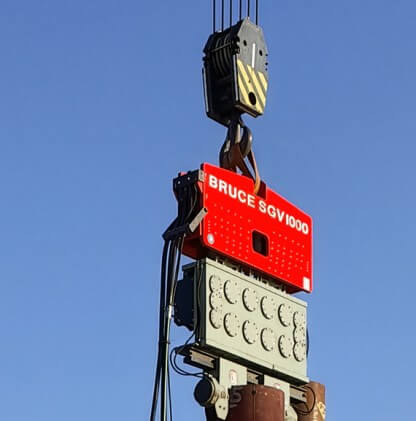
US references include the Sakonnet River Bridge (Rhode Island), Hathaway Bridge (Florida), Chincoteague Channel Bridge (Virginia), and Williamsburg Bridge (Virginia). In Korea, references include the Incheon Bridge and Incheon Great Bridge. The SGV-40 New Zealand hospital deployment and SGV-1000 marine Oil and Gas bridge project are additionally documented as field performance references.