Hydraulic Pile Hammer Technical Library:
2026 Brochure, Catalogue, & Manual Hub
“VALIDATING IMPACT INTEGRITY THROUGH ADVANCED KINETIC DOCUMENTATION”
“Impact efficiency in 2026 is no longer a matter of guesswork. It is a calculated result derived from terminal velocity data and ram-to-pile mass ratios found within a manufacturer’s certified technical library.”
01. The Hydraulic Pile Hammer Brochure
A high-performance hydraulic pile hammer brochure is the primary document for cross-referencing impact technology with global infrastructure standards. In 2026, piling contractors in the United States and United Kingdom rely on these brochures to identify the mechanical capability of a hammer’s stroke control system. For Tier-1 projects, the brochure must illustrate the unit’s ability to provide variable impact energy — allowing the operator to adjust output from minimum stroke to maximum in real time from the remote control box.
TECHNICAL FOUNDATION
How do these impact forces compare to vibratory methods? Review the Full Meaning and Mechanics of Vibration Technology in our core technical pillar guide.
SGH Series — Energy Range and Mounting Options
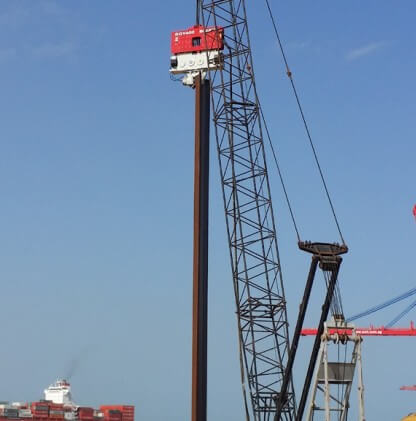
The SGH hydraulic impact hammer series covers a full energy range from 12 kNm (1.2 ton.m) to 1,178 kNm (120 ton.m). Pile types driven include round, square, and octagonal precast concrete piles, steel casing piles, H-beam piles, and sheet piles. Mounting configurations include Fixed Leader, Crane Suspended, U-Type Leads, and Offshore Leader — giving contractors flexibility across project types from urban bridge foundations to offshore platform piling. Furthermore, the accumulator assembly assists with absorbing hydraulic shocks and maintaining consistent ram speed, directly improving energy transfer to the pile head at every blow.
Remote Control System — Operational Functions
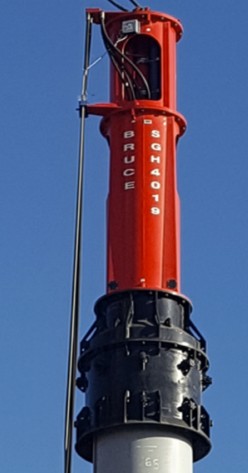
The BRUCE remote control system allows operators to manage all key functions from a distance. Standard features include adjustable ram stroke from minimum to maximum, dwell control, digital blow counter, automatic cut-off circuit breaker, and emergency stop. High-brightness LED indicators monitor abnormalities during operation. Consequently, operators can manage energy delivery in real time without stopping the drive cycle — a critical capability for projects in variable ground conditions.
02. The Engineering Catalogue: Rated Energy Data
The hydraulic pile hammer catalogue provides the quantitative foundation for wave equation (GRLWEAP) modeling. For projects regulated by ASTM D4945 in the US or ICE specifications in the UK, the catalogue is an essential tool for verifying ram mass, maximum stroke, and rated energy. Precise energy data allows engineers to predict pile set per blow, ensuring that ultimate bearing capacity is achieved at the design depth.
IEA Energy Monitoring System
For compliance-critical projects, the optional IEA (Impact Energy Analysis) System records real-time energy delivery at every blow. Developed and launched by BRUCE, the IEA system has been adopted as a standard energy monitoring system by the Hong Kong Housing Government and applied on major government-funded projects including the Incheon Bridge in Korea. Field measurements on SGH-1015 and SGH-1415 deployments confirmed energy transfer rates of up to 90% — data that supports structural verification requirements where pile capacity must be formally documented.
Real-World Project References
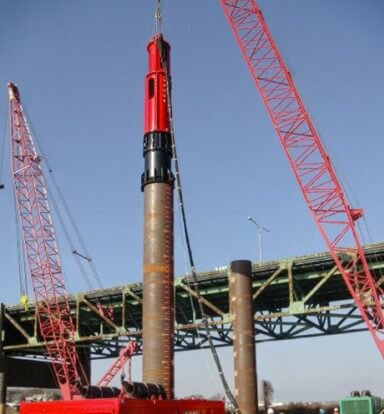
The SGH series has been deployed on major infrastructure projects across the United States, Korea, Hong Kong, and New Zealand. The SGH-4719 — with a 47-ton ram weight and maximum energy of 89.3 ton.m — was used on the Sakonnet River Bridge (Rhode Island, USA), a USD 163.7 million contract that was the largest single contract in Rhode Island DOT history. The SGH-3013 drove 60-inch precast concrete cylinder piles on the Hathaway Bridge (Florida, USA) — one of only two hammers in the world capable of handling that specification at the time of construction. Additionally, the SGH-3015 powered by the PQ-600 power pack was deployed on the Incheon Bridge (Korea) — ranked the fifth longest bridge in the world at completion.
03. The Shop Manual: Field Calibration & Safety
The hydraulic pile hammer manual is the definitive guide for field operations and asset longevity. In 2026, shop manuals focus on accumulator pre-charge calibration, hydraulic pressure tolerances, and remote control system setup. For field engineers, these documents dictate the exact procedures required to maintain consistent impact energy — a critical factor for passing dynamic load tests and satisfying structural verification requirements on certified projects.
Accumulator Function and Hydraulic Circuit Management
The accumulator assists in absorbing hydraulic shocks during the ram drop cycle and maintains consistent ram speed across the full stroke length. Proper pre-charge pressure — as specified in the operation manual — ensures the hammer delivers its rated energy at every blow. Furthermore, lower hose vibration is achieved through the high-quality accumulator assembly, reducing stress on hydraulic connections during extended operation. The manual specifies inspection intervals for hose condition, hydraulic fluid quality, and accumulator charge pressure as part of the scheduled maintenance routine.
Drive Cap and Buffer Ring Maintenance
The drive cap cushion absorbs shock impact at the pile head and transmits energy efficiently into the pile shaft. Buffer rings protect the hammer body from pile rebound force at the end of each blow. Both are high-wear consumables that require periodic inspection and replacement according to the manual’s maintenance schedule. Consequently, replacement intervals are specified based on blow count rather than calendar time — ensuring that cushion condition does not degrade energy transfer efficiency over the project duration.
“We focus exclusively on NEW equipment because factory-current operation manuals contain the accumulator safety protocols and hydraulic pressure tolerances mandatory for 2026 urban shoring sites — documentation that pre-owned units frequently lack.”
How to Verify Hammer-Pile Compatibility
1. CONFIRM RAM WEIGHT AND ENERGY CLASS
Reference the technical catalogue for the ram weight (ton) and maximum energy (ton.m or kNm) of the selected model. Confirm that the rated energy is sufficient for the pile type and soil conditions at the design depth. For bridge and offshore projects with large steel casing piles, high ram weight models such as the SGH-3015 (30-ton RAM, 45 ton.m) or SGH-4719 (47-ton RAM, 89.3 ton.m) are typically required. Furthermore, confirm that a matched power pack is specified — each SGH model requires a corresponding PQ series hydraulic power pack.
2. VERIFY STROKE ADJUSTMENT RANGE
Confirm in the brochure that the hammer supports adjustable ram stroke via the remote control system. The BRUCE SGH series allows stroke adjustment from a minimum setting to maximum stroke in real time from the remote control box. This allows soft-start driving in urban zones — reducing initial impact energy near existing structures — and satisfies BS EN 12699 and ICE protection protocols for urban shoring. Additionally, confirm the blow rate (bpm) at the intended stroke for your soil type, as this affects daily pile driving productivity.
3. CONFIRM DRIVE CAP AND PILE HEAD COMPATIBILITY
The drive cap must match the pile head geometry and material. Round, square, octagonal, and H-beam piles each require a specific drive cap profile and cushion arrangement. Mismatched drive caps cause energy loss at the pile head and can damage the pile top during hard driving. Reference the manual for the correct cushion material and thickness specification for your specific pile type — the cushion arrangement directly determines how efficiently the kinetic stress wave is transmitted into the pile shaft.
Technical Operation FAQ
Q: What is the energy range of the BRUCE hydraulic pile hammer series?
“The SGH series covers energies from 12 kNm (1.2 ton.m) to 1,178 kNm (120 ton.m) — with larger models available on request.”
This full range covers light building foundation piling through to major offshore bridge structures. Ram weights range from 7 tons (SGH-0712) to 47 tons (SGH-4719). Furthermore, all models are matched to specific PQ series hydraulic power packs, and mounting options include Fixed Leader, Crane Suspended, U-Type Leads, and Offshore Leader configurations.Q: What is the IEA System and when is it required?
“The IEA (Impact Energy Analysis) System is an optional monitoring system that records real-time energy at every blow — required on projects where ASTM D4945 or structural energy verification is mandated.”
Developed by BRUCE, the IEA system has been selected as a standard energy monitoring system by the Hong Kong Housing Government and applied on major bridge projects in Korea and the US. It provides the verifiable energy transfer documentation required for federally funded bridge and highway contracts. Consequently, it is typically specified on any project where pile capacity must be formally certified by a structural engineer.Q: How do I select the correct drive cap for my pile type?
“The drive cap profile must match the pile head geometry. Round, square, octagonal, and H-beam piles each require a specific cap and cushion arrangement.”
The cushion material and thickness determine how efficiently the kinetic stress wave is transmitted from the hammer into the pile shaft. A correct cushion arrangement protects the pile head from damage during hard driving and reduces energy loss at the pile-hammer interface. Moreover, cushion condition must be monitored throughout the project — degraded cushion material directly reduces energy transfer efficiency and should be replaced according to the manufacturer’s manual.Q: When should a hydraulic impact hammer be used instead of a vibratory hammer?
“Use a hydraulic impact hammer when final bearing capacity must be verified by blow count — typically in hard strata, dense clay, or on permanent load-bearing structures.”
Hydraulic impact hammers deliver discrete percussive energy that creates a compressive stress wave overcoming skin friction and end-bearing resistance in stiff soils. In contrast, vibratory hammers are faster in granular soils and enable pile extraction but cannot provide the blow count data required for structural certification. Consequently, the combined approach — vibratory hammer for initial penetration and impact hammer for final set — is standard protocol on major bridge and offshore foundation projects.