What Is Vibro?
Definition, Meaning
& Pile Driving Guide
A complete technical breakdown of vibro meaning, how vibratory hammers work, and when to deploy them — for engineers, procurement teams, and project managers.
What Does Vibro Mean?
Vibro means vibration-based. From the Latin vibrare — “to set in tremulous motion” — the word vibro in engineering refers to any equipment or method that uses controlled high-frequency oscillation to drive, extract, or compact piles and sheet piles into the ground without impact energy.
Vibration-based. Controlled oscillation applied to pile driving to overcome soil friction.
A hydraulic hammer that drives piles using counter-rotating eccentric weights — not impact blows.
Generation of vertical harmonic oscillation to induce transient soil liquefaction around a pile.
Soil temporarily loses friction — the pile sinks under its own weight and the hammer’s downforce.
Technical Meaning of Vibro in Engineering
The term vibro derives from the Latin root vibrare — to tremble or set into oscillatory motion. In modern geotechnical engineering, vibro meaning is more specific: it describes any system in which counter-rotating eccentric weights generate a directed, high-frequency vertical force that is transmitted into a pile or casing to overcome ground resistance through a process called soil liquefaction.
Unlike casual use of the word “vibration,” the engineering vibro definition always implies a purpose-built, controlled system. The oscillation is not incidental — it is precisely engineered in terms of frequency (vibrations per minute), amplitude (displacement per cycle), and centrifugal force (kN) to match specific soil conditions at depth.
“Vibro-technology is the strategic application of centrifugal force to induce transient soil liquefaction. In 2026, mastering vibration mechanics is the defining competitive advantage in deep foundation engineering.”
Where the Term Appears
The prefix vibro- appears across multiple related terms in the industry: vibro hammer, vibratory pile driver, vibro compaction, and vibro displacement. In each case, the common thread is the use of oscillatory energy — not impact — as the primary force mechanism. This page focuses specifically on vibro in the context of pile driving and sheet pile installation.
Understand the full installation process: How a Vibratory Hammer Works in Pile Driving →
How a Vibro Hammer Works
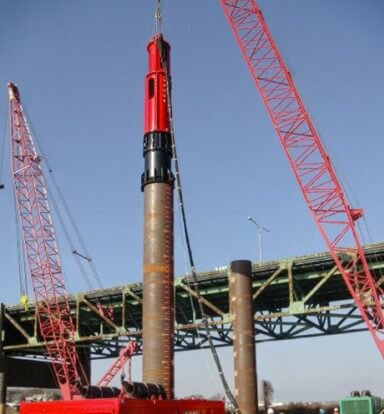
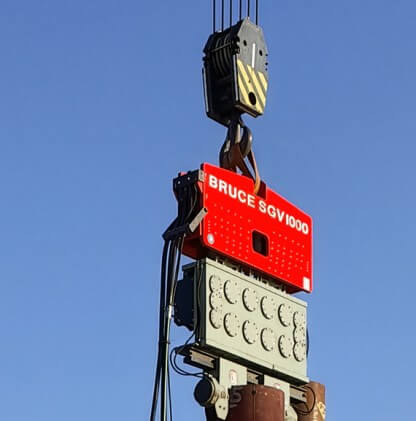
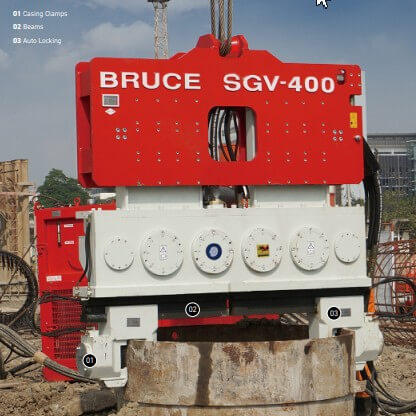
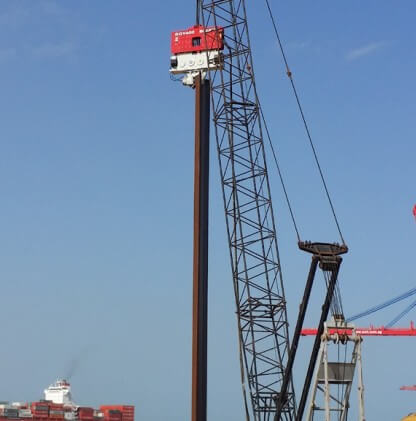
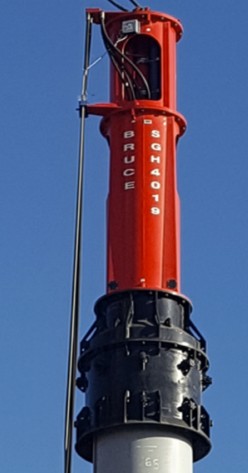
What is a vibro hammer? It is a hydraulic piling attachment consisting of three main assemblies: the gear case (housing the eccentric weights and hydraulic motors), the suppressor (a vibration isolation block made of high-grade elastomer rubbers), and the clamp (which grips the pile head). The entire unit is suspended from a crane leader or mounted directly to an excavator arm via a bracket.
Inside the gear case, pairs of eccentric weights are driven by hydraulic motors to rotate in opposite directions. The counter-rotation is synchronized so that horizontal centrifugal force components cancel each other out completely, while vertical components combine and amplify. The result is a powerful, single-axis oscillation transmitted directly downward into the pile at frequencies typically ranging from 1,200 to 2,400 vibrations per minute (20–40 Hz).
Three Key Operating Parameters
Eccentric Moment
Determines amplitude — the physical displacement of the pile tip per vibration cycle. Higher eccentric moment = more displacement = better penetration in cohesive soils.
Centrifugal Force
The raw downward force (kN) generated by the rotating weights. As a rule of thumb, centrifugal force should be at least 15× the pile weight for reliable penetration.
Operating Frequency
How many vibration cycles per minute (vpm). Higher frequency maintains soil liquefaction state more continuously, improving penetration rate in loose granular soils.
All three parameters are adjustable in real time via a remote control pendant from the operator cab. This allows the driver to respond to changing soil conditions at depth — increasing amplitude through dense layers or reducing frequency near sensitive structures to stay within vibration limits.
Crane-Suspended vs. Excavator-Mounted
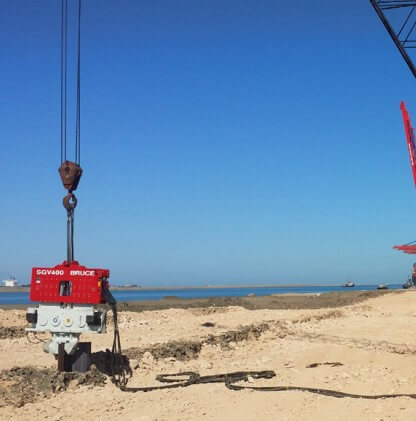
Crane-suspended vibro hammers deliver the highest centrifugal force outputs — up to 4,610 kN — and are used for heavy marine, bridge, and offshore foundation work. Excavator-mounted models connect directly to the host machine’s auxiliary hydraulic circuit without a separate power pack, enabling faster repositioning across urban shoring and confined-site applications. In both configurations, the hydraulic flow (lpm) and system pressure (bar) supplied by the carrier must match the hammer’s motor rating precisely to achieve stable operating frequency under soil load.
Read the full soil-mechanics breakdown: Excavator Vibro Hammer Engineering & Soil Mechanics →
Vibration & Soil Liquefaction
The reason vibro technology works is soil liquefaction. As the hammer oscillates, it creates rapid pore-water pressure fluctuations in the soil matrix surrounding the pile. This temporarily reduces effective stress between soil particles — transforming the solid-friction state into a low-friction state. The pile then advances under the combined deadweight of the hammer and pile itself, without requiring the compressive energy pulse of an impact blow.
This is not permanent liquefaction. The moment oscillation stops, pore-water pressure dissipates and soil friction is restored. This is precisely why vibro technology enables pile extraction: the process runs in reverse — the same hammer that drives a pile can pull it back out with equal efficiency, enabling full pile reuse on temporary works.
Urban Vibration Management
When a vibro hammer’s operating frequency approaches the natural resonance frequency of adjacent structures, transmitted vibration increases sharply. Modern vibratory hammers counter this by operating at frequencies above structural resonance — minimizing transmitted energy to buildings and buried utilities. This, combined with the suppressor’s elastomer isolation, makes vibro technology the preferred method in zones governed by BS 5228 (UK) and municipal vibration ordinances across the United States and Europe. For the academic physics, engineers reference the Encyclopedia Britannica definition of vibration.
Vibro Hammer vs. Impact Hammer
The most common question engineers face: when to use vibro, and when to use impact? The answer depends on soil type, pile type, project timeline, and site constraints. Here is the full comparison:
| Category | Vibro Hammer | Impact Hammer |
|---|---|---|
| Operating Principle | Continuous harmonic oscillation via counter-rotating eccentric weights | Discrete percussive blows via falling or hydraulically-driven ram |
| Penetration Speed | ⚡ Fast — especially in granular soils | Slower — one energy transfer per blow cycle |
| Noise Level | ✅ Low — continuous hum, no impact shock | High — percussive impact at every blow |
| Urban Suitability | ✅ High — BS 5228 and municipal vibration compliant | Limited — shockwave transmission to adjacent structures |
| Pile Extraction | ✅ Yes — identical process in reverse; enables pile reuse | ❌ Not possible with impact |
| Best Soil Type | Loose to medium-dense granular soils (sand, gravel, silt) | Stiff clay, hard strata, rock-bearing layers |
| Bearing Capacity Verification | ⚠️ Requires separate load test | ✅ Final set blow count = direct verification |
| Typical Use Case | Sheet piling, cofferdams, marine foundations, temporary works | Permanent load-bearing piles, final set, hard layer penetration |
| Combined Deployment | ✅ Both systems are routinely used in sequence — vibro for rapid initial penetration, impact for final set and structural bearing verification on the same project. | |
Vibro Performance by Soil Type
The effectiveness of vibro pile driving varies significantly by ground conditions. Use this guide to match hammer selection to your site investigation data:
Liquefaction occurs immediately. Pile advances rapidly under moderate centrifugal force. Fastest vibro penetration conditions.
Similar to loose sand. High pore-water pressure response. Standard vibro model sufficient for most depths.
Penetration achievable with higher-capacity model. Skin friction accumulates with depth — monitor penetration rate closely.
High amplitude model required. Penetration rate lower than sand but generally achievable. Clamp force critical.
Vibro works but slowly. Clay doesn’t liquefy — force acts against plastic shear strength. Extended vibration time needed.
Vibro alone typically insufficient. Protocol: vibro for initial penetration, impact hammer for final set through clay layer.
High-capacity vibro model with maximum eccentric moment required. Pre-augering may be necessary at refusal depth.
Vibro cannot penetrate rock. Impact hammer or rotary methods required. Vibro suitable only for penetration above rock level.
Continue Your Research
FAQ — Vibro Meaning, Definition & Use
2026 Technical Catalogues & Data Sheets
Full performance specifications, eccentric moment tables, centrifugal force outputs, and hydraulic requirement data for 2026 vibratory hammer models are available in the official technical catalogues below.