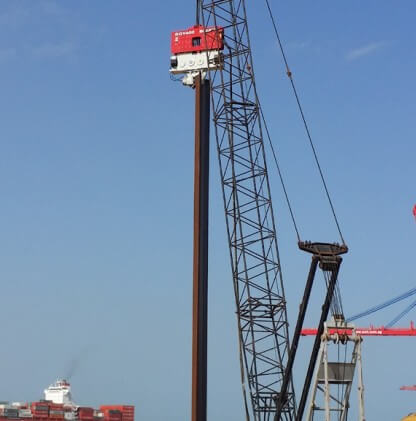
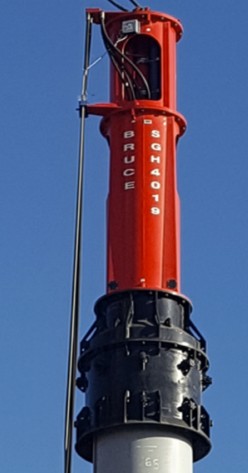
Sheet Piling Hammer for Sale:
2026 Driver Selection & Kinetics Guide
“A DEEP DIVE INTO SOIL-STRUCTURE INTERACTION AND VIBRATORY KINETICS FOR MODERN DRIVERS”
“Selecting a professional driver is an exercise in harmonic resonance. In 2026, the efficacy of a sheet piling hammer is measured by its ability to liquefy soil strata while preserving the structural integrity of the pile head and the carrier boom.”
01. The Kinetics of Soil Liquefaction & Penetration
To select the right sheet piling hammer for sale, one must first understand the physics of vibratory kinetics. A professional driver does not simply push a pile — it induces rapid pressure fluctuations in the pore water of the soil strata. This process, known as soil liquefaction, temporarily reduces effective stress between soil particles, allowing the pile to advance under its own weight and the hammer’s downforce without impact energy.
Eccentric Moment and Frequency Selection
The efficiency of a sheet piling driver is primarily determined by its eccentric moment and operating frequency. In complex strata such as London Clay or the high-saturation aquifers of the southern United States, the choice of driver frequency determines whether a project progresses efficiently or stalls at refusal. Furthermore, if the driver’s frequency drops under soil resistance load — a common failure mode in worn gearbox assemblies — the liquefaction state collapses and the pile freezes mid-drive. As a selection rule, centrifugal force should be at least 15 times the pile weight, and the power pack’s hydraulic output must be matched to the hammer’s motor demand before deployment.
Planning to integrate a new driver into your 2026 project?
Review our Master Strategy for Infrastructure Bidding & Cost Estimation.
Amplitude and Pile Structural Integrity
Amplitude — the physical vertical displacement of the pile per vibration cycle — must be calibrated to the pile material and soil resistance. Excessive amplitude in lightweight sheet piles can cause interlock fatigue at the pile joints. Conversely, insufficient amplitude in stiff clay fails to break cohesive particle bonding and leads to progressive stall. Consequently, the remote control pendant’s flow adjust function — which allows real-time centrifugal force adjustment — is an essential operational tool for managing amplitude across changing soil profiles during a single drive.
02. Audit: Selecting a High-Performance Driver
Procurement officers searching for a sheet piling hammer for sale must perform a dynamic compatibility audit. A leading driver must move beyond raw mass and offer precision modulation — matching its energy output to actual soil conditions at every depth of the drive.
Critical Selection Benchmarks:
- • Real-Time Flow Control: The ability to adjust centrifugal force via the remote pendant’s flow dial in real time — adapting to refusal zones and soil transitions without stopping the penetration cycle.
- • Elastomer Suppressor System: High-grade elastomer rubbers with mechanical stops isolate vibration from the carrier structure. This is mandatory for urban sites to meet ICE noise and vibration standards.
- • Clamp Check Valve: A built-in check valve maintains clamping pressure even in case of hose damage — preventing pile drop and unplanned stops that directly affect the project cost-per-pile metric.
- • Biodegradable Oil Compatibility: All hydraulic components should be compatible with biodegradable oils for environmentally sensitive and coastal permit-restricted project sites.
Mounting Configuration and Carrier Matching
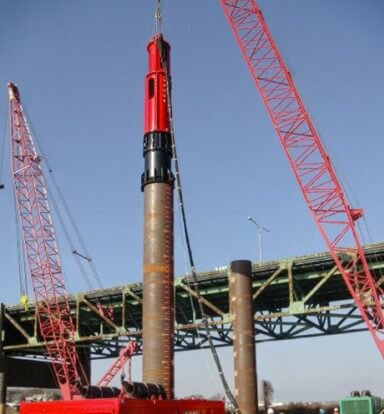
The mounting configuration of a sheet piling driver determines its long-term operational versatility. Crane-suspended models cover the full centrifugal force range for heavy offshore and bridge foundation work. Excavator-mounted models provide faster repositioning and simpler setup for urban and confined site applications. In either case, the hammer’s motor demand — flow (lpm) and pressure (bar) — must be precisely matched to the carrier’s auxiliary circuit output. Mismatched hydraulic specifications are the primary cause of motor seal failure in newly deployed equipment.
New Assets vs. Mechanical Fatigue
We focus exclusively on NEW sheet piling hammers. Pre-owned drivers often carry micro-fractures in the eccentric shafts and degraded elastomers in the suppressor housing — defects that are undetectable without full gearbox disassembly and that lead to sudden on-site failure under operational load.
Gearbox Harmonic Drift
In used vibratory hammers, worn bearings and degraded gear tooth profiles cause harmonic drift — the operating frequency drops progressively under load. As a result, soil liquefaction is not maintained at depth, the pile stalls, and the operator applies increasing line pull to compensate. This combination of reduced vibration and increased static tension is the leading cause of pile fracture at weld joints during extraction on pre-owned equipment.
Factory Certification and Compliance
By investing in new machinery, contractors secure a factory-certified energy curve, verified hydraulic specifications, and a known consumable parts schedule from day one. These are critical requirements for high-stakes projects in the United States and United Kingdom where energy transfer documentation is mandatory on federally funded bridge and rail contracts.
04. Global Engineering Standards: ASTM & Eurocode 7
Any sheet piling hammer for sale in 2026 must be audited against international engineering protocols. In the United States, ASTM D4945 dynamic testing is the industry gatekeeper for deep foundation energy verification on federally funded projects. In England and the EU, BS EN 12699 and Eurocode 7 dictate the requirements for permanent retaining structures and displacement pile installation.
IEA Energy Monitoring for Compliance
For hydraulic impact hammers on compliance-critical projects, optional IEA (Impact Energy Analysis) systems record real-time energy delivery at every blow. This data provides the verifiable energy transfer log required for structural auditing. In contrast, used equipment without documented energy monitoring history cannot reliably satisfy these audit requirements — consequently leading to expensive project stoppages and structural re-testing on government-funded contracts.
Urban Vibration Compliance — BS 5228 and Municipal Standards
In urban shoring environments, BS 5228 in the UK and local municipal vibration ordinances in the US set permitted ground vibration levels adjacent to existing structures. The remote control pendant’s real-time amplitude adjustment capability is essential for maintaining compliance within these limits while still achieving the centrifugal force needed to drive piles. Moreover, high-frequency operation above the natural resonance frequency of adjacent structures further reduces transmitted vibration to surrounding buildings.
Technical Procurement FAQ
Q: What sheet pile profiles can a vibratory hammer driver handle?
“Vibratory hammer drivers handle Z-piles, U-piles, H-beams, flat steel plates, and round casing piles — clamp jaw selection determines compatibility.”
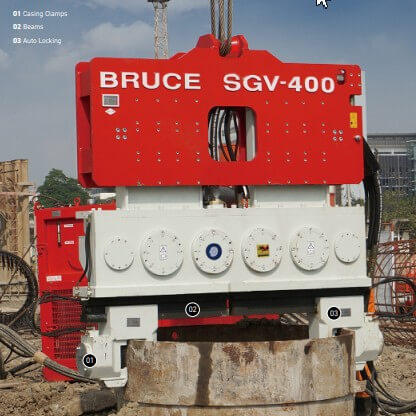
Universal clamps handle interlocking sheet pile profiles. Casing pile clamps with hydraulic auto-locking beams handle round pipe and casing piles. Confirm the jaw profile against your specific pile section before mobilization to avoid site-level downtime during changeovers.Q: How does driver frequency affect sheet pile installation in different soils?
“Higher frequency maintains soil liquefaction efficiently in sandy and granular soils. In stiff clay, higher amplitude — not simply higher frequency — is the primary penetration driver.”
In granular soils, operating frequency directly determines how effectively the liquefaction state is maintained at depth. In cohesive clays, the eccentric moment and resulting amplitude are the critical parameters. The remote pendant’s flow adjust dial allows real-time tuning of both parameters to match changing soil conditions during a single drive.Q: Can a sheet piling hammer driver also extract piles?
“Yes — pile extraction is one of the primary advantages of a vibratory driver over an impact system.”
The hammer clamps onto the pile and vibrates while the crane applies upward line pull. Vibration temporarily reduces skin friction along the pile shaft, allowing withdrawal. This makes vibratory drivers the standard choice for temporary cofferdams and sheet pile shoring where piles must be removed and reused after construction.Q: What is the difference between a vibratory driver and a hydraulic impact hammer for sheet piling?
“A vibratory driver uses continuous oscillation to reduce soil friction. A hydraulic impact hammer delivers discrete percussive blows to overcome hard strata resistance.”
Vibratory drivers are fast, low-noise, and capable of extraction — ideal for temporary works and granular soils. Impact hammers are required for final bearing verification in hard strata and on permanent structures where blow count data must be recorded. For projects involving both soil types, both systems are often deployed in sequence.