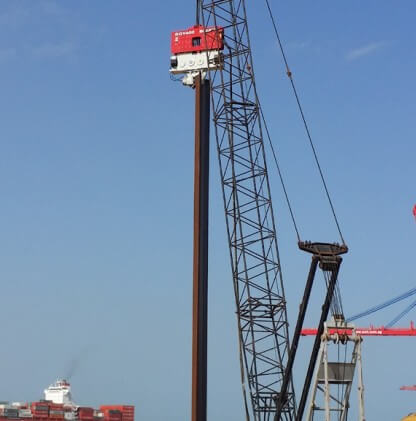
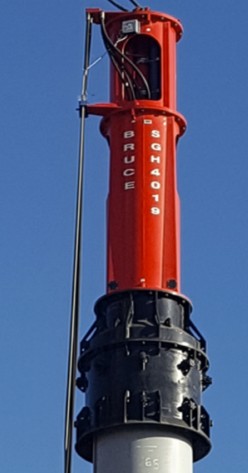
Vibro Hammer for UK Flood Defense:
Environment Agency Permit Guide 2026
“EA FLOOD RISK ACTIVITY PERMITS, BIODEGRADABLE OIL COMPLIANCE, AND ESTUARINE PILING FIELD PROTOCOL”
01. UK Flood Defense Piling — The EA Regulatory Framework
The Environment Agency (EA) is the primary regulatory body for flood risk management infrastructure in England, operating under the Flood and Water Management Act 2010 and the Water Framework Directive as retained in UK law. EA-funded flood defense capital programmes — delivered through Regional Flood and Coastal Committees (RFCCs) and major partnership funding arrangements with Local Authorities — involve significant volumes of sheet pile flood wall construction, river bank reinforcement, and tidal barrier installation across the English river catchments. These projects are subject to EA Flood Risk Activity Permits (FRAPs) under the Environmental Permitting Regulations 2016, which impose specific equipment and operational conditions that directly affect vibratory hammer specification and site management.
The scale of EA flood defense capital investment has accelerated following the significant flood events of recent years across the Severn, Trent, Yorkshire Ouse, and Thames catchments. Programme delivery through EA framework contractors and alliance delivery models creates sustained demand for technically compliant piling equipment across multiple simultaneous flood defense construction sites. For piling contractors operating within EA framework agreements, the ability to demonstrate full permit compliance from pre-mobilisation — including verified biodegradable oil compatibility, suppressor performance documentation, and silt curtain protocol — is increasingly a prequalification requirement rather than a post-award consideration.
Flood Defense vs. Commercial Waterway Piling — Different EA Permit Conditions
EA flood defense piling projects are subject to different permit conditions than commercial waterway piling carried out under Navigation Authority bylaws or Marine Management Organisation (MMO) licensing. The FRAP framework specifically addresses flood risk activity in the functional floodplain and within 8 metres of a main river — the zone that encompasses the majority of flood wall and embankment sheet pile installation. Unlike MMO-licensed marine dredging and piling, FRAP conditions are assessed and issued by local EA Area teams, meaning that the specific permit conditions vary between EA Area offices and between individual flood defense schemes — requiring contractors to confirm the precise equipment specification requirements of each FRAP before mobilisation rather than assuming a standard national condition set applies.
02. Flood Risk Activity Permit Conditions for Piling Equipment
EA Flood Risk Activity Permits for sheet pile flood defense installation consistently include several equipment-specific conditions that define the acceptable specification for vibratory hammers operating within the main river corridor. The most operationally significant of these conditions in 2026 are the mandatory use of biodegradable hydraulic fluids for all plant operating adjacent to or within the main river channel, restrictions on in-water working windows aligned with fish migration and spawning seasons, turbidity monitoring requirements during driving in tidal and estuarine zones, and noise management obligations under the Control of Pollution Act 1974 Section 61 consent process for urban flood defense sites.
Biodegradable hydraulic oil compatibility is the single most commonly encountered equipment specification condition in EA FRAPs for flood defense piling. Any hydraulic fluid release into the main river corridor — whether from a hose failure, seal degradation, or hydraulic connection leak — is treated as a pollution incident under the Water Resources Act 1991 and triggers EA regulatory intervention that can halt works for days or weeks pending investigation. All BRUCE SGV series hydraulic components and PQ-V power packs are confirmed compatible with biodegradable hydraulic oils without modification to the hydraulic circuit, satisfying this FRAP condition from the point of equipment delivery. This specification must be confirmed at factory order stage — not addressed post-mobilisation — as hydraulic circuit adaptation on a pre-owned unit with non-compatible seals requires full seal replacement throughout the system before biodegradable oil can be safely used.
Fish Migration Window Restrictions and Seasonal Planning
EA FRAPs for flood defense piling on salmon and sea trout rivers — including the Severn, Wye, Exe, and the majority of rivers in the North West and Yorkshire — impose working window restrictions during migratory fish runs, typically covering the period from October through to March on rivers with active salmon runs. These seasonal constraints concentrate in-water sheet pile installation into the April to September window on ecologically sensitive catchments, creating competition for equipment availability and possession of suitable piling plant among multiple EA framework contractors. For contractors managing flood defense delivery programmes across multiple simultaneous EA schemes, access to reliable, fully EA-compliant vibratory hammer equipment from a manufacturer with established global export logistics — ensuring site delivery within the constrained working window — is a programme management requirement as much as a technical specification issue.
03. Estuarine and Riparian Soil Conditions — Severn to Thames
English flood defense sheet pile projects span a wide range of riparian and estuarine soil profiles, and the vibratory hammer configuration required varies substantially between catchments. The three dominant geological environments for EA flood defense piling — alluvial river floodplains, estuarine tidal mudflats, and upland glaciated river valleys — each present distinct driving conditions that require different hammer selections and operational approaches.
Alluvial Floodplain — Severn, Trent, and Yorkshire Ouse
The major English river floodplains — the Severn in the Midlands, the Trent in the East Midlands, and the Yorkshire Ouse system — present alluvial deposits of silty clay, sandy silt, and peat overlying river terrace gravels at varying depths. The soft alluvial upper horizon allows rapid vibratory penetration with moderate centrifugal force, but the gravel horizon at depth creates a sudden increase in driving resistance that can stall an under-specified hammer before the design embedment level in the underlying stiff clay or bedrock is reached. Pre-mobilisation model selection must therefore account for the gravel horizon resistance encountered at depth, not just the soft alluvial conditions dominant in the upper portion of the pile embedment zone.
Estuarine Tidal Zones — Thames Estuary and Humber
Flood defense sheet pile installation in the Thames Estuary and Humber Estuary environments involves estuarine alluvium — soft tidal muds, marine silts, and brackish organic deposits — overlying London Clay or Chalk at depth. The very soft upper estuarine deposits require careful amplitude management during initial pile installation to prevent over-driving and maintain pile verticality in the low-resistance zone before the pile gains sufficient embedment to self-guide. Tidal water level fluctuations additionally affect the hydrostatic load on the hammer during submersion at high tide, requiring a power pack with sufficient hydraulic output reserve to maintain operating frequency under the increased resistive load of tidal submersion. The BRUCE PQ-V series power packs provide this reserve capacity and are designed for operation across the ambient temperature range encountered in year-round English estuarine construction.
04. Field Protocol for EA-Permitted Flood Defense Piling
Effective field management of EA-permitted flood defense sheet pile installation requires pre-mobilisation preparation that goes beyond standard civil engineering site setup. The FRAP conditions, turbidity monitoring plan, oil spill response plan, and ecological watching brief requirements must all be in place and operationally ready before the first pile is positioned. Equipment-specific preparation includes confirming biodegradable oil fill and hydraulic system integrity, deploying silt curtaining around the active piling area to contain sediment disturbance, and verifying that the remote pendant flow adjust function and emergency stop are operational before any plant enters the main river corridor.
During active piling within the EA permit zone, the turbidity monitoring operative and the hammer operator must maintain continuous communication so that the flow adjust dial can be reduced if turbidity readings approach the permit trigger level — typically caused by amplitude-induced sediment disturbance in the soft estuarine or alluvial soils characteristic of English flood defense sites. This real-time coordination between turbidity monitoring and hammer amplitude control is the operational equivalent of the PPV monitoring coordination required on Network Rail track-side projects, and similarly demands equipment with proportional amplitude response capability that fixed-frequency alternatives cannot provide.
Temporary Flood Defense Bypass — Piling During Active Flood Season
EA flood defense construction programmes sometimes require sheet pile installation during the active flood season, when river levels are elevated and the risk of tidal or fluvial inundation of the construction site is present. In these conditions, the ability to extract temporary shoring piles quickly if an unforecast flood event threatens to overtop the temporary works is a programme management and safety requirement. Vibratory hammers provide this extraction capability — the same hammer used for installation can extract the temporary piles within hours if required — whereas impact-driven piles cannot be rapidly extracted without specialist plant that may not be available at short notice. This extraction capability is a material advantage for EA flood defense contractors managing construction programmes that overlap with the November to April high flood risk period on English catchments.
For pre-mobilisation EA FRAP documentation support, biodegradable oil specification confirmation, and vibratory hammer model selection for your flood defense project, contact the BRUCE engineering desk at powerquip.co.kr/contact-us/. Full technical specifications are at powerquip.co.kr/products/vibro-hammer/features-2/.
UK Flood Defense Piling FAQ
Q: Is biodegradable hydraulic oil a standard EA FRAP condition for flood defense sheet pile installation in England?
“Yes — EA Flood Risk Activity Permits consistently require biodegradable hydraulic fluids for all plant operating within the main river corridor. Any mineral oil release into the watercourse triggers EA pollution incident procedures.”
All BRUCE SGV hydraulic components and PQ-V power packs are confirmed compatible with biodegradable hydraulic oils without circuit modification. This must be confirmed at factory order stage — post-mobilisation seal replacement on non-compatible pre-owned equipment is expensive and time-consuming.Q: How do fish migration window restrictions affect flood defense piling programme planning?
“On salmon and sea trout rivers, EA FRAPs typically restrict in-water piling to April through September — concentrating sheet pile installation demand within a six-month window across multiple simultaneous EA framework schemes.”
Equipment availability and delivery lead time from the BRUCE factory in Siheung, Korea must therefore be factored into programme planning well in advance of the permitted working window opening, particularly for large flood defense schemes requiring multiple hammer units.Q: Why does tidal water level affect vibratory hammer performance on estuarine flood defense sites?
“Tidal submersion increases hydrostatic drag on the vibrating hammer body, raising the resistive load on the hydraulic motor — a power pack without sufficient output reserve will show frequency drop at high tide that stalls penetration.”
BRUCE PQ-V series power packs provide the hydraulic output reserve required to maintain operating frequency under tidal submersion loads. The remote pendant’s flow adjust allows operators to increase pump flow at high tide to compensate for the additional resistive load without manually stopping the drive.Q: What turbidity management measures does an EA FRAP typically require during estuarine sheet pile installation?
“EA FRAPs typically require silt curtain deployment around the active piling area, continuous turbidity monitoring at a defined downstream location, and a pre-agreed work stoppage protocol if turbidity exceeds the permit trigger level.”
Vibratory hammers generate less sediment disturbance than impact hammers in soft estuarine soils, reducing the frequency of turbidity trigger exceedances. The remote pendant’s real-time amplitude reduction capability provides an additional tool for turbidity management without requiring a full work stoppage when monitoring readings approach the permit threshold.