How to Choose a Vibratory Hammer for Sheet Pile Driving
A practical engineering guide to matching sheet pile size, soil conditions, eccentric moment, hydraulic power, clamp configuration and carrier capacity for efficient vibratory pile driving.
- What Is a Vibratory Hammer?
- Why Correct Vibratory Hammer Sizing Matters
- 1. Start with the Sheet Pile
- 2. Review the Geotechnical Report Before Selecting the Hammer
- 3. Understand Eccentric Moment
- 4. Do Not Select a Hammer by Centrifugal Force Alone
- 5. Understand Amplitude
- 6. Evaluate Operating Frequency
- 7. Fixed Moment vs Variable Moment Vibratory Hammer
- 8. Match the Hydraulic Power Pack to the Hammer
- 9. Clamp Selection Is Critical
- 10. Crane-Suspended vs Excavator-Mounted Vibratory Hammer
- 11. Consider Total Suspended Weight and Line Pull
- 12. Sheet Pile Driving Is Different from Pipe Pile Driving
- 13. What Happens When a Sheet Pile Reaches Refusal?
- 14. When Should Pre-Drilling Be Considered?
- 15. Ground Vibration Should Be Evaluated as a Project Condition
- 16. A Practical Vibratory Hammer Selection Process
- 17. Common Vibratory Hammer Selection Mistakes
- 18. Questions to Send a Vibratory Hammer Supplier
- Frequently Asked Questions About Vibratory Hammer Selection
- Final Thoughts
Selecting a vibratory hammer for sheet pile driving requires much more than choosing the largest hammer available. The correct hammer must be matched to the sheet pile section, pile length and weight, soil profile, required penetration depth, hydraulic power supply, clamp configuration, carrier capacity, and environmental limitations of the jobsite.
An oversized vibratory hammer can create unnecessary ground vibration, increase equipment cost, place excessive stress on sheet pile interlocks, and demand more hydraulic power than the project requires. An undersized hammer, on the other hand, may slow penetration, overheat the hydraulic system, cause repeated refusal, or fail to reach the required installation depth.
This guide explains the main engineering factors contractors, equipment managers, foundation specialists, and project engineers should evaluate when selecting and sizing a vibratory hammer for steel sheet pile installation and extraction.
What Is a Vibratory Hammer?
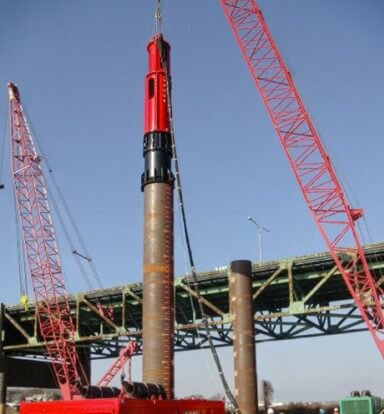
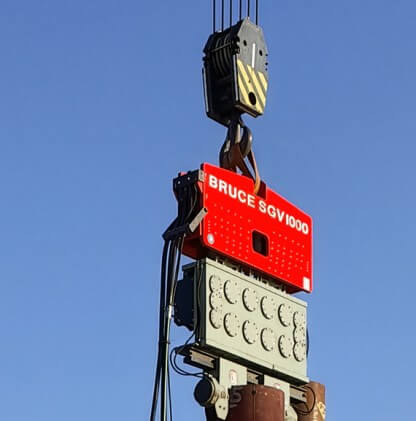
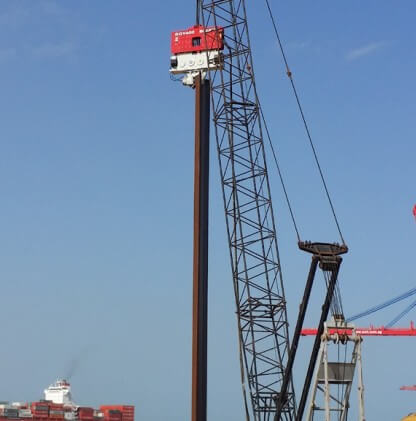
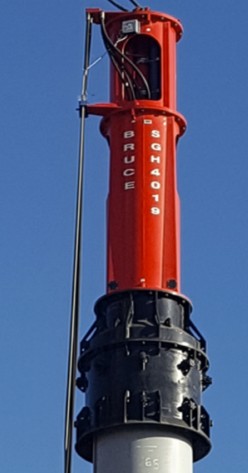
A vibratory hammer, also called a vibro hammer, vibratory pile driver, or vibratory pile driving hammer, is a piling machine that generates vertical vibration through rotating eccentric weights.
Unlike an impact pile hammer that repeatedly strikes the pile, a vibratory hammer transfers continuous oscillating force into the pile. This vibration changes the interaction between the pile surface and the surrounding soil, reducing resistance sufficiently for the combined weight of the pile and vibrating system to advance the pile into the ground.
The same principle can also be used in reverse to extract temporary sheet piles.
Vibratory hammers are widely associated with:
- Steel sheet pile installation
- Sheet pile extraction
- Temporary retaining walls
- Cofferdams
- Marine bulkheads and seawalls
- H-piles in suitable ground conditions
- Open-ended steel pipe piles
- Flood protection structures
- Bridge and transportation projects
- Utility and excavation support systems
The suitability of a vibratory system still depends strongly on the pile geometry and subsurface conditions. A machine that performs efficiently in loose sand may behave very differently when the same pile encounters dense gravel, stiff cohesive material, cemented layers, or obstructions.
Why Correct Vibratory Hammer Sizing Matters
Vibratory hammer selection is ultimately a system-matching problem. The hammer, pile, soil, clamp, hydraulic power source, and carrier must work together.
A common mistake is to compare hammers only by centrifugal force. Although centrifugal force is important, it does not by itself determine whether a hammer will successfully install a particular sheet pile.
Important parameters include:
- Eccentric moment
- Operating frequency
- Centrifugal force
- Amplitude
- Vibrating mass
- Total suspended weight
- Hydraulic pressure
- Required hydraulic oil flow
- Clamp force
- Extraction capacity
- Carrier lifting capacity
Soil resistance and sheet pile characteristics must then be evaluated together with these machine specifications.
1. Start with the Sheet Pile
The first step in selecting a vibratory hammer should be defining exactly what must be installed.
For steel sheet piles, collect at least the following information:
- Sheet pile profile or section
- Width
- Section thickness
- Length
- Weight per unit length
- Total weight of each driven element
- Single sheet, paired sheet, or multiple-sheet configuration
- Required penetration depth
- Interlock type
- Temporary or permanent installation
A light sheet installed to a shallow depth in loose sand has very different equipment requirements from a heavy paired sheet that must penetrate dense material to a substantial depth.
The hammer manufacturer or equipment supplier should therefore receive the actual sheet pile designation rather than simply being told that the project uses “sheet pile.”
Sheet Pile Weight Is Only One Part of the Calculation
It is tempting to select a hammer by comparing pile weight with hammer capacity. However, the resistance that develops along the pile surface and at the pile toe can become much more important than the static pile weight.
This is why two projects using identical sheet piles can require different vibratory hammer configurations.
2. Review the Geotechnical Report Before Selecting the Hammer
Ground conditions are among the most important variables in vibratory pile driving.
A proper equipment recommendation should ideally consider available geotechnical information such as:
- Soil classification
- Layer thickness
- Groundwater elevation
- Standard Penetration Test (SPT) data
- Cone Penetration Test (CPT) data when available
- Dense or cemented layers
- Gravel and cobble content
- Boulders or other obstructions
- Depth to rock
Vibratory installation is generally particularly effective in many granular soils because vibration can reduce resistance around the pile and facilitate penetration. Performance may become less predictable as cohesive strength, density, cementation, or obstruction content increases.
| Typical Ground Condition | General Vibratory Driving Consideration |
|---|---|
| Loose to medium sand | Generally favorable for vibratory sheet pile installation |
| Saturated granular soil | Often favorable, depending on pile and project conditions |
| Silt | Performance depends on density, plasticity, and layering |
| Soft clay | May be workable, but pile-soil response should be evaluated |
| Stiff clay | Higher resistance may significantly reduce penetration rate |
| Dense sand | May require greater hammer capability or supplemental methods |
| Dense gravel | Potentially difficult depending on gradation and pile geometry |
| Cobbles or boulders | Vibratory driving alone may not be suitable |
| Cemented soil | Pre-drilling or another installation method may be necessary |
| Rock | Normally requires another penetration method rather than conventional vibratory driving alone |
This table is only a general guide. Actual drivability should be evaluated using site-specific geotechnical information.
3. Understand Eccentric Moment
Eccentric moment is one of the fundamental specifications of a vibratory hammer.
The hammer contains rotating eccentric masses. Their mass and distance from the rotational axis determine the eccentric moment of the vibrating system.
Conceptually:
The eccentric moment influences the vibration generated by the hammer and is closely related to attainable amplitude, centrifugal force, operating characteristics, and power requirements.
When comparing two vibratory hammers, therefore, looking at operating frequency without considering eccentric moment can give an incomplete picture of their performance.
4. Do Not Select a Hammer by Centrifugal Force Alone
Centrifugal force is one of the most prominently advertised specifications on vibratory pile driving equipment.
It represents the dynamic force produced by the rotating eccentric masses and increases strongly as rotational speed increases.
However, a larger centrifugal force number does not automatically mean that a hammer is better for every piling application.
The actual driving response depends on a combination of:
- Frequency
- Eccentric moment
- Amplitude
- Vibrating mass
- Pile mass
- Soil resistance
- Available hydraulic power
Contractors should therefore avoid ranking vibratory hammers solely by maximum centrifugal force.
5. Understand Amplitude
Amplitude describes the vertical movement of the vibrating system. In simplified engineering terms, amplitude is related to eccentric moment and the dynamic mass being vibrated.
A commonly used conceptual relationship is:
As a result, attaching the same hammer to piles of substantially different mass changes the behavior of the total vibrating system.
This is an important reason why hammer selection should be made using the actual pile configuration.
High amplitude can help overcome certain soil resistance conditions, but excessive amplitude is not automatically desirable. Nearby structures, utilities, sensitive equipment, pile integrity, and project-specific vibration criteria also have to be considered.
6. Evaluate Operating Frequency
The operating frequency of a vibratory hammer is normally expressed in vibrations or revolutions per minute.
Different vibratory hammer designs use different combinations of frequency and eccentric moment.
Broad equipment categories may include:
- Standard-frequency vibratory hammers
- High-frequency vibratory hammers
- Variable-moment vibratory hammers
Higher frequency is often considered for projects where vibration behavior around nearby structures is an important design concern. However, frequency alone does not determine the vibration transmitted through the ground.
Ground response is influenced by the complete pile-soil-hammer system.
7. Fixed Moment vs Variable Moment Vibratory Hammer
A fixed-moment vibratory hammer operates using a fixed eccentric configuration. These machines are widely used for general-purpose piling where site conditions do not require sophisticated control of the eccentric moment during startup and shutdown.
A variable-moment vibratory hammer allows the eccentric moment to be controlled during operation.
This can be particularly useful on projects involving:
- Urban construction
- Existing buildings close to the piling area
- Utilities near the excavation
- Transportation infrastructure
- Vibration-sensitive equipment
- Projects with specified vibration monitoring requirements
The choice should be based on actual project restrictions rather than assuming that variable-moment technology is necessary for every project.
8. Match the Hydraulic Power Pack to the Hammer
A hydraulic vibratory hammer cannot deliver its intended performance unless the hydraulic power source can supply the required flow and pressure.
Important specifications include:
- Required hydraulic oil flow
- Operating pressure
- Maximum allowable pressure
- Hydraulic horsepower
- Cooling capacity
- Reservoir capacity
- Hose diameter and length
- Return-line restrictions
An inadequate power pack can limit hammer speed and reduce available vibratory performance even when the hammer itself appears correctly sized.
The opposite problem should also be avoided. Hydraulic pressure or flow should never simply be increased beyond manufacturer limits in an attempt to improve penetration.
Symptoms of a Hydraulic System Problem
Possible indications that the hydraulic system requires inspection include:
- Hammer cannot achieve normal operating speed
- Slow penetration despite apparently favorable soil
- Repeated hydraulic overheating
- Unstable hammer operation
- Excessive pressure
- Reduced clamp performance
- Unexpected loss of performance after extended operation
Hydraulic troubleshooting should distinguish between insufficient hammer capacity and a power supply problem.
9. Clamp Selection Is Critical
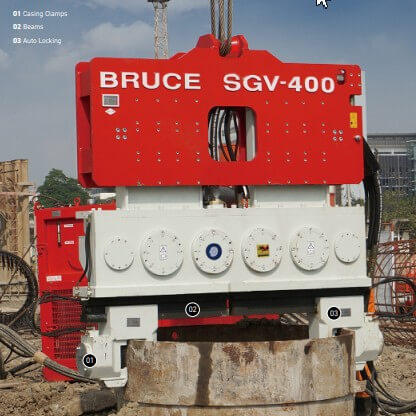
The clamp is the mechanical connection between the vibratory hammer and the pile.
Its job is not simply to hold the pile. It must maintain sufficient grip so that vibratory energy is transmitted efficiently into the pile without excessive slipping.
Clamp selection should consider:
- Pile profile
- Available gripping surface
- Required clamp force
- Sheet thickness
- Single or paired sheets
- Pipe pile diameter when applicable
- Condition of the gripping surface
- Installation versus extraction requirements
Poor clamping can waste vibratory energy and damage the contact surface. The correct clamp arrangement is therefore part of hammer sizing rather than a secondary accessory decision.
10. Crane-Suspended vs Excavator-Mounted Vibratory Hammer
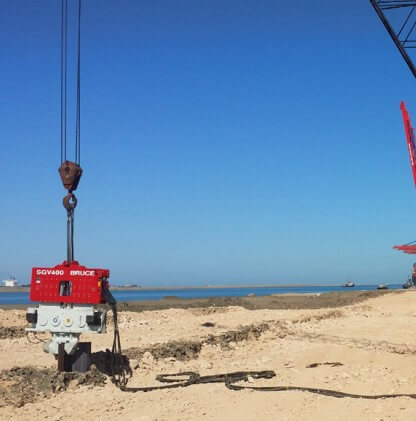
Vibratory pile driving systems can generally be configured around either a crane-suspended hammer or an excavator-mounted system.
Crane-Suspended Vibratory Hammer
Crane-suspended systems are commonly used for long piles, heavy piling elements, deep installations, marine foundations, and large civil projects.
Potential advantages include:
- Ability to handle long sheet piles
- Large hammer sizes available
- Suitable for heavy piling systems
- Strong extraction capability when correctly configured
- Well suited to many marine operations
Excavator-Mounted Vibratory Hammer
An excavator-mounted vibratory hammer combines pile handling and vibratory installation with an excavator carrier.
Potential advantages include:
- High mobility along linear piling work
- Fast repositioning
- Reduced dependence on a separate piling crane
- Useful pile positioning capability
- Suitable for many temporary works and retaining wall projects
However, excavator-mounted hammer selection must account for more than excavator operating weight.
The following should also be checked:
- Excavator lifting chart
- Working radius
- Maximum pile length
- Hammer weight
- Pile weight
- Hydraulic pump capacity
- Available oil flow
- Available hydraulic pressure
- Machine stability
- Quick coupler or mounting arrangement
A hammer being hydraulically compatible with an excavator does not necessarily mean the complete combination is mechanically safe or stable at every working radius.
11. Consider Total Suspended Weight and Line Pull
For crane-suspended systems, contractors must consider the complete suspended load rather than hammer weight alone.
The crane may be supporting:
- Vibratory hammer
- Clamp
- Hydraulic hoses
- Rigging
- Sheet pile
- Additional handling equipment
Required extraction force can also become an important consideration when temporary sheet piles must be removed after construction.
A crane that can lift the static hammer-and-pile combination may still require additional reserve capacity during extraction operations.
12. Sheet Pile Driving Is Different from Pipe Pile Driving
A vibratory hammer used successfully on sheet piles should not automatically be assumed to perform identically on every other pile type.
Typical pile types include:
| Pile Type | Typical Vibratory Hammer Consideration |
|---|---|
| Steel sheet pile | One of the most common vibratory driving applications |
| H-pile | Can be suitable depending on soil and penetration requirements |
| Open-ended pipe pile | Often suitable when soil can enter the open pile |
| Large pipe pile | Requires evaluation of pile mass, clamp configuration and soil resistance |
| Closed-ended displacement pile | May develop substantially greater toe resistance |
| Precast concrete pile | Requires specialized engineering consideration; conventional vibratory methods may not be appropriate |
For this reason, hammer recommendations should always identify both the pile section and installation method.
13. What Happens When a Sheet Pile Reaches Refusal?
When penetration slows dramatically, the immediate assumption should not always be that a larger vibratory hammer is required.
Possible reasons for apparent refusal include:
- Unexpected dense soil layer
- Gravel or cobbles
- Buried obstruction
- Cemented material
- Rock
- Damaged sheet pile toe
- Interlock friction
- Pile misalignment
- Insufficient hydraulic power
- Incorrect hammer operating parameters
- Clamp slippage
The actual cause should be investigated before changing equipment.
Depending on the project and geotechnical conditions, possible responses may include:
- Pre-drilling
- Jetting where permitted and technically appropriate
- Changing installation sequence
- Using a different hammer configuration
- Using an impact hammer for the final penetration
- Removing an obstruction
- Re-evaluating the specified penetration depth with the project engineer
Increasing hammer size without identifying the cause can damage the sheet pile while leaving the underlying problem unresolved.
14. When Should Pre-Drilling Be Considered?
Pre-drilling can be considered when hard or obstructive ground conditions prevent efficient sheet pile penetration.
Potential reasons include:
- Very dense soil
- Cemented layers
- Hard lenses within layered soil
- Repeated sheet pile deviation
- Excessive resistance near the pile interlock
- Risk of damaging relatively light sheet sections
Pre-drilling should be designed so that it assists installation without unnecessarily disturbing the surrounding ground or compromising the intended performance of the sheet pile wall.
15. Ground Vibration Should Be Evaluated as a Project Condition
Vibratory pile driving inevitably transmits some vibration into surrounding soil.
The resulting ground vibration does not depend only on the hammer.
Important variables include:
- Soil type
- Soil layering
- Pile type
- Pile section
- Hammer characteristics
- Operating frequency
- Installation method
- Penetration resistance
- Depth of penetration
- Distance to nearby structures
- Condition of surrounding structures
Projects near buildings, utilities, railways, laboratories, hospitals, historic structures, or sensitive industrial equipment may therefore require vibration monitoring.
Project-specific limits should be established by the responsible engineer or authority rather than relying on a universal vibration value for every jobsite.
16. A Practical Vibratory Hammer Selection Process
A systematic selection process can reduce the risk of choosing a hammer based on incomplete information.
Step 1: Identify the Pile
Provide the exact sheet pile section, length, weight, configuration, and required penetration depth.
Step 2: Review Ground Conditions
Use the project geotechnical report rather than assuming the ground is simply “sand” or “clay.”
Step 3: Define the Installation Method
Determine whether the project requires installation only, installation and extraction, or permanent sheet piling.
Step 4: Select the Carrier Type
Determine whether a crane-suspended or excavator-mounted vibratory hammer is more practical for the work.
Step 5: Compare Hammer Parameters
Review eccentric moment, centrifugal force, frequency, amplitude, dynamic mass, and total weight together.
Step 6: Verify Hydraulic Requirements
Confirm power pack or excavator hydraulic flow and pressure are compatible with the selected hammer.
Step 7: Select the Correct Clamp
Match the clamp to the actual pile profile and installation configuration.
Step 8: Review Site Restrictions
Check noise restrictions, vibration limits, overhead clearance, crane access, environmental restrictions, and nearby structures.
Step 9: Evaluate Difficult Layers
Determine whether pre-drilling, impact assistance, or another method could be required.
Step 10: Confirm the Final Configuration
Final equipment selection should be reviewed using project-specific information and the current manufacturer’s operating limits.
17. Common Vibratory Hammer Selection Mistakes
Several mistakes repeatedly lead to poor field performance.
Choosing the Largest Hammer Available
A larger hammer can increase cost and equipment demand without necessarily improving installation efficiency.
Comparing Only Centrifugal Force
Centrifugal force is only one component of vibratory hammer performance.
Ignoring Soil Information
Equipment that performs well in granular soil may encounter significant difficulty in dense cohesive or obstructed ground.
Ignoring Hydraulic Flow
An incorrectly supplied hydraulic hammer cannot produce its designed operating performance.
Using the Wrong Clamp
Insufficient or inappropriate clamping reduces energy transmission and can cause slippage or pile damage.
Ignoring Extraction Requirements
Temporary sheet pile projects should be evaluated for removal as well as installation.
Matching an Excavator by Tonnage Alone
Hydraulic capacity, lifting capacity, operating radius, pile length, and stability all matter.
18. Questions to Send a Vibratory Hammer Supplier
Before requesting an equipment recommendation, prepare the following information:
- Project location
- Sheet pile manufacturer and section
- Pile length
- Pile weight
- Single or paired sheets
- Required penetration depth
- Number of piles
- Geotechnical report
- SPT or CPT information when available
- Groundwater conditions
- Required installation schedule
- Crane or excavator information
- Available hydraulic system information
- Need for pile extraction
- Nearby structures or utilities
- Noise or vibration restrictions
The more complete this information is, the more meaningful the hammer selection can be.
Frequently Asked Questions About Vibratory Hammer Selection
What size vibratory hammer do I need for sheet pile?
There is no single hammer size that fits every sheet pile. Selection depends on the sheet section, pile length and mass, soil conditions, penetration depth, hydraulic supply, carrier configuration, and whether extraction is required.
Is a bigger vibratory hammer always better?
No. An oversized hammer may increase cost, hydraulic demand, suspended load, and vibration without providing a proportional improvement in installation performance.
What soil is best for vibratory pile driving?
Vibratory hammers generally perform very effectively in many granular soils such as sand. Performance in stiff cohesive soil, cemented material, gravel containing large particles, cobbles, or rock can be more challenging.
Can a vibratory hammer drive sheet piles into clay?
It can in many cases, but suitability depends on clay strength, pile dimensions, depth, layering, and other site-specific conditions. Stiff cohesive soils can significantly increase driving resistance.
Can a vibratory hammer drive through rock?
A conventional vibratory hammer is generally not intended to penetrate competent rock. Projects encountering rock may require pre-drilling, sockets, different foundation systems, or other installation techniques.
What is more important: centrifugal force or eccentric moment?
Neither specification should be evaluated independently. Hammer performance results from the relationship between eccentric moment, operating frequency, centrifugal force, amplitude, vibrating mass, pile characteristics, and soil resistance.
Can the same vibratory hammer install and extract sheet piles?
Many vibratory hammers can perform both functions, but extraction requirements should be considered during equipment and crane selection because pulling resistance can become substantial.
Can I run a vibratory hammer directly from an excavator?
Some excavator-mounted systems are designed to operate using an excavator hydraulic system. Compatibility must be confirmed for hydraulic flow, pressure, return circuit, lifting capacity, stability, mounting system, and manufacturer requirements.
When is an impact hammer needed after vibratory driving?
An impact hammer or another supplemental method may be considered when the vibratory system cannot achieve the required penetration because of dense layers, high toe resistance, cohesive material, obstructions, or project-specific foundation requirements.
Final Thoughts
Choosing the correct vibratory hammer for sheet pile driving is not a matter of selecting the machine with the highest centrifugal force or the largest physical size.
A technically sound selection begins with the pile and the ground.
The sheet pile profile, pile length, total mass, geotechnical conditions, penetration depth, eccentric moment, frequency, amplitude, hydraulic power, clamp configuration, carrier capacity, extraction requirements, and surrounding environment should all be considered as parts of one piling system.
For straightforward sheet pile projects in favorable granular soil, the selection process may be relatively simple. For deep sheet piling, dense or layered soils, urban construction, marine foundations, or vibration-sensitive projects, more detailed drivability and equipment analysis may be justified before mobilization.
Using project-specific geotechnical information and current manufacturer specifications remains the most reliable way to select a vibratory pile driving system that provides adequate productivity without unnecessarily increasing equipment size, project risk, or operating cost.
Technical Reference Sources: Federal Highway Administration (FHWA), Design and Construction of Driven Pile Foundations; Pile Driving Contractors Association (PDCA), Basic Principles of Hammers for Sheet Pile Installation and Hammer Database Guidance. Equipment capacities and operating limits should always be verified against current manufacturer documentation for the specific model being considered.
Need to Match Piling Equipment to Your Project?
Final equipment selection should consider the actual pile section, penetration depth, geotechnical conditions, hydraulic requirements, carrier limits and project restrictions together.
Explore POWERQUIP Piling Equipment