Vibratory Hammer vs Hydraulic Impact Hammer – Which Pile Driving Method Fits the Project?
Compare energy transfer, pile applications, soil response, penetration capability, extraction, noise, vibration and bearing-pile verification.
- How Does a Vibratory Hammer Work?
- How Does a Hydraulic Impact Hammer Work?
- 1. Continuous Vibration vs Individual Impact
- 2. Which Hammer Is Faster?
- 3. Soil Conditions Can Determine the Better Method
- 4. Sheet Piles Often Favor Vibratory Installation
- 5. Bearing Piles Often Favor Impact Hammers
- 6. Can Vibratory Hammers Install Bearing Piles?
- 7. Vibratory Hammer Specifications
- 8. Hydraulic Impact Hammer Specifications
- 9. Energy Comparison Is Not One-to-One
- 10. Noise Characteristics
- 11. Ground Vibration
- 12. Startup and Shutdown of a Vibratory Hammer
- 13. Pile Damage Considerations
- 14. Extraction Strongly Favors Vibratory Equipment
- 15. Hybrid Installation Can Be the Best Solution
- 16. Vibratory vs Hydraulic Impact Hammer Comparison
- 17. Questions to Ask Before Selecting the Hammer
- Frequently Asked Questions
- Conclusion
Vibratory hammers and hydraulic impact hammers are both widely used in pile driving, but they transfer energy into the pile in fundamentally different ways. A vibratory hammer applies continuous cyclic vibration, while a hydraulic impact hammer applies repeated individual blows.
Neither method is universally superior. The appropriate method depends on pile type, soil conditions, required penetration, bearing requirements, productivity, vibration constraints, noise restrictions, equipment availability and how foundation performance will be verified.
How Does a Vibratory Hammer Work?
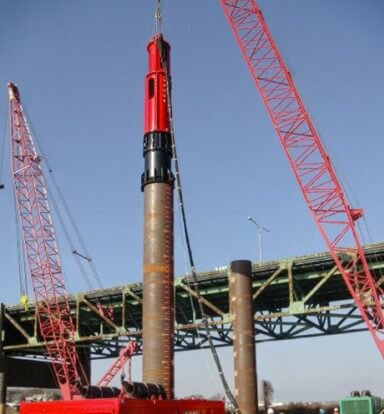
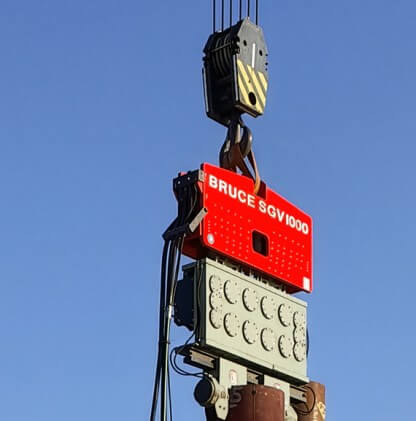
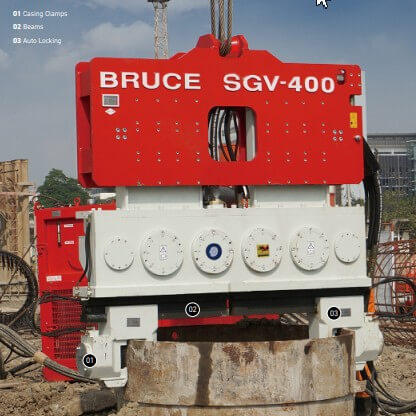
A vibratory hammer uses paired rotating eccentric weights to generate vertical oscillating force. The hammer is connected to the pile through a clamp or another attachment system.
As vibration enters the pile, the pile-soil interface is repeatedly disturbed. Under suitable conditions, resistance around the pile is reduced enough for the pile to penetrate under the combined dynamic action and weight of the system.
- Steel sheet piles
- Temporary retaining walls
- Cofferdams
- Bulkheads
- Marine sheet piling
- Open-ended pipe piles
- Temporary piles requiring extraction
How Does a Hydraulic Impact Hammer Work?
A hydraulic impact hammer raises and accelerates a ram onto the pile-driving system. Each impact transfers kinetic energy through the drive cap and into the pile. The process repeats blow after blow until the pile reaches the required depth, resistance or project acceptance criterion.
- Steel pipe piles
- H-piles
- Precast concrete piles
- Bearing piles
- Bridge foundations
- Marine foundations
- Offshore and heavy foundation construction
1. Continuous Vibration vs Individual Impact
| Characteristic | Vibratory Hammer | Hydraulic Impact Hammer |
|---|---|---|
| Energy Delivery | Continuous cyclic force | Individual repeated impacts |
| Main Mechanism | Rotating eccentric weights | Hydraulically controlled ram |
| Typical Sheet Pile Use | Very common | Useful when higher penetration resistance occurs |
| Bearing Pile Use | Project dependent | Widely used |
| Extraction | Major advantage | Not a primary function |
2. Which Hammer Is Faster?
There is no universal answer. In favorable granular soil, vibratory installation of steel sheet piles can achieve very high production because penetration is continuous rather than blow-by-blow.
When a pile encounters dense material, a hard layer, high toe resistance or conditions that limit vibratory penetration, an impact hammer may achieve penetration that a vibro hammer cannot efficiently produce.
Productivity should therefore be measured as total installed piles per shift, including setup, positioning, hammer changes and verification requirements.
3. Soil Conditions Can Determine the Better Method
Granular Soil
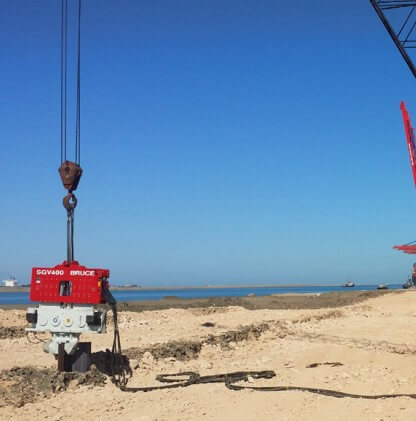
Vibratory hammers are especially effective in many sands and other granular soils because vibration can reduce pile-soil resistance.
Dense Granular Layers
As density increases, vibratory penetration may become more difficult. Some projects use vibratory equipment for initial installation and impact driving for final penetration.
Cohesive Soil
Clay behavior is more complex because cohesive strength and pile adhesion can reduce the effectiveness of vibratory installation. Soft cohesive soil may still be workable while stiff clay can require greater effort.
Gravel, Cobbles and Obstructions
Large particles and obstructions can stop smooth vibratory penetration. Impact driving, pre-drilling, obstruction removal or another method may be required.
4. Sheet Piles Often Favor Vibratory Installation
Steel sheet piling is one of the strongest applications for vibratory hammers because of rapid continuous installation, straightforward clamping to steel sections, extraction capability and good performance in many granular soils.
Impact assistance can still be useful when sheet piles encounter high resistance or require a difficult final penetration.
5. Bearing Piles Often Favor Impact Hammers
A major advantage of impact pile driving is that each blow creates measurable pile response. Blow count, hammer energy, pile stress and pile movement can be incorporated into established engineering procedures used to evaluate drivability and pile resistance.
Wave equation analysis and dynamic pile testing are commonly associated with impact-driven bearing piles. This is one reason hydraulic impact hammers are widely used where the installed pile must satisfy structural bearing requirements.
6. Can Vibratory Hammers Install Bearing Piles?
They can install certain bearing piles, but installation method and capacity verification are separate questions. Reaching the required tip elevation with a vibratory hammer does not by itself demonstrate that a foundation has achieved the specified axial capacity.
Possible Verification Methods
- Static load testing
- Dynamic testing
- Impact restrike
- Wave equation analysis
- Other project-specific acceptance procedures
7. Vibratory Hammer Specifications
- Eccentric moment
- Centrifugal force
- Frequency
- Amplitude
- Dynamic weight
- Maximum line pull
- Hydraulic power, flow and pressure
8. Hydraulic Impact Hammer Specifications
- Ram weight
- Stroke
- Rated or potential energy
- Blows per minute
- Operating pressure
- Hydraulic flow
- Total hammer weight
- Drive cap configuration
9. Energy Comparison Is Not One-to-One
Correct comparison should focus on whether each system can install the specified pile under the expected ground conditions while remaining within pile stress and equipment limits.
10. Noise Characteristics
Impact pile driving creates repeated short-duration impact noise. Vibratory driving creates a more continuous mechanical sound and vibration signature. Which method creates the greater project concern depends on equipment size, pile type, receptor distance, soil conditions, local ordinances and operating duration.
Noise and ground vibration should be evaluated separately.
11. Ground Vibration
Both methods generate ground vibration. Vibratory equipment produces continuous periodic excitation, while impact hammers create discrete transient events.
Response at nearby structures depends on soil propagation characteristics, pile geometry, distance, frequency content and structural response. Sensitive projects may require preconstruction surveys and vibration monitoring regardless of hammer type.
12. Startup and Shutdown of a Vibratory Hammer
Conventional vibratory systems pass through a range of frequencies while accelerating and decelerating. Depending on the ground and nearby structures, transition periods can matter. Variable-moment systems can provide greater control of dynamic behavior during these phases.
13. Pile Damage Considerations
| Vibratory Driving Risks | Impact Driving Risks |
|---|---|
| Clamp or gripping damage | Excessive compressive stress |
| Interlock damage | Tensile stress in some pile types |
| Local deformation | Pile-head damage |
| Alignment problems | Concrete cracking where applicable |
| Excessive vibration of light sections | Local steel deformation |
14. Extraction Strongly Favors Vibratory Equipment
One major advantage of a vibratory driver/extractor is the ability to assist pile removal. Vibration reduces pile-soil resistance while the crane or carrier applies upward force.
- Temporary sheet pile walls
- Temporary cofferdams
- Work trestles
- Temporary marine piles
- Construction access structures
15. Hybrid Installation Can Be the Best Solution
Confirm line, level and pile orientation.
Take advantage of continuous installation where the soil responds favorably.
Identify the point where vibratory progress becomes inefficient.
Use impact driving for dense layers or final penetration if the project requires it.
Follow the project acceptance and testing plan.
16. Vibratory vs Hydraulic Impact Hammer Comparison
| Project Requirement | Vibratory Hammer | Hydraulic Impact Hammer |
|---|---|---|
| Steel Sheet Pile | Excellent common application | Useful for difficult final penetration |
| Temporary Extraction | Excellent | Not a primary function |
| Granular Soil | Often highly effective | Effective |
| Very Dense / Hard Layer | May become inefficient | Often advantageous |
| Bearing Verification | Requires additional evaluation | Established impact-driving methods |
| Precast Concrete Pile | Specialized evaluation required | Common application |
| Continuous Installation Speed | Can be very high | Blow-by-blow penetration |
17. Questions to Ask Before Selecting the Hammer
Project Decision Inputs
- What pile type will be installed?
- Is the pile structural or temporary?
- What are the soil layers?
- What penetration depth is required?
- Is bearing-capacity verification required?
- Will the pile later be extracted?
- Are dense layers expected?
- Are vibration-sensitive structures nearby?
- What noise restrictions apply?
- What crane, carrier and hydraulic power are available?
Frequently Asked Questions
Is a vibratory hammer better than an impact hammer?
Neither is universally better. Vibratory hammers can be highly efficient for sheet piling and extraction, while hydraulic impact hammers are widely used for bearing piles and difficult penetration conditions.
Can I finish a pile with an impact hammer after using a vibro?
Yes. Combined installation is used where vibratory equipment performs initial penetration and an impact hammer completes final penetration or supports capacity verification.
Which hammer is better for sand?
Vibratory hammers are frequently very effective in granular soils such as sand, although density, pile type and required depth still matter.
Which hammer is better for hard soil?
Dense or hard layers can favor impact driving, but the correct method depends on the actual geotechnical profile and pile type.
Which hammer is best for temporary sheet pile?
Vibratory driver/extractors are particularly useful because the same general system can assist both installation and extraction.
Conclusion
The decision between a vibratory hammer and hydraulic impact hammer should be based on how the pile must interact with the ground and how the completed foundation will be accepted.
For steel sheet piles and temporary works in favorable ground, vibratory driving can provide excellent productivity and extraction capability. For bearing piles, dense soils, difficult penetration or projects where blow-by-blow resistance information is important, hydraulic impact driving can provide major advantages.
Many complex projects benefit from both methods. The best installation plan starts with pile type, soil conditions, foundation requirements, testing requirements and equipment constraints.
Need to Match Piling Equipment to Your Project?
Final equipment selection should consider the actual pile section, penetration depth, geotechnical conditions, hydraulic requirements, carrier limits and project restrictions together.
Explore POWERQUIP Piling Equipment