Best Hydraulic Pile Hammer Models:
2026 Deep Foundation Audit
“VALIDATING IMPACT ENERGY TRANSFER AND STRUCTURAL INTEGRITY IN EXTREME STRATA”
“The effectiveness of a deep foundation project is determined not just by the weight of the ram, but by the energy transfer efficiency from the hammer to the pile head. Precision models achieve this through advanced accumulator systems that maintain consistent ram speed across the full stroke length.”
01. Engineering Excellence: Energy Transfer Rates
Deep foundation engineering requires more than heavy impact — it demands precise stroke control and verifiable energy transfer consistency at every blow. When engineers evaluate the best hydraulic pile hammer models for deep foundation projects, they prioritize the accumulator assembly, drive cap configuration, and striker plate alignment as the three primary components determining energy transfer from the hammer to the pile head.
TECHNICAL BRAND RANKING
How do these impact models influence overall brand reliability? Review the Best Vibratory Hammer Brands 2026 User Reviews & Ratings.
Accumulator Assembly — Ram Speed Consistency
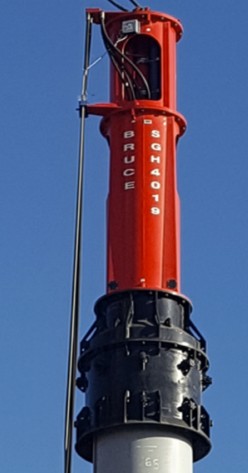
The accumulator assembly on the BRUCE SGH series assists in absorbing hydraulic shocks during the ram drop cycle and maintains consistent ram speed across the full stroke length. This consistency ensures the hammer delivers its rated energy at every blow — not just under ideal conditions — providing the repeatable blow energy data required by DOT structural auditors on ASTM D4945 compliant projects. Furthermore, lower hose vibration is achieved through the high-quality accumulator assembly, reducing stress on hydraulic connections during extended high-frequency driving cycles on major US bridge contracts. Pre-owned units with internal hydraulic bypass leakage generate erratic stroke heights that fail energy repeatability audits and require expensive re-testing.
IEA-Confirmed Energy Transfer — Field Performance Benchmark
The optional IEA (Impact Energy Analysis) System records real-time energy at every blow. Field measurements on SGH-1015 and SGH-1415 deployments confirmed energy transfer rates of up to 90% — data that provides the verifiable baseline for GRLWEAP wave equation analysis and AASHTO LRFD pile capacity certification. This system has been adopted as a standard monitoring system by the Hong Kong Housing Government and applied on major bridge projects in Korea and the United States.
02. Mounting Versatility: Global Logistical Adaptation
Every project site presents unique logistical constraints. Modern hydraulic pile hammer models support multiple mounting configurations to accommodate existing carrier fleets and site access conditions. Confirming the correct mounting type at order stage — rather than after delivery — is the primary step for eliminating compatibility issues on active construction sites.
SGH Series Mounting Configurations
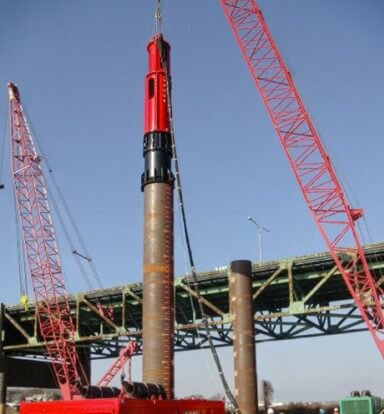
The BRUCE SGH series supports four mounting configurations. Fixed Leader mounting provides vertical precision for land-based bridge and building foundation piling. Crane Suspended mounting — used on the Sakonnet River Bridge (Rhode Island, SGH-4719) and Incheon Bridge (Korea, SGH-3015) — provides flexibility for large-diameter offshore and marine foundation work. U-Type Leads mounting allows the hammer to be used with standard crane equipment without a fixed leader system, as deployed on the Williamsburg Bridge (Virginia, SGH-2015, SKANSKA USA). Offshore Leader mounting provides the structural support required for offshore platform piling in marine conditions.
Drive Cap Compatibility — Pile Profile Matching
The drive cap must be matched to the pile head geometry at order stage — round, square, octagonal, and H-beam piles each require a distinct cap profile and cushion arrangement. The cushion material and thickness directly determine how efficiently the kinetic stress wave is transmitted from the hammer into the pile shaft. Consequently, professional foundation crews confirm drive cap specification before mobilization to prevent energy loss at the pile-hammer interface — a common source of inefficiency on projects where drive caps are sourced separately from the hammer without engineering desk verification.
03. Performance Benchmarks: SGH Model Matrix
Understanding the relationship between ram weight and maximum impact energy is essential for selecting the correct SGH model for deep foundation work. The following matrix presents verified BRUCE SGH series specifications across the main model classes:
| SGH Model | RAM Weight (ton) | Max Energy (kNm / ton.m) | Documented Project Reference |
|---|---|---|---|
| SGH-1015 | 10 ton | 15 ton.m | Port expansion, IEA 90% ETR confirmed |
| SGH-2015 | 20 ton | 30 ton.m | Chincoteague Channel Bridge (VA, USA) — PDA Magazine; Williamsburg Bridge (VA, USA) — SKANSKA USA |
| SGH-3013 | 30 ton | 39 ton.m | Hathaway Bridge (FL, USA) — 60″ cylinder piles, FSU thesis |
| SGH-3015 | 30 ton | 45 ton.m | Incheon Bridge (Korea) — 18.248km, world 5th longest |
| SGH-4719 | 47 ton | 89.3 ton.m | Sakonnet River Bridge (RI, USA) — USD 163.7M, RI DOT largest contract; 72″ casing piles, 200ft depth |
“We strictly recommend NEW assets for deep foundation contracts — used units with undocumented maintenance histories cannot provide the verifiable energy transfer data required for ASTM D4945 and AASHTO LRFD pile capacity certification on US and UK federally funded contracts.”
04. Advanced Monitoring: Real-Time Impact Energy
Modern piling standards in the United States and United Kingdom demand energy transfer transparency. The optional IEA (Impact Energy Analysis) System provides real-time energy data at every blow — creating the verifiable record required for structural auditing on ASTM D4945 regulated projects. Developed by BRUCE and adopted as a standard monitoring system by the Hong Kong Housing Government, the IEA has been applied on major bridge projects in Korea and the US, including the Incheon Bridge and Sakonnet River Bridge.
Remote Control System — Stroke Adjustment and Safety Functions
The BRUCE SGH series remote control system allows adjustment from minimum stroke to maximum in real time from the rig cabin. Standard functions include digital blow counter, dwell control, automatic cut-off circuit breaker, and emergency stop. High-brightness LED indicators monitor abnormalities during operation. Consequently, operators can manage impact energy delivery in real time — reducing stroke during initial driving near existing bridge foundations and increasing it progressively as pile embedment increases. This precisely controlled stroke adjustment protects precast concrete and steel casing pile heads from over-stressing during the most vulnerable initial driving phase on US DOT bridge and UK National Highways contracts.
Silence Cap Housing and Environmental Compliance
For UK urban sites requiring BS 5228 Section 61 noise compliance and US urban projects with EPA permit conditions, the optional Silence Cap Housing Kit on the SGH series reduces noise emissions for the most stringent urban requirements — specified at factory order stage rather than as a post-purchase field retrofit. Furthermore, BRUCE hydraulic impact hammers produce no smoke and significantly lower baseline noise than diesel hammers, directly reducing environmental monitoring burdens on urban and coastal construction permits where both noise and air quality conditions apply simultaneously.
Technical FAQ
Q: What is the primary benefit of the accumulator back-charging system on the SGH series?
“The accumulator absorbs hydraulic shocks during the ram drop and maintains consistent ram speed across the full stroke — ensuring the hammer delivers its rated energy at every blow.”
Additionally, the accumulator reduces hose vibration during extended driving, reducing stress on hydraulic connections throughout the project duration. Proper pre-charge pressure — as specified in the operation manual — must be confirmed before project start to ensure consistent energy delivery across the full blow count required for ASTM D4945 structural auditing.Q: Can SGH series hammers be used for underwater or offshore piling?
“Yes — the SGH series supports Offshore Leader mounting and has been deployed on major bridge and offshore projects in the US and Korea.”
The SGH-4719 drove 72-inch casing piles to over 200 feet depth on the Sakonnet River Bridge (Rhode Island) — a marine bridge foundation contract. The SGH-3015 was deployed on the Incheon Bridge (Korea), a 18.248km bridge ranked among the world’s longest. Furthermore, all BRUCE hydraulic components are compatible with biodegradable hydraulic oils, satisfying EPA and Environment Agency permit conditions for marine piling near sensitive coastal ecosystems.Q: How does the drive cap cushion selection affect energy transfer on deep foundation projects?
“The drive cap cushion must match the pile head geometry and be maintained within the manufacturer’s specified condition — degraded cushion material directly reduces energy transfer efficiency and increases pile head spalling risk.”
Round, square, octagonal, and H-beam piles each require a distinct cap profile. Cushion replacement intervals are specified by blow count in the operation manual, not by calendar time. Pre-ordering sufficient cushion stock before project mobilization prevents unplanned downtime caused by cushion depletion during hard driving on deep foundation contracts.Q: What pile types and maximum dimensions can the SGH series handle on deep foundation projects?
“The SGH series drives round, square, and octagonal precast concrete piles, steel casing piles, H-beam piles, and sheet piles — with documented deployments up to 72-inch diameter at 200+ feet depth.”
The SGH-4719 (47-ton RAM) drove 72-inch steel casing piles to over 200 feet on the Sakonnet River Bridge — one of the largest hydraulic impact hammer deployments in US DOT history. The SGH-3013 drove 60-inch precast concrete cylinder piles on the Hathaway Bridge (Florida), documented in a Florida State University engineering thesis. Consequently, the full range of deep foundation pile profiles for US bridge, offshore, and coastal projects is covered within the SGH series.