Where to Buy Hydraulic Pile Hammers Near Me:
A 2026 Strategic Procurement & Global Logistics Guide
“OPTIMIZING LOCAL ACCESSIBILITY FOR NEW DEEP FOUNDATION ASSETS IN THE US AND UK”
“Choosing a supplier for hydraulic equipment is not just about proximity; it is about finding a partner that provides ready-to-use technical support and standardized replacement parts. In the high-stakes world of foundation work, minimizing downtime through accessible service is the ultimate competitive advantage.”
01. The Logic of Proximity in Hydraulic Hammer Procurement
If you are searching for “where to buy hydraulic pile hammers near me,” you likely understand that the quality of your supplier directly impacts your project’s timeline. In 2026, the global foundation sector has moved beyond simple availability — professional contractors now prioritize manufacturers that offer a combination of verified technical hardware and direct engineering support accessible across time zones. Consequently, sourcing a new hydraulic impact hammer from a factory-direct exporter with an established global logistics track record provides the compliance documentation and technical support that local used equipment resellers cannot offer.
Planning a high-stakes infrastructure bid in the US or UK?
Review our Master Strategy for Infrastructure Bidding & Cost Estimation.
Downtime Cost — The Real Procurement Driver
The economics of hydraulic hammer procurement are driven by the cost of downtime. For federal projects in the United States or rail infrastructure in the United Kingdom, unplanned equipment failure triggers penalty clauses, subcontractor standby costs, and crane idle time — all compounding simultaneously. Purchasing new, standardized machinery through a factory-direct global exporter provides the hydraulic specifications, known consumable schedules, and manufacturer support that eliminate this risk from the project financial model. Furthermore, new equipment ships with compliance documentation — ISO 9001 certificates, technical specification sheets, and operation manuals — that directly support permit submissions and federal procurement requirements.
Factory-Direct vs. Local Reseller — Key Differences
Factory-direct procurement from the manufacturer — BRUCE Piling Equipment (Siheung, Korea) — provides access to the full SGH and SGV series with matched PQ power packs, confirmed clamp specifications, and compliance documentation in a single transaction. Additionally, model selection confirmation, power pack matching, and clamp specification verification are handled directly by the engineering desk before dispatch — rather than requiring the buyer to source and verify each item separately through a local intermediary.
02. Regional Construction Equipment Hubs & Logistics
For those operating in key global markets, understanding regional logistics is essential for rapid procurement. Whether the project site is on the US Gulf Coast, in the UK Midlands, or in the Middle East, heavy machinery export requires B2B specialists who understand ASTM D4945 and ICE standards and can prepare the corresponding compliance documentation as part of the export process.
Export Track Record — 80+ Countries
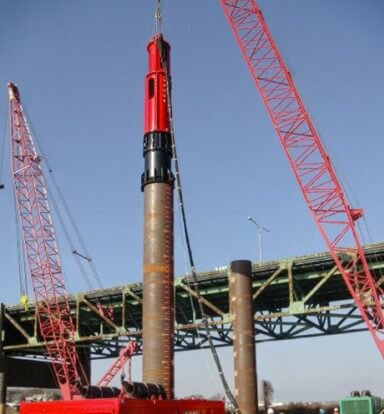
BRUCE Piling Equipment has supplied hydraulic impact hammers and vibratory hammers to projects across Asia, the Middle East, Europe, and the Americas. Documented US deliveries include the SGH-4719 on the Sakonnet River Bridge (Rhode Island), the SGH-3013 on the Hathaway Bridge (Florida), and the SGH-2015 on the Chincoteague Channel Bridge (Virginia) — all factory-direct from Korea to US project sites. Furthermore, BRUCE holds a designation as a Specialized Trading Company by the Korean Ministry of Trade, Industry and Energy, and is a member of the Korea International Trade Association — confirming the established export infrastructure required for reliable global delivery.
Logistics Package — What is Included:
- CIF or FOB Shipping Terms: Confirmed at order stage with transparent landed cost calculation for accurate budget submission to the project owner.
- Compliance Documentation: Certificates of origin, ISO 9001 certification documents, and technical specification sheets prepared as part of the export process.
- Technical Support: Model selection confirmation, power pack matching, and clamp specification verified by the engineering desk before dispatch.
While local hubs offer convenience, the cost to purchase a new hydraulic hammer must include an audit of the supplier’s ability to handle international duty estimates and port-to-site logistics. A “near me” search should always be secondary to factory-certified support backed by documented global project performance.
How to Select the Right Local Partner
STEP 1: VERIFY EQUIPMENT SPECIALIZATION
Confirm the supplier understands the specific hydraulic requirements of your carrier machine — auxiliary flow (lpm), operating pressure (bar), and case drain line routing. Not all general construction equipment suppliers carry specialized piling attachments. Furthermore, confirm that the supplier can specify the correct matched PQ series power pack for the specific SGH or SGV model — a mismatched power pack is the most common cause of underperformance on first deployment and results in immediate unplanned downtime on active project sites.
STEP 2: CHECK CONSUMABLE PARTS AVAILABILITY
Confirm that consumable parts — elastomer rubbers, clamp cylinder seals, hydraulic fittings, and drive cap cushions — are specified by part number in the operation manual and available from qualified suppliers. Pre-ordering a consumable parts stock before project mobilization eliminates unplanned downtime caused by consumable depletion on active sites. Additionally, verify that the case drain line routing is documented in the installation diagram and that the correct hydraulic fittings are included in the initial parts package.
STEP 3: EVALUATE TECHNICAL SUPPORT CAPABILITY
Effective operation requires specific knowledge of hydraulic flow settings, case drain installation, and clamp jaw selection. Choose a partner that provides operation manuals, technical specification sheets, and direct engineering desk access for troubleshooting. Additionally, confirm that commissioning support is available to verify hydraulic matching before the machine enters service — ensuring the case drain, operating pressure, and clamp jaw configuration are all confirmed against the project pile schedule before first deployment.
04. Why New Equipment Outperforms Local Used Markets
The search for “hydraulic hammers near me” often leads to used equipment listings. However, in foundation engineering, pre-owned units carry risks that are undetectable without full disassembly — micro-fractures in eccentric shafts, degraded elastomers in the suppressor housing, and hydraulic contamination from metal particulates generated by worn gearbox components. We do not sell or support used equipment because these defects surface under operational load and cannot be resolved without taking the machine fully offline.
Gearbox Harmonic Drift — The Used Equipment Risk
In used vibratory hammers, worn bearings and degraded gear tooth profiles cause harmonic drift — operating frequency drops progressively under soil load. Consequently, soil liquefaction collapses at depth, the pile stalls, and the operator increases line pull to compensate. This combination is the primary cause of pile fracture at weld joints during extraction on pre-owned equipment. New machinery with factory-calibrated eccentric weight assemblies and verified bearing specifications eliminates this failure mode entirely from the first day of site operation.
Compliance and Energy Verification
By investing in new machinery, contractors secure factory-certified hydraulic specifications and the verified energy documentation required for ASTM D4945 and ICE/BS EN compliance on government-funded contracts. Used units without documented maintenance histories cannot reliably satisfy these audit requirements — leading to expensive project stoppages and structural re-testing on federally funded US bridge and highway contracts.
Regional Procurement FAQ
Q: Why should I buy a new hydraulic hammer instead of a used one found locally?
“New units provide factory-verified hydraulic specifications, known consumable schedules, and compliance documentation — eliminating the hidden risks of gearbox harmonic drift and hydraulic contamination in pre-owned equipment.”
Used units carry micro-fractures and gearbox wear that are undetectable without full disassembly and surface under operational load — causing pile stall, frequency drop, and unplanned downtime that erodes project margins faster than any initial cost saving from a lower purchase price.Q: Is global shipping available for procurement outside the US and UK?
“Yes — BRUCE Piling Equipment supplies factory-direct to projects in over 80 countries, with CIF or FOB shipping terms confirmed at order stage.”
Shipping documentation, certificates of origin, and technical compliance documents are prepared as part of the export process. The manufacturer has established logistics channels to major ports across Asia, the Middle East, Europe, and the Americas from the Siheung, Korea factory.Q: Can I get custom clamp configurations for non-standard pile profiles?
“Yes — Universal Sheet Pile Clamps (60U to 320U) and Casing Pile Clamps (2x40D to 4x160D) cover the full range of standard pile profiles. Custom jaw configurations are available on request for special pile geometries.”
Clamp jaw type is confirmed at order stage based on the specific pile profile in the project schedule. Furthermore, for projects requiring both sheet pile and casing pile work across different construction phases, the same hammer body can be reconfigured with a different clamp — maximizing equipment versatility across the full project lifecycle.Q: What documentation supports ASTM D4945 and ICE compliance for import purposes?
“ISO 9001 certification, technical specification sheets, operation manuals, and optional IEA energy monitoring capability documentation are available for all new equipment.”
For US federally funded projects, the IEA system provides verifiable energy transfer data at every blow — satisfying ASTM D4945 structural auditing requirements. For UK projects, the elastomer suppressor isolation system and biodegradable oil compatibility documentation satisfy ICE specifications and Environment Agency permit requirements. Additionally, government recognition documentation — Presidential Citation (2021) and Prime Minister Citation (2017) — is available as supplementary credibility support for formal procurement submissions.