Hydraulic Pile Hammer Purchase Cost:
2026 Global Engineering & CAPEX Report
“STRATEGIC AUDIT OF CAPITAL EXPENDITURE FOR DEEP FOUNDATION IMPACT DRIVERS”
01. Key Drivers of CAPEX Estimations
Evaluating purchase cost for a new hydraulic pile hammer in 2026 requires a multidimensional analysis of engineering specifications. Unlike standard machinery, a hydraulic impact hammer’s price is primarily a function of its ram weight, maximum stroke, and rated impact energy. Consequently, the mass of the ram and the hydraulic circuit efficiency are the primary metrics that dictate the total acquisition cost — and these must be matched to the actual soil conditions and pile specifications of the target project before committing to a procurement budget.
Need to finalize your 2026 infrastructure bid?
Review our Master Bidding Strategy & Global Cost Estimate Guide.
SGH Series — What Drives the Cost Differential
The BRUCE SGH series spans ram weights from 7 tons (SGH-0712) to 47 tons (SGH-4719) and energies from 12 kNm to 1,178 kNm. As ram weight and maximum stroke increase, the cost scales accordingly — driven by the higher-grade alloy steel required for the ram body, the larger hydraulic cylinder, the matched PQ series power pack, and the more robust leader or suspension configuration. Furthermore, a complete cost estimate must include the matched power pack, drive cap configuration for the specific pile type, and hose bundle length — items that are frequently excluded from initial quotations but represent a meaningful portion of the total landed cost.
Accumulator and Remote Control System
The accumulator assembly — which assists in absorbing hydraulic shocks and maintaining consistent ram speed — is a factory-standard component on the SGH series. The remote control system, which provides adjustable stroke control, digital blow counter, dwell control, and emergency stop, is also standard. Additionally, the optional IEA (Impact Energy Analysis) system — which records real-time energy at every blow and supports ASTM D4945 structural auditing — is specified as an add-on at order stage. Including the IEA system in the initial cost estimate prevents separate procurement of dynamic load test monitoring equipment later in the project lifecycle.
02. Cost Drivers by Rated Energy and Model Class
For industrial procurement, hydraulic impact hammers are categorised by their maximum impact energy. These tiers help project managers align their capital budgets with the required soil penetration capability and pile type. Consequently, understanding what drives cost within each tier — rather than relying on generic market price ranges — is the most reliable foundation for a defensible CAPEX estimate.
Light to Medium Energy Class (SGH-0712 to SGH-1815)
Models in this range cover ram weights from 7 to 18 tons and energies from 8.4 kNm to 27 kNm. They are typically deployed for precast concrete cylinder piles, PHC piles, and smaller casing pile work in building foundation and light bridge applications. Drive cap sizes and cushion materials vary by pile head geometry — confirming compatibility at order stage prevents site-level delays. Furthermore, power pack requirements for this class are lower-output PQ models, reducing the total package cost compared to heavy-duty configurations.
Heavy to Ultra-Heavy Energy Class (SGH-2015 to SGH-4719)
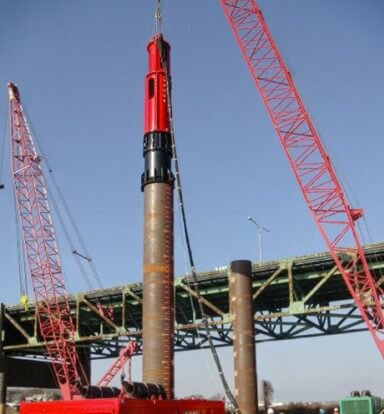
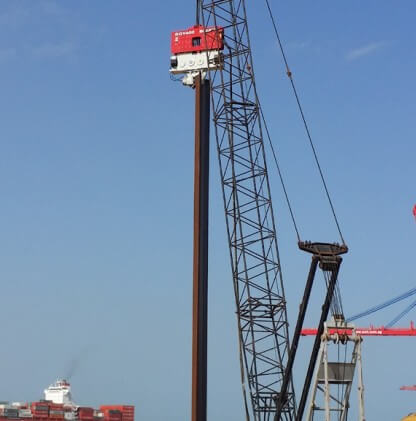
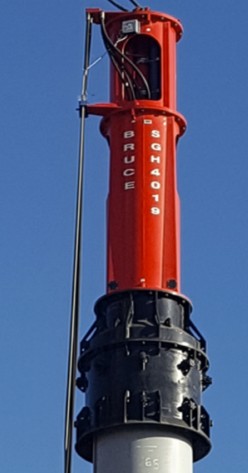
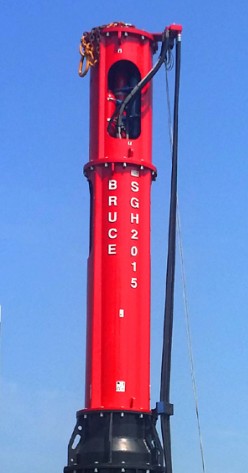
Models in this range cover ram weights from 20 to 47 tons and energies from 30 kNm to 89.3 kNm. They are required for large-diameter steel casing piles, offshore bridge foundations, and port expansion piling. The SGH-4719 (47-ton RAM, PQ-1200 power pack) drove 72-inch diameter steel casing pipes to over 200 feet on the Sakonnet River Bridge — the largest single contract in RI DOT history at USD 163.7M. Consequently, the total package cost for this class includes a matched high-output power pack, Long Pile Skirt mounting configuration, and extended hose bundles — all of which must be specified at order stage for an accurate CAPEX estimate.
03. US & UK Market: Compliance Costs
In the United States, a new hydraulic pile hammer deployed on federally funded bridge and highway projects must support ASTM D4945 dynamic testing compliance. The optional IEA energy monitoring system — developed by BRUCE and adopted by the Hong Kong Housing Government as a standard system — provides the real-time blow energy data required by DOT structural auditors. Including this option in the initial procurement cost eliminates the need for separate third-party dynamic load test equipment on compliance-critical contracts.
“The total cost to purchase a new hydraulic hammer in the UK must factor in BS EN 12699 compliance documentation and BS 5228 noise management requirements. The optional Silence Cap Housing Kit on the SGH series addresses noise ordinance requirements for urban England sites.”
UK Stroke Control and Urban Protection
UK contractors operating under Network Rail or Highways England standards consistently prioritize equipment with real-time adjustable stroke control. The BRUCE SGH series remote control system provides stroke adjustment from minimum to maximum in real time from the rig cabin — protecting precast concrete sections from over-stressing during initial driving near existing foundations. Furthermore, biodegradable hydraulic oil compatibility — confirmed across all BRUCE hydraulic components — satisfies UK Environment Agency permit conditions for piling near watercourses without post-procurement modification.
Engineering Procurement FAQ
Q: What information is needed to obtain an accurate hydraulic pile hammer purchase cost estimate?
“Provide pile type, pile head geometry, outer diameter, soil bore log N-values, design tip elevation, and compliance requirements.”
This data allows the engineering desk to confirm the correct SGH model, matched PQ power pack, drive cap configuration, mounting type, and any compliance add-ons (IEA system, Silence Cap, biodegradable oil specification). Consequently, confirming the destination port enables accurate CIF or FOB shipping cost calculation for a complete landed cost estimate.Q: What is the energy range of the BRUCE SGH hydraulic impact hammer series?
“The SGH series covers 12 kNm (1.2 ton.m) to 1,178 kNm (120 ton.m), with ram weights from 7 tons to 47 tons — larger models available on request.”
This full range covers light building foundation piling through to major offshore bridge structures. Mounting configurations include Fixed Leader, Crane Suspended, U-Type Leads, and Offshore Leader. Furthermore, all models are matched to specific PQ series power packs — the power pack model must be confirmed at order stage for an accurate total package cost estimate.Q: Does the purchase cost include shipping to US and UK ports?
“Factory-direct quotes from Siheung, Korea include CIF or FOB shipping terms — providing transparent landed cost calculation for project budget submission.”
Shipping documentation, certificates of origin, and compliance technical documents are prepared as part of the export process. The manufacturer has an established logistics track record supplying equipment to projects across Asia, the Middle East, Europe, and the Americas — including documented deliveries to major US bridge projects in Rhode Island, Florida, and Virginia.Q: Why is the IEA energy monitoring system worth including in the initial purchase cost estimate?
“Including the IEA system upfront consolidates the ASTM D4945 energy monitoring requirement into a single procurement — eliminating separate third-party monitoring equipment costs later in the project.”
The IEA system records real-time impact energy at every blow and provides the energy transfer log required for structural auditing on federally funded bridge and highway contracts. It has been adopted as a standard system by the Hong Kong Housing Government and applied on major US and Korean infrastructure projects. Consequently, specifying it in the initial CAPEX estimate provides full compliance transparency to project owners from the outset.Geotechnical Engineering Standards: