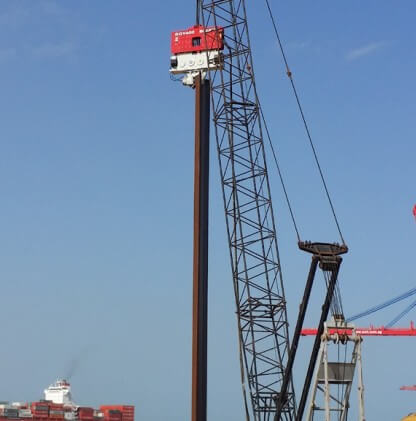
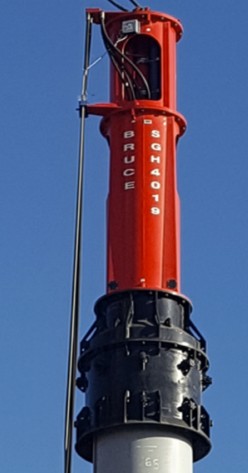
Excavator Vibro Hammer:
Engineering Mechanics & Soil Guide 2026
“OPTIMIZING HYDRAULIC POWER DENSITY AND SOIL LIQUEFACTION EFFICIENCY”
“The integration of an excavator vibro hammer is a precision balancing act between the carrier’s auxiliary hydraulic capacity and the soil’s critical hydraulic gradient. Understanding this kinetic synergy is the key to maximizing penetration in diverse strata.”
01. Kinematics: The Science of High-Frequency Vibration
The excavator vibro hammer operates on the principle of induced soil liquefaction. By rotating eccentric weights at high velocity, the hammer generates vertical oscillations that temporarily reduce the effective stress in granular and silty strata. Consequently, this allows for rapid pile penetration with minimal downward crowd force — making excavator-mounted vibratory hammers significantly faster than impact hammers in suitable soil conditions.
TECHNICAL FOUNDATION
To understand the fundamental physics of these oscillations, review the Complete Meaning and Mechanics of Vibration Technology in our technical pillar.
Eccentric Moment and Amplitude
The effectiveness of an excavator-mounted vibro hammer depends on two interconnected parameters. Eccentric moment determines the amplitude of vibration — the physical vertical displacement of the pile per cycle. Centrifugal force determines the penetration capability against soil resistance. As a general selection rule, centrifugal force should be at least 15 times the pile weight. Furthermore, achieving the correct amplitude is vital to breaking adhesion in stiff clays without generating excessive boom stress in the carrier structure.
High-Frequency Operation and Excavator Compatibility
Excavator-mounted vibro hammers typically operate at higher frequencies than crane-suspended models — up to 3,100 to 3,300 vpm depending on the model. This higher frequency range is achievable because the excavator’s hydraulic system delivers flow directly to the hammer motor without the long hose runs associated with crane-suspended power packs. However, the host machine’s auxiliary circuit must be confirmed against the hammer’s rated flow (lpm) and pressure (bar) before deployment, as under-flow causes frequency decay and pile stall under load.
02. Hydraulic Integration: Carrier Pressure Optimization
Unlike crane-suspended units, an excavator vibro hammer draws power directly from the carrier’s auxiliary hydraulic lines. This requires precise flow and pressure matching. If the flow exceeds the hammer’s motor rating, it leads to excessive heat generation and seal failure. Conversely, insufficient pressure results in frequency stalling when encountering resistive strata such as dense gravel or glacial till.
Case Drain Line — The Non-Negotiable Connection
The most critical hydraulic connection in any excavator-mounted vibro hammer installation is the case drain line. This line routes from the hammer’s hydraulic motor housing directly to the excavator’s hydraulic tank — not to the return line. Any restriction in the case drain path causes internal motor pressure to build, destroying the shaft seals and requiring full motor replacement. Therefore, this connection must be verified as a dedicated, unrestricted path to tank before every deployment.
Real-Time Flow Control via Remote Pendant
Current-generation excavator vibro hammers include a remote control pendant with a flow adjust volume dial. This allows the operator to adjust pump flow — and therefore centrifugal force and frequency — in real time from the excavator cab. In practice, this means the operator can reduce frequency in soft layers to prevent over-driving, and increase it in dense strata to maintain penetration rate. Moreover, monitoring hydraulic oil temperature during the first 30 minutes of operation is standard practice — if temperature rises abnormally, flow should be reduced incrementally until the system stabilizes.
03. Soil Mechanics: Breaking Molecular Adhesion
Foundation engineering in the United States and United Kingdom demands a thorough understanding of soil-structure interaction. While sandy and granular soils liquefy readily under vibration, stiff clays require high-amplitude kinetic energy to break the cohesive bond between particles. Furthermore, the pile age matters — longer-installed piles have undergone greater soil consolidation and require higher centrifugal force to initiate movement.
Soil Type and Model Selection
The soil SPT N-value is the primary benchmark for selecting the appropriate excavator vibro hammer model. In loose sand and silt (N-value 0–15), a mid-range model with moderate centrifugal force drives quickly and efficiently. In medium-dense conditions (N-value 15–30), a higher centrifugal force model is needed to maintain penetration rate. In stiff clay and dense sand (N-value 30–50), a high-amplitude model is required — and if refusal occurs, transitioning to a hydraulic impact hammer for final set is standard field protocol.
Preventing Soil Damping
A professional excavator vibro driver utilizes variable-frequency control via the remote pendant to match energy output to actual soil resistance at every depth. This prevents soil damping — where the ground absorbs the vibration energy rather than liquefying — by allowing the operator to adjust frequency in response to penetration rate changes observed during the drive. In addition, this variable control directly supports compliance with ASTM and BS EN vibration management requirements on urban infrastructure sites.
How to Match a Vibro Hammer to Your Excavator
1. CONFIRM EXCAVATOR WEIGHT CLASS
Excavator-mounted vibro hammers are designed for specific carrier weight ranges. For example, SGV-40 and SGV-60 models are built for 20 to 50 ton excavators. Deploying on an undersized carrier risks structural stress on the excavator boom and insufficient downforce to assist penetration in dense soil. Specifically, confirm the host machine’s operating weight against the hammer’s rated excavator range before mobilization — this is a non-negotiable step.
2. VERIFY AUXILIARY HYDRAULIC LIMITS
Match the carrier’s auxiliary flow (lpm) and pressure (bar) to the hammer’s motor rating. Furthermore, confirm that the case drain connection point is accessible and that the drain line can be routed directly to the hydraulic tank without restrictions. For excavators in the 20–35 ton range, auxiliary flow typically ranges from 210 to 350 lpm — confirm this against the specific hammer model’s rated demand before specifying the equipment.
3. SELECT CLAMP JAW BY PILE PROFILE
Confirm the clamp jaw profile against your sheet pile geometry before mobilization. Z-piles and U-piles require different jaw geometries to achieve reliable lateral grip. In addition, for projects involving both sheet piles and casing piles across different construction phases, confirm that jaw changeovers can be completed on site without specialized tooling to avoid downtime between pile types.
Technical FAQ
Q: Can an excavator vibro hammer penetrate stiff clay such as London Clay or Texas hard-pan?
“Yes — with a high eccentric moment model that maintains frequency under the increased resistive load of cohesive strata.”
Stiff clays require high-amplitude vibrations to break cohesive particle bonding progressively. The key is maintaining stable operating frequency throughout the drive — if frequency drops under load, the liquefaction effect collapses and the pile stalls. Furthermore, if refusal occurs in very stiff clay layers, transitioning to a hydraulic impact hammer for final set is the standard field protocol used on major bridge and infrastructure projects.Q: What is the difference between a crane-suspended and an excavator-mounted vibro hammer?
“Crane-suspended models offer higher centrifugal force for heavy offshore and deep foundation work. Excavator-mounted models offer faster repositioning and simpler setup for urban and confined site applications.”
Excavator-mounted models connect directly to the host machine’s hydraulic supply — no separate power pack is required. As a result, mobilization is faster and site setup is simpler. However, the centrifugal force range of excavator-mounted models is limited by the host machine’s hydraulic output. For heavy casing piles in offshore or bridge projects, crane-suspended models covering up to 4,610 kN are required.Q: How does the tilting function on an excavator vibro hammer improve productivity?
“The 90° hydraulic tilt and 360° rotation allow a single operator to pick up a pile, position it vertically, and begin driving — without a secondary crane or ground crew.”
On tilting models such as the SGV-40T and SGV-60T, the operator picks the pile from the ground stack, tilts it into the vertical drive position using the hydraulic tilt function, aligns it precisely using 360° rotation, and begins driving — all from the excavator cab. Consequently, this eliminates the need for a separate crane for pile positioning and reduces the number of personnel required in the active pile zone, improving safety on congested urban sites.Q: Can an excavator vibro hammer also extract piles after installation?
“Yes — extraction is one of the primary advantages of a vibratory hammer over an impact system.”
During extraction, the hammer clamps onto the pile and vibrates while the excavator applies upward crowd force. The vibration temporarily reduces skin friction along the pile shaft, allowing withdrawal with significantly lower pull force than static extraction methods. This makes excavator-mounted vibro hammers the standard choice for temporary works — cofferdams, trench shoring, and sheet pile walls — where piles must be removed and reused after construction.