Hydraulic Pile Hammer Engineering:
UK Infrastructure Standards 2026
“TECHNICAL ANALYSIS OF BS EN 12699 COMPLIANCE AND REGIONAL SOIL IMPEDANCE”
“Engineering excellence in the United Kingdom requires a granular understanding of the Institution of Civil Engineers (ICE) piling specifications. In 2026, a hydraulic impact hammer is measured by its energy transfer consistency, its adjustable stroke capability, and its surgical precision in London Clay and Midlands Mudstone.”
01. UK Piling Taxonomy & Infrastructure Terminology
In the United Kingdom civil engineering sector, the hydraulic pile hammer is the primary tool for driving precast concrete piles and steel tubes on major infrastructure works. Selection is dictated by the hammer’s ability to deliver consistent transferred energy — reaching specified bearing capacity at design tip elevation without over-stressing pile sections — for projects on the Strategic Road Network (SRN) managed by National Highways and Network Rail track-side developments.
TECHNICAL PILLAR HUB
How does impact driving efficiency compare to side-grip versatility in urban UK sites? Review the Side Grip Technology Guide for Urban Shoring.
Impact Hammer vs. Vibratory — When UK Projects Require Impact
Unlike vibratory methods, hydraulic impact hammers are required when piles must be set into resistive strata — such as the Chalk of the South Downs, the Mercia Mudstone of the Midlands, or dense gravel at refusal depth. Furthermore, final bearing capacity verification by blow count — mandatory on National Highways and Network Rail foundation contracts — can only be achieved with an impact hammer, as vibratory methods do not provide the discrete blow count data required for structural pile certification.
SGH Series — UK Foundation Application Range
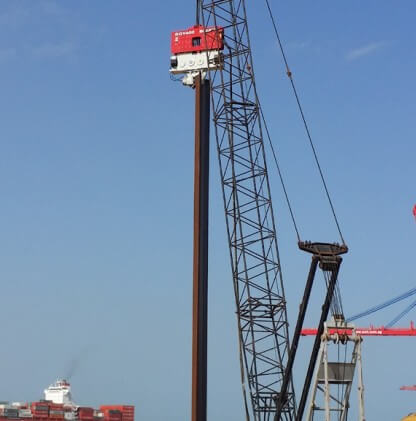
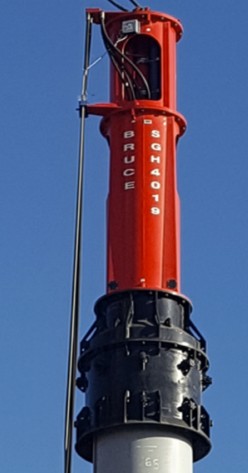
The BRUCE SGH series covers energies from 12 kNm (1.2 ton.m) to 1,178 kNm (120 ton.m), with ram weights from 7 tons to 47 tons. Pile types driven include round, square, and octagonal precast concrete piles, H-beam piles, steel casing piles, and sheet piles. Mounting configurations include Fixed Leader, Crane Suspended, U-Type Leads, and Offshore Leader — covering the full range of UK foundation project types from urban building foundations through to offshore bridge piling.
02. Mechanics of Hydraulic Impact: Stroke Control & Energy Transfer
The fundamental operating principle of a high-performance hydraulic pile hammer is controlled energy delivery — raising the ram to a precise stroke height and releasing it to generate a compressive stress wave that travels down the pile shaft, overcoming skin friction and end-bearing resistance at the pile tip. By precisely managing the stroke height and ram acceleration via the remote control system, operators can deliver consistent blow energy across the full drive cycle.
Remote Control System — UK Operational Functions
The BRUCE SGH series remote control system provides adjustable stroke from minimum to maximum in real time from the rig cabin. Standard functions include digital blow counter, dwell control, automatic cut-off circuit breaker, and emergency stop. High-brightness LED indicators monitor abnormalities during operation. Consequently, operators can manage energy delivery in real time without stopping the drive cycle — allowing progressive stroke reduction near sensitive Victorian-era structures and gradual increase as pile embedment depth increases.
Drive Cap, Cushion, and Striker Plate — Energy Transfer at the Pile Head
The drive cap must match the pile head geometry — round, square, octagonal, and H-beam piles each require a distinct cap profile and cushion material. The cushion transmits the kinetic stress wave from the hammer into the pile shaft while protecting the pile head from peak impact force. Furthermore, using new equipment ensures that the striker plate and anvil alignment have not been compromised by off-centre strikes — a progressive failure mode in pre-owned hammers that reduces energy transfer efficiency and can fracture concrete pile heads in hard driving conditions.
03. Regulatory Compliance: BS EN 12699 & BS 5228
All hydraulic pile hammer operations in the United Kingdom must comply with BS EN 12699 (Execution of Displacement Piles). Furthermore, the Institution of Civil Engineers (ICE) Specification for Piling requires hammers to be correctly sized to prevent over-stressing pile materials during the driving cycle — a requirement directly satisfied by the SGH series’ real-time adjustable stroke control.
BS 5228 Noise Compliance — Silence Cap Housing Option
Noise and vibration control in England is governed by BS 5228, with Section 61 consent requirements applying to urban construction sites in London, Birmingham, and Manchester. BRUCE hydraulic impact hammers produce significantly lower noise than diesel hammers as a baseline. Furthermore, the optional Silence Cap Housing Kit — available on the SGH series — reduces noise emissions for the most stringent urban Section 61 requirements, providing a factory-specified noise reduction option that is verified before site deployment rather than requiring a post-purchase retrofit.
Biodegradable Oil Compliance — UK Environment Agency Requirements
UK Environment Agency permit conditions for piling operations in or near watercourses increasingly require non-toxic, biodegradable hydraulic fluids. All BRUCE hydraulic components are confirmed compatible with biodegradable hydraulic oils — meeting these permit requirements without post-procurement modification. Additionally, BRUCE equipment produces no smoke during operation, directly reducing the environmental monitoring burden on UK urban and riverside construction permit applications.
“We strictly provide NEW equipment for UK infrastructure because used diesel or poorly maintained hydraulic hammers fail the modern environmental audits required for residential-adjacent construction in Manchester and Leeds — particularly where BS 5228 Section 61 consent and Environment Agency permit conditions apply simultaneously.”
04. Regional Soil Impedance: London Clay to Chalk
UK field engineers must adapt energy delivery to specific regional geologies. Consequently, hammer model selection — ram weight, maximum stroke, and drive cap specification — must be confirmed against the project soil bore log before procurement.
South East (London Clay)
Stiff over-consolidated London Clay requires high ram energy to overcome end-bearing resistance at the pile tip. New equipment provides consistent blow energy at every stroke — allowing accurate blow count monitoring for final set verification. Furthermore, reducing stroke during initial driving near adjacent Victorian-era foundations protects existing structures during the most vulnerable phase of the drive.
Midlands (Mercia Mudstone)
Mercia Mudstone requires careful stroke management — excessive impact energy causes pile heave in the softer upper horizons and cracking of precast concrete heads in harder bands. The SGH series remote control allows real-time stroke reduction when refusal is approached, preventing pile head damage and protecting the structural integrity of the driven section during final set.
IEA Energy Monitoring — UK Structural Audit Support
For UK projects where energy transfer must be formally documented — including major National Highways SRN contracts and Network Rail foundation upgrades — the optional IEA (Impact Energy Analysis) System records real-time energy at every blow. Developed by BRUCE and adopted as a standard monitoring system by the Hong Kong Housing Government, the IEA provides the energy transfer log required by structural auditors on projects where pile capacity must be formally certified. Consequently, including the IEA system in the initial procurement specification eliminates the need for separate third-party monitoring equipment and reduces total project procurement complexity.
UK Technical FAQ
Q: Are hydraulic impact hammers suitable for Network Rail piling works near live tracks?
“Yes — the SGH series’ real-time adjustable stroke control allows energy reduction during initial driving near live track assets, protecting sensitive signaling equipment from peak impact forces.”
Furthermore, BRUCE hydraulic impact hammers produce no smoke and significantly lower noise than diesel hammers — reducing the environmental monitoring burden on Network Rail work site permits. The optional Silence Cap Housing Kit can be specified for the most stringent track-adjacent noise ordinance requirements.Q: How does the SGH series satisfy the ICE Specification for Piling requirements?
“The SGH series satisfies ICE Specification requirements through correct sizing against pile material and soil resistance, real-time stroke adjustment, and optional IEA energy monitoring.”
ICE Specification requires hammers to be correctly sized to prevent over-stressing pile sections — confirmed through the model selection process using pile weight, soil bore log N-values, and design tip elevation. Additionally, the optional IEA system provides the verifiable energy transfer log required for structural pile certification on major UK civil engineering contracts.Q: What is the Silence Cap Housing Kit and when is it required on UK urban projects?
“The Silence Cap Housing Kit is a factory-specified optional component for the SGH series that reduces noise emissions for projects requiring BS 5228 Section 61 consent in London, Birmingham, or Manchester.”
It is specified at order stage as a factory option — not a field retrofit — ensuring the noise reduction specification is verified before site deployment. Furthermore, BRUCE hydraulic impact hammers already produce significantly lower baseline noise than diesel hammers, so the Silence Cap option is typically required only on the most stringent residential-adjacent urban sites.Q: How does hydraulic oil compatibility affect UK coastal and riverside piling permits?
“UK Environment Agency permit conditions for piling near watercourses increasingly require biodegradable hydraulic fluids — all BRUCE hydraulic components are confirmed compatible without modification.”
This compatibility is confirmed in the manufacturer’s technical documentation and is available as a standard specification item on the export compliance documentation package. Consequently, procurement teams can include biodegradable oil specification in the initial cost estimate without requiring post-purchase equipment modification or hydraulic circuit adaptation.