Hydraulic Pile Hammer:
The Definitive US Engineering Guide
“INTEGRATING FHWA-NHI-16-009 STANDARDS AND ASTM D4945 DYNAMIC MONITORING”
“Deep foundation projects in the United States are governed by kinetic precision. In 2026, a hydraulic impact hammer is no longer just a drop weight; it is a calibrated instrument for satisfying AASHTO LRFD bridge design specifications and federal geotechnical audits.”
01. US Piling Taxonomy & Kinetic Nomenclature
In the United States heavy construction and geotechnical engineering landscape, the hydraulic pile hammer is formally categorized as an externally powered impact driving system. Unlike the internal combustion cycle of legacy diesel hammers, a hydraulic system utilizes a pressurized fluid medium to elevate a ram of specified mass to a controlled stroke height — generating consistent potential energy that is converted to kinetic force at the pile head with each blow.
TECHNICAL PILLAR HUB
How does impact energy compare to side-grip kinematics in US urban shoring? Review the Side Grip Technology Guide for Urban and Restricted Sites.
SGH Series — US Foundation Application Range
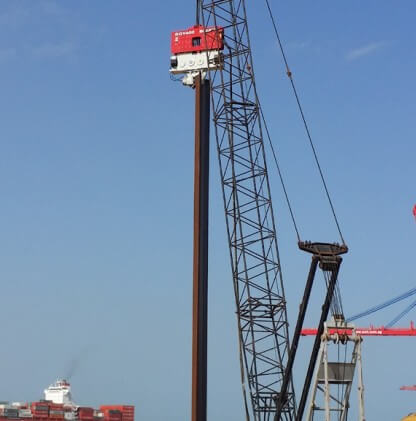
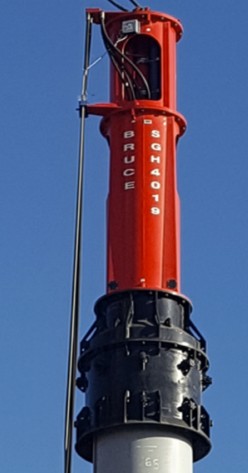
The BRUCE SGH series covers energies from 12 kNm (1.2 ton.m) to 1,178 kNm (120 ton.m), with ram weights from 7 tons (SGH-0712) to 47 tons (SGH-4719). Pile types driven include round, square, and octagonal precast concrete piles, steel casing piles, H-beam piles, and sheet piles. Mounting configurations include Fixed Leader, Crane Suspended, U-Type Leads, and Offshore Leader — covering the full range of US bridge, port, and coastal foundation project types. Furthermore, engineering firms prioritize new equipment because pre-owned units with internal hydraulic bypass generate erratic stroke heights that fail the energy repeatability audits required by State DOT inspectors.
Documented US Federal Bridge Project References
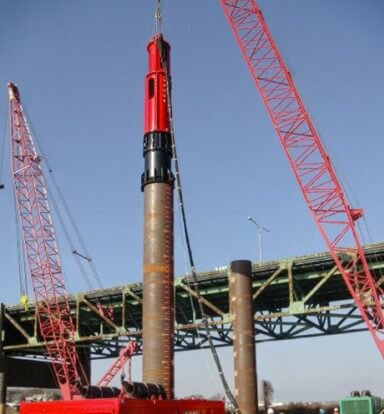
BRUCE has documented performance on multiple major US federally funded bridge contracts. The SGH-4719 drove 72-inch steel casing pipes to over 200 feet on the Sakonnet River Bridge (Rhode Island) — the largest single DOT contract in RI DOT history at USD 163.7M, cited in Providence Journal and confirmed by official RI DOT announcement. Additionally, the SGH-3013 drove 60-inch precast concrete cylinder piles on the Hathaway Bridge (Florida), documented in a Florida State University engineering thesis. The SGH-2015 was used by SKANSKA USA on the Williamsburg Bridge (Virginia) and by American Bridge Company on the Chincoteague Channel Bridge (Virginia), with the latter published in Pile Driving Association Magazine.
02. FHWA Regulatory Framework: NHI-16-009 Baseline
The Federal Highway Administration (FHWA) manual FHWA-NHI-16-009 serves as the reference framework for driven pile foundation design and installation in the United States. Under these guidelines, hydraulic pile hammer performance must be a verifiable data point recorded during the driving cycle — requiring the energy transfer at each blow to be documentable by field instrumentation for DOT project auditing.
IEA System — FHWA and State DOT Energy Documentation
The optional IEA (Impact Energy Analysis) System — developed by BRUCE — records real-time energy at every blow, providing the verifiable energy transfer log required for DOT structural auditing on federally funded contracts. Field measurements on SGH-1015 and SGH-1415 deployments confirmed energy transfer rates of up to 90% — providing the quantitative baseline for GRLWEAP wave equation analysis and dynamic load test planning on AASHTO LRFD bridge projects. Furthermore, including the IEA system in the initial procurement specification consolidates the monitoring requirement into a single factory-direct purchase rather than sourcing separate third-party instrumentation after contract award.
Remote Control System — Adjustable Stroke for US DOT Compliance
The BRUCE SGH series remote control system allows adjustment from minimum stroke to maximum in real time from the rig cabin. Standard functions include digital blow counter, dwell control, automatic cut-off circuit breaker, and emergency stop. Consequently, operators can modulate impact energy in real time — reducing stroke during initial driving near existing bridge foundations and increasing it progressively as pile embedment depth increases. This precisely controlled stroke adjustment is the operational mechanism that protects precast concrete and steel casing pile heads from over-stressing during the most vulnerable initial driving phase on US DOT bridge replacement and expansion contracts.
03. ASTM D4945: High-Strain Dynamic Testing
Compliance with ASTM D4945 is mandatory for large-scale US infrastructure projects requiring verification of driven pile bearing capacity. This protocol involves a Pile Driving Analyzer (PDA) to measure force and velocity at the pile head during impact. A hydraulic pile hammer must deliver a consistent compressive stress wave — allowing PDA sensors to accurately calculate ultimate bearing capacity and soil resistance distribution.
Drive Cap and Striker Plate Integrity — Signal Quality for PDA
The quality of the PDA force-velocity signal depends directly on the alignment and condition of the striker plate and drive cap cushion. A misaligned striker plate — common in pre-owned hammers with worn ram guide bushings — introduces off-centre impact forces that distort the stress wave measured by PDA sensors, leading to inaccurate capacity readings and re-testing requirements. New equipment with factory-verified striker plate alignment eliminates this signal distortion risk from day one. Furthermore, the drive cap cushion must match the pile head geometry and be maintained within the manufacturer’s specified condition for consistent energy transfer throughout the project duration.
“Modern geotechnical audits in Texas and Virginia reject hammers with erratic internal ram alignment. A new, factory-certified unit ensures the striker plate delivers a perfectly vertical blow — preserving the structural integrity of the pile toe in abrasive glacial till and saturated coastal sands.”
Optimizing Piling for US DOT Bridge Projects
1. EXECUTE WAVE EQUATION MODELING (GRLWEAP)
Run pre-mobilization GRLWEAP simulations using the SGH model’s ram weight, maximum stroke, and rated energy to match hammer energy with the regional US soil impedance profile. For Houston clay or Florida coastal sands, this simulation confirms the minimum stroke required to achieve final set at design depth without pile head damage — preventing costly pile refusal caused by under-specified equipment selection. Furthermore, the IEA system’s field energy data can be used to calibrate and validate the GRLWEAP model against actual site conditions after mobilization.
2. VERIFY TRANSFERRED ENERGY VIA IEA MONITORING
Specify the optional IEA (Impact Energy Analysis) system to satisfy ASTM D4945 energy transfer documentation requirements on federally funded bridge and highway contracts. The IEA records real-time energy at every blow — providing the data required by DOT structural auditors to verify pile capacity formally. Additionally, field measurements on SGH series models confirmed energy transfer rates of up to 90% — data that directly supports AASHTO LRFD pile capacity certification without separate third-party PDA monitoring equipment.
3. ADJUST STROKE VIA REMOTE CONTROL FOR COASTAL TIDAL CONDITIONS
In intertidal coastal regions where soil resistance fluctuates with tidal water level, adjust stroke height via the remote pendant’s real-time control to maintain consistent blow energy as resistance changes. Reducing stroke during high-tide driving — when pore water pressure temporarily reduces effective stress and lowers pile resistance — prevents over-driving and pile head damage. Furthermore, real-time blow count monitoring via the digital counter allows operators to identify final set precisely without stopping the drive cycle for manual count verification.
US Technical FAQ
Q: Are BRUCE hydraulic hammers compliant with both FHWA and state-level DOT requirements?
“Yes — BRUCE SGH series equipment has been deployed on FHWA and State DOT-funded projects in Rhode Island, Florida, and Virginia, with documented performance on record.”
The optional IEA system provides the energy transfer documentation required for ASTM D4945 compliance on federally funded structural pile installations. Furthermore, the remote control system’s adjustable stroke capability satisfies AASHTO LRFD soft-driving requirements for protection of pile sections during initial driving on bridge foundation contracts.Q: Why prioritize hydraulic impact hammers over diesel hammers in urban US cities?
“Hydraulic impact hammers produce no smoke and lower noise than diesel hammers — directly reducing environmental monitoring burdens on urban EPA permit conditions in Los Angeles, New York, and Chicago.”
Additionally, real-time stroke adjustment via the remote control system provides the precision energy management required by urban project managers to protect adjacent structures during pile driving near existing building foundations. Furthermore, all BRUCE hydraulic components are compatible with biodegradable hydraulic oils — satisfying EPA coastal and riverside permit conditions where non-toxic hydraulic fluids are required.Q: What pile types and sizes has the BRUCE SGH series driven on US projects?
“Documented US deployments include 72-inch steel casing piles at 200+ feet depth (Sakonnet River Bridge, RI) and 60-inch precast concrete cylinder piles (Hathaway Bridge, FL).”
The SGH series handles round, square, and octagonal precast concrete piles, steel casing piles, H-beam piles, and sheet piles across the full energy range from 12 kNm to 1,178 kNm. Consequently, the full range of US bridge, port, and coastal foundation pile types and sizes is covered within a single product line with documented field performance references.Q: How does the accumulator assembly affect blow energy consistency on US DOT projects?
“The accumulator absorbs hydraulic shocks and maintains consistent ram speed across the full stroke — directly affecting energy transfer consistency at every blow.”
Proper accumulator pre-charge pressure — as specified in the operation manual — ensures the hammer delivers its rated energy consistently at each blow, rather than showing variance that would appear in the IEA energy log and require explanation to DOT structural auditors. Furthermore, lower hose vibration achieved through the high-quality accumulator assembly reduces stress on hydraulic connections during extended high-frequency driving cycles on large US bridge contracts.