Marine Vibratory Hammer:
Harbor & Coastal Project Excellence
“ENGINEERING RESILIENCE IN CORROSIVE AND HIGH-PRESSURE UNDERWATER ENVIRONMENTS”
“Operating in the intertidal zone is the ultimate test of foundation machinery. In 2026, a marine vibratory hammer is not defined by its weight, but by its ability to neutralize hydrostatic drag and resist chloride-induced oxidation.”
01. Underwater Kinematics & Soil Liquefaction
Operating a marine vibratory hammer in a harbor or coastal environment requires a thorough understanding of hydrostatic pressure and its effect on soil behavior. In saturated marine silts and coastal sands, the hammer must generate sufficient amplitude to displace water from the soil pores. This pore-water pressure elevation temporarily reduces the effective stress between soil particles — consequently allowing for rapid installation of sheet piles for quay walls, seawall reinforcements, and temporary cofferdams.
TECHNICAL PILLAR GUIDE
How does marine piling efficiency compare to urban shoring? Explore the Side Grip Technology Guide for Urban and Restricted Sites.
Hydrostatic Drag and Frequency Stability
Marine drivers must account for the drag force exerted by the surrounding water column on the vibrating hammer body. As submersion depth increases during tidal shifts, the resistive load on the hydraulic motor rises. Therefore, maintaining stable operating frequency under this additional load requires a high-torque hydraulic motor with sufficient power reserve. Frequency drop under load is the primary cause of pile stall in marine conditions — the soil liquefaction state collapses and the pile freezes mid-drive.
Crane-Suspended vs Excavator-Mounted in Marine Environments
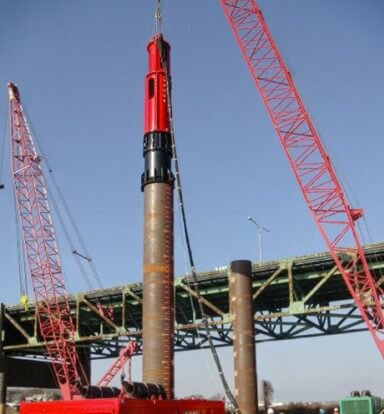
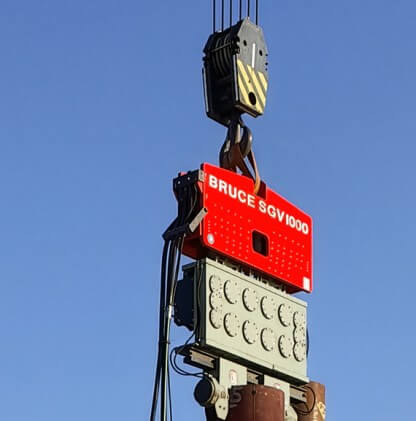
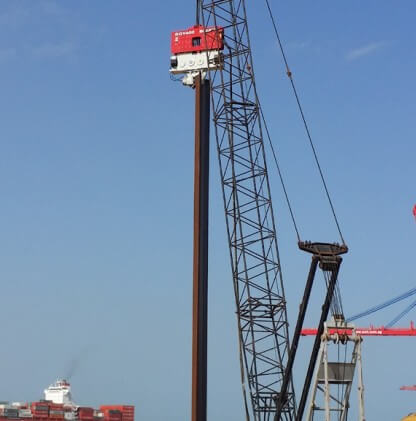
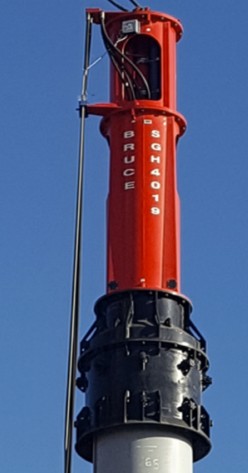
For large-scale harbor foundation work — port construction, offshore bridge foundations, and oil and gas storage piling — crane-suspended vibratory hammers provide the centrifugal force levels and vertical clearance that excavator-mounted units cannot reach. The crane-suspended configuration allows deployment from marine vessels and barges, with the suppressor assembly isolating vibration from the crane hook through elastomer rubbers. For smaller jetty and seawall work in accessible tidal zones, excavator-mounted models offer faster repositioning and simpler setup.
02. Corrosion Mitigation & Hydraulic Sealing
The saltwater environment is the most aggressive operating condition for foundation machinery. A professional marine vibratory hammer must be equipped with hydraulic seals rated for exposure to saline conditions. Salt ingress into the hydraulic system accelerates seal degradation and causes internal corrosion in the motor housing — ultimately leading to hydraulic failure that requires full motor replacement.
Biodegradable Hydraulic Oil — Environmental and Mechanical Necessity
In marine environments, hydraulic oil leakage carries a direct environmental risk. All hydraulic components on current-generation vibratory hammers are compatible with biodegradable hydraulic oils — meeting European and international environmental regulations. Moreover, biodegradable oils are increasingly required under coastal construction permits in both the US and UK, where any hydraulic fluid release into tidal water triggers environmental enforcement action. Using biodegradable-compatible equipment is therefore both a regulatory and operational necessity on harbor projects.
Gearbox Protection in Tidal Zones
The gearbox is the most vulnerable component during tidal submersion. As the hammer descends below the waterline, external water pressure acts on any gap or seal imperfection in the gearbox housing. Consequently, the gearbox must be sealed to prevent seawater displacement of the internal gear oil. In addition, hydraulic hoses routed along the hammer body must be protected against abrasion from marine debris and algae-covered steel pile surfaces — conditions that accelerate outer sheath wear and can cause hose failure mid-drive.
03. Coastal Compliance: USACE & UK Standards
Infrastructure work in coastal zones is governed by strict environmental and engineering mandates. In the United States, operations in navigable waters and tidal zones fall under the jurisdiction of the US Army Corps of Engineers (USACE). Permit conditions typically require specific vibration mitigation measures to protect sensitive marine habitats and aquatic species — particularly in estuarine environments with active fisheries or protected species zones.
UK Environment Agency Requirements
In the United Kingdom, the Environment Agency sets permit conditions for piling operations in estuary and coastal environments. These typically include silt curtain deployment to contain sediment disturbance, restrictions on working windows during fish migration periods, and requirements for non-toxic lubrication on all equipment in contact with the water column. Vibratory hammers compatible with biodegradable hydraulic oils directly satisfy this last requirement without additional equipment modification.
“We strictly provide NEW machinery for coastal infrastructure because the maintenance logs of used equipment are rarely verifiable for the environmental audits required by USACE or the UK Environment Agency.”
Underwater Acoustic Pressure Considerations
In both US and UK coastal permitting, underwater noise from piling operations is a growing regulatory focus. Vibratory hammers generate significantly lower underwater acoustic pressure compared to hydraulic impact hammers — making them the preferred method in environmentally sensitive marine zones. Furthermore, the ability to adjust frequency and amplitude via the remote control pendant allows operators to reduce vibration output in proximity to sensitive receivers without halting the drive cycle entirely.
How to Configure a Vibro Hammer for Jetty Work
1. AUDIT BARGE STABILITY & REACH
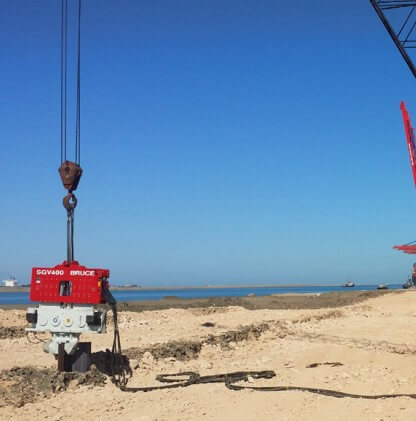
When working from a barge, the excavator’s center of gravity shifts dynamically as the hammer is extended over the water. Confirm the barge’s rated payload and stability margins against the combined weight of the excavator and hammer before deployment. Additionally, the excavator’s reach must be sufficient to position the hammer at the pile location without the barge requiring repositioning between each drive — repositioning on tidal water is time-consuming and affects the project schedule significantly.
2. VERIFY GEARBOX SEALING FOR TIDAL SUBMERSION
Confirm that the gearbox housing is sealed for the anticipated submersion depth at high tide. The case drain line must be routed to a point above the waterline to prevent siphoning of hydraulic fluid out of the motor housing during submersion. Furthermore, all external hydraulic hose connections must be inspected for seal integrity before marine deployment — salt water entry through a degraded hose fitting will contaminate the full hydraulic circuit.
3. SELECT CLAMP TYPE FOR MARINE PILE PROFILES
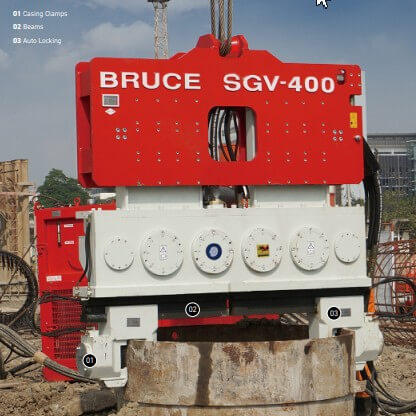
Marine sheet pile profiles — typically Z-piles or U-piles — require universal clamps with high-friction jaw inserts. Algae-covered and wet pile surfaces reduce jaw grip compared to dry onshore conditions. In addition, for casing pile work on harbor foundations, hydraulic auto-locking casing clamps maintain clamping force independently of hose pressure — preventing pile drop during tidal current surges that can momentarily shift the hammer position.
Maritime Operations FAQ
Q: Can a standard vibratory hammer be used in saltwater environments?
“Standard onshore vibratory hammers can be used in marine environments — however, saltwater exposure requires specific precautions for hydraulic sealing and gearbox protection.”
The primary risks are salt ingress into the gearbox through inadequately sealed housing and accelerated seal degradation in the hydraulic motor. Consequently, all hydraulic connections must be inspected before and after each marine deployment. Moreover, biodegradable hydraulic oil should be used to comply with coastal environmental permit requirements in both the US and UK.Q: How does tidal movement affect vibratory hammer performance?
“Tidal submersion increases the resistive load on the hydraulic motor — maintaining stable frequency under this additional drag is critical to preventing pile stall mid-drive.”
As the hammer descends below the waterline, hydrostatic pressure acts on the vibrating body and increases the torque demand on the motor. Furthermore, water resistance slows the eccentric weight rotation if the motor lacks sufficient power reserve. The remote control pendant’s flow adjust dial allows the operator to increase pump flow — and therefore centrifugal force — to compensate for the additional load during high-tide drives.Q: Is a vibratory hammer or hydraulic impact hammer better for marine piling?
“Vibratory hammers are preferred for marine sheet piling and temporary works. Hydraulic impact hammers are required for final set and bearing verification on permanent marine structures.”
In coastal sand and marine silt, vibratory hammers drive and extract piles quickly with low underwater noise — an important advantage under environmental permit conditions. For permanent bridge piers and harbor foundations where pile capacity must be structurally verified, a hydraulic impact hammer is required for final set. Additionally, the combined approach — vibro for initial penetration, impact for final bearing verification — is standard practice on major marine bridge projects.Q: What clamp type is required for marine sheet pile installation?
“Universal sheet pile clamps handle Z-piles and U-piles. Casing clamps with hydraulic auto-locking beams handle round pipe and casing piles — both are required for full marine foundation capability.”
In marine conditions, jaw grip is reduced by algae, wet steel surfaces, and marine growth on older piles. High-friction jaw inserts improve clamping reliability on wet pile profiles. Furthermore, hydraulic auto-locking casing clamps maintain clamping force independently of hose pressure — critical during tidal current surges that can shift the hammer position relative to the pile head.