Global Piling Fleet Strategy &
Pile Driver Machine Procurement Guide 2026
“STRATEGIC ASSET ALLOCATION AND TECHNICAL LIFECYCLE AUDITS FOR DEEP FOUNDATION INFRASTRUCTURE”
“A global piling fleet strategy is no longer just about owning machines; it is about maximizing the Energy Transfer Ratio per dollar of capital invested. In 2026, the shift toward factory-new, high-frequency assets is the only way to ensure project continuity and regulatory compliance in the US and UK markets.”
01. 2026 Global Piling Fleet Optimization Strategy
Developing a global piling fleet strategy in 2026 requires a transition from reactive maintenance to proactive asset lifecycle management. For Tier 1 contractors, the focus has shifted toward high-strain dynamic verification and emissions compliance. A modern fleet must be composed of new pile driver machines that offer standardized hydraulic circuits — ensuring that a unit deployed in a Texas harbor project performs with the same Energy Transfer Ratio as one in a London rail expansion.
Need to calculate the ROI of your next fleet expansion?
Review our Master Strategy for Infrastructure Bidding & Cost Estimation.
Modular Fleet Architecture
The economics of fleet management are driven by operational sync. When a firm standardizes on new vibratory or impact hammers from a single manufacturer, hoses, clamps, drive caps, and striker plates become interchangeable across models. This modular architecture — found only in factory-certified new inventory — simplifies spare parts logistics and eliminates the compatibility issues that arise when mixing pre-owned legacy components from different production generations.
Equipment Selection by Application
A well-structured fleet covers three core application categories. Vibratory hammers handle sheet piling, temporary cofferdams, and pile extraction in granular soils — where speed and low noise are the primary requirements. Hydraulic impact hammers are deployed for final set and bearing verification in hard strata, where blow count data is required by structural codes. Excavator-mounted vibro hammers provide mobility on confined urban sites where crane setup is impractical. Matching each machine class to its application prevents over-deployment of large capacity assets on tasks that do not require them — directly improving cost-per-pile metrics across the fleet.
02. Technical Specifications: New Pile Driver Machines
When reviewing pile driver machines for sale, procurement officers must look beyond raw tonnage. Value in 2026 is defined by force consistency — a new hydraulic hammer must maintain its eccentric moment and energy output across thousands of continuous operating hours without the harmonic degradation that accumulates in used machinery with worn bearings and fatigued gearbox components.
Vibratory Hammer Key Parameters
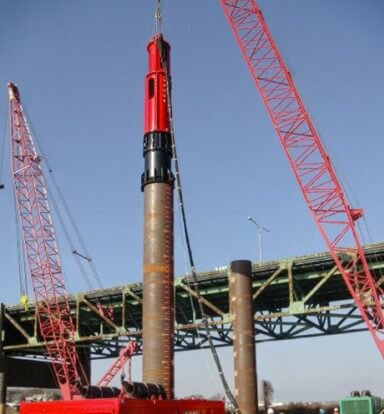
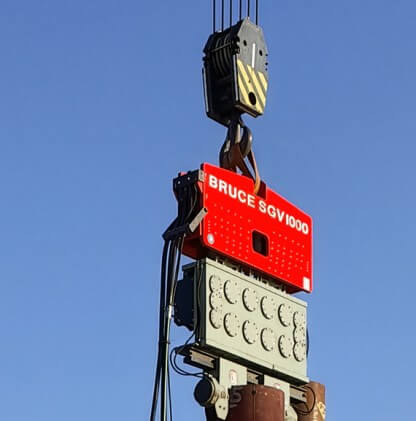
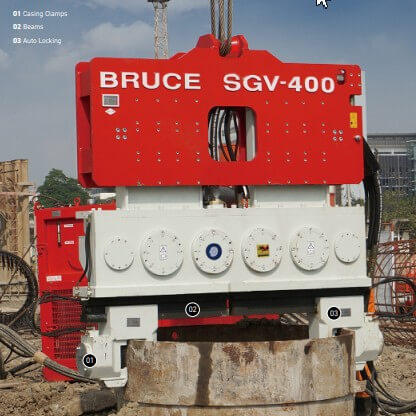
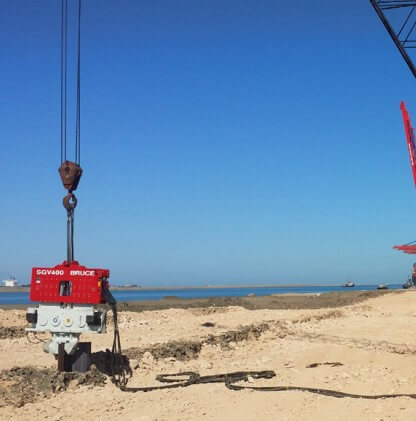
For vibratory hammer procurement, three parameters define machine capability. Eccentric moment determines amplitude — the physical displacement applied to the pile per vibration cycle. Centrifugal force determines penetration capability through the soil resistance. Operating frequency (vpm) determines how effectively soil liquefaction is maintained at depth. As a field selection rule, centrifugal force should be at least 15 times the pile weight. Crane-suspended models cover the full range from light sheet piling through to heavy offshore casing work. Excavator-mounted models connect directly to the host machine’s hydraulic supply — no separate power pack required.
Hydraulic Impact Hammer Key Parameters
For hydraulic impact hammers, the primary selection parameters are ram weight and maximum stroke — together defining the maximum potential impact energy delivered per blow. The drive cap and cushion arrangement determine how efficiently that energy transfers into the pile shaft as a compressive stress wave. Modern impact hammers include remote variable stroke control — allowing operators to adjust energy output from a minimum stroke to maximum in real time from the rig cabin. This protects piles from over-stressing in hard strata and allows precise energy management in variable ground conditions.
Fleet-Ready Value Drivers:
- Energy Monitoring Systems: Optional IEA (Impact Energy Analysis) systems record real-time blow energy at every strike. This data supports ASTM D4945 compliant auditing and structural verification on certified projects.
- Adjustable Stroke Control: New impact hammers offer real-time hydraulic stroke tuning via remote control, protecting the pile from over-stressing in hard strata like London Clay or Florida Limestone.
- Biodegradable Oil Compatibility: All hydraulic components on current-generation machines are compatible with biodegradable hydraulic oils — meeting European and US environmental regulations for sensitive project sites.
Mitigating Fleet Decay: Why New Assets Win
THE HIDDEN COST OF PRE-OWNED FATIGUE
We focus exclusively on the procurement of NEW pile driver machines. Used equipment often suffers from hydraulic contamination and micro-fractures in the gearbox assembly — defects that lead to sudden onsite failure. For a global fleet, one unreliable machine can halt an entire project’s critical path, eliminating any cost advantage of a used purchase within days of deployment.
Gearbox wear in used vibratory hammers causes harmonic drift — the hammer’s operating frequency drops under load. When frequency drops, soil liquefaction is no longer maintained and the pile stalls. This failure mode is unpredictable and cannot be resolved without full gearbox disassembly. New machines eliminate this risk through factory-calibrated eccentric weight assemblies and verified bearing specifications.
STANDARDIZED COMPLIANCE (US/UK)
Only new piling equipment can guarantee compliance with the latest BS 5228 noise limits and ASTM energy verification standards. For a fleet manager, having a uniform set of new assets means simplified operator training and a consistent safety profile that meets the insurance requirements of 2026 infrastructure contracts. Older machines with undocumented maintenance histories cannot reliably satisfy the energy transfer documentation required on federally funded bridge and rail projects.
CONSUMABLE PARTS AND LONG-TERM SERVICEABILITY
New machines from established manufacturers ship with verified consumable part specifications — elastomer rubbers, clamp cylinder seals, hydraulic fittings, and drive cap cushions are all sourced from qualified suppliers. This allows fleet managers to stock a predictable parts inventory. For vibratory hammers, the suppressor elastomers and clamp seals are the primary wear items. For impact hammers, the drive cap cushion and buffer rings are the highest-frequency replacements. Knowing exact part specifications from day one eliminates the improvisation that drives up maintenance costs on pre-owned equipment.
04. Integrating Fleet Standards in the US and UK
US Market Requirements
In the United States, federal DOT and FHWA-funded bridge and highway projects require dynamic monitoring data at every pile. The optional IEA energy monitoring system — which records impact energy at each blow — directly supports this compliance requirement. Pile driving contractors on federally funded projects must demonstrate that energy delivery meets design specifications, making real-time monitoring capability a procurement necessity rather than an optional upgrade.
UK Market Requirements
In the United Kingdom, ICE specifications and BS 5228 noise and vibration limits dictate the equipment profile for urban projects. Variable-moment vibratory technology — which allows amplitude to be adjusted during operation — is essential for working within permitted vibration boundaries near existing structures, rail infrastructure, and residential zones. Hydraulic systems compatible with biodegradable oils are increasingly required under UK environmental permit conditions.
Cross-Atlantic Fleet Standardization
For firms operating across both markets, purchasing from a manufacturer with documented export experience in both regions reduces the compliance burden significantly. Equipment pre-fitted with energy monitoring sensor mounts and hydraulic systems compatible with biodegradable oils satisfies both US monitoring requirements and UK environmental permit conditions — allowing assets to move between project sites without reconfiguration.
Fleet Management FAQ
Q: What is the difference between a vibratory hammer and a hydraulic impact pile hammer?
“A vibratory hammer reduces soil friction through oscillation. A hydraulic impact hammer overcomes soil resistance through percussive energy.”
Vibratory hammers are suited for sheet piling, temporary works, and pile extraction in granular soils. Hydraulic impact hammers are required when final bearing capacity must be verified by blow count in hard strata. Both systems are often used in sequence on the same project — vibro for initial penetration, impact for final set.Q: How do I match a pile driver machine to my host excavator?
“Match the hammer’s hydraulic demand — flow (lpm) and pressure (bar) — precisely to the excavator’s auxiliary circuit output.”
Under-matching causes cavitation and frequency decay. Over-matching places structural stress on the excavator boom and stick pins. Excavator-mounted vibratory hammers are typically designed for specific carrier weight classes — confirm the host machine tonnage against the hammer’s rated excavator range before procurement.Q: What pile types can a modern pile driver machine handle?
“Modern piling equipment covers steel sheet piles, H-beams, casing piles, concrete cylinder piles, PHC piles, and round pipe piles — clamp selection determines compatibility.”
Vibratory hammers use interchangeable clamp types. Universal clamps handle sheet piles and H-beams. Casing pile clamps with hydraulic auto-locking beams handle round casing and pipe piles. Impact hammers use drive caps matched to the pile head geometry and material. Confirming clamp or drive cap compatibility with your specific pile profile before mobilization eliminates site-level delays.Q: How does a new pile driver machine improve project ROI?
“New machines deliver predictable performance, known consumable specifications, and manufacturer warranty — eliminating the unplanned downtime that erodes project margins.”
Unplanned mechanical failures on a marine barge or confined urban site create compounding schedule delays that affect the entire project critical path. New equipment with factory-calibrated hydraulics and verified gearbox specifications removes this risk. Direct manufacturer support for parts and technical troubleshooting further reduces resolution time when maintenance is required.