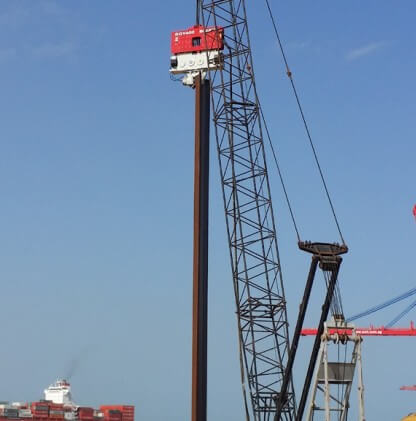
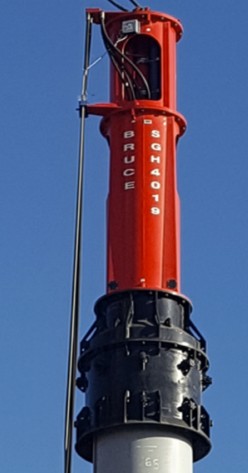
Pile Driver Machine:
Types, Mechanics
& Buying Guide
A complete comparison of every pile driver machine type — vibratory, hydraulic impact, diesel — with soil guides, specs, and 2026 cost estimates.
What Is a Pile Driver Machine?
A pile driver machine is construction equipment that installs structural piles into the ground using impact force, vibration, or static pressure to overcome soil resistance. The three primary types are vibratory hammers (oscillation-based, best for granular soils), hydraulic impact hammers (percussive, for hard strata and bearing verification), and diesel hammers (combustion-driven, largely legacy). Vibratory pile driver machines are also the only type capable of extracting piles for reuse on temporary works.
4 Types of Pile Driver Machines
Not all pile driver machines operate the same way. Selecting the wrong type for your soil conditions or project constraints can result in refusal, equipment damage, or noise violations. The four main types cover the full range of modern piling requirements:
Vibratory Hammer
Best for GranularCounter-rotating eccentric weights generate high-frequency oscillation. Drives and extracts piles via soil liquefaction. Crane-suspended or excavator-mounted. Lowest noise output.
Hydraulic Impact Hammer
Standard BearingHydraulic ram drops onto the pile head delivering a compressive stress wave. Required for final set and bearing capacity verification. Works in all soil types including hard strata.
Diesel Hammer
Legacy / LimitedDiesel combustion drives the ram. Now largely replaced by hydraulic impact in most markets due to emissions and control limitations. Still used in some developing markets.
Drop Hammer
Basic / Low VolumeSimplest type — a heavy ram lifted by crane and released by gravity. Very slow. Used only on small projects or where no alternative equipment is available on-site.
In practice, the most common modern deployments combine a vibratory pile driver machine for rapid initial penetration with a hydraulic impact hammer for final set — using each type for what it does best on the same project.
Learn how the vibratory type works at the physics level: What Is Vibro? Definition & Mechanics →
How a Pile Driver Machine Works
All pile driver machines share one objective: overcome the resistance of soil at the pile tip and along the pile shaft (skin friction) to drive the pile to the required set depth. The mechanism used to generate that force varies significantly by type.
Vibratory Pile Driver — Oscillation Mechanism
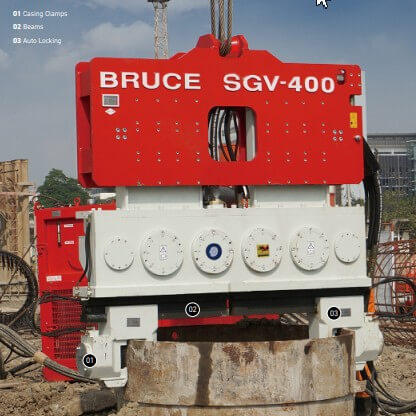
Inside a vibratory hammer, pairs of eccentric weights are driven by hydraulic motors to counter-rotate in synchronization. Horizontal centrifugal forces cancel each other; vertical forces combine and amplify, generating a powerful downward oscillation at 1,200–2,400 vibrations per minute (20–40 Hz). This oscillation creates rapid pore-water pressure fluctuations in the surrounding soil, temporarily reducing friction — a state called soil liquefaction. The pile then sinks under the combined deadweight of the hammer and pile, without requiring impact energy. The same process reversed enables pile extraction.
Hydraulic Impact Hammer — Stress Wave Mechanism
A hydraulic impact hammer operates on a fundamentally different principle. A heavy steel ram is lifted by hydraulic pressure to a calibrated drop height, then released. The ram’s kinetic energy at impact is transferred into the pile head as a compressive stress wave that travels down the pile to the tip, forcing it through bearing-layer resistance. The blow count — measured as blows per unit of pile set — is the primary engineering method for verifying final bearing capacity without a separate load test.
Carrier Integration
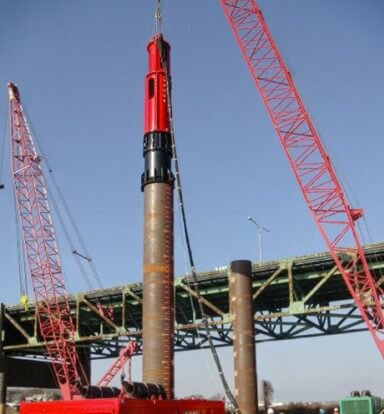
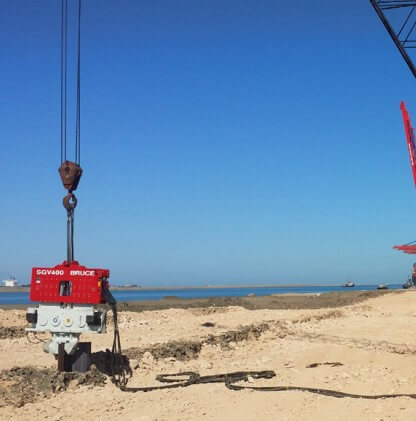
Both machine types can be configured as crane-suspended systems (highest capacity, up to 4,610 kN centrifugal force for vibratory models) or excavator-mounted systems (faster repositioning, no separate power pack required). Excavator-mounted pile driver machines are increasingly preferred for urban shoring and confined site applications due to their mobility and reduced setup time.
“The right pile driver machine is not the most powerful one — it is the one matched to your soil profile, pile type, site constraints, and schedule. Selecting on capacity alone is the most common and most expensive mistake in foundation engineering.”
Carrier integration requirements and hydraulic specs: Excavator-Mounted Vibratory Hammers — Integration Guide →
Pile Driver Machine — Specification Comparison
Use this table to compare all major pile driver machine types across the criteria that determine project suitability:
| Criterion | Vibratory Hammer | Hydraulic Impact | Diesel Hammer | Drop Hammer |
|---|---|---|---|---|
| Drive Mechanism | Oscillating eccentric weights | Hydraulically driven ram | Diesel combustion ram | Gravity-dropped ram |
| Best Soil | Granular (sand, gravel, silt) | All types incl. hard strata | Granular & cohesive | Soft to medium |
| Penetration Speed | ⚡ Fastest in granular | Moderate | Moderate | Very slow |
| Noise Level | ✅ Low — continuous hum | High — impact per blow | High + exhaust | High — each drop |
| Urban Suitability | ✅ High — vibration compliant | Limited | ❌ Not recommended | ❌ Not recommended |
| Pile Extraction | ✅ Yes — same process reversed | ❌ No | ❌ No | ❌ No |
| Bearing Verification | ⚠️ Requires separate load test | ✅ Blow count method | ✅ Blow count method | ⚠️ Approximate only |
| Emission Profile | ✅ Zero exhaust | ✅ Zero exhaust | ❌ Diesel exhaust | ✅ Zero exhaust |
| Pile Types | Sheet pile, H-pile, tube, casing | All pile types | Concrete, steel, timber | Timber, concrete |
| Best Combined Use | ✅ Vibro for initial penetration → Hydraulic impact for final set and bearing verification on the same project | |||
Soil Compatibility Guide
The single most important factor in pile driver machine selection is your site investigation data. Match the machine type to actual soil conditions:
Fastest possible penetration. Liquefaction occurs immediately under standard centrifugal force. Pile advances rapidly with minimal resistance.
High pore-water pressure response. Standard model sufficient. Often the fastest vibratory pile driving conditions encountered on site.
Higher-capacity model required as depth increases. Monitor penetration rate — skin friction accumulates. Impact for final set if required.
High-amplitude model needed. Penetration achievable but slower than sand. Clamp force critical to prevent slippage.
Clay does not liquefy. Force works against plastic shear strength. Extended vibration time required. Impact may be needed for final depth.
Standard protocol: vibratory to maximum penetration depth, then hydraulic impact hammer for final set through stiff bearing layer.
Maximum eccentric moment required. Pre-augering through dense layer may be necessary at refusal. Impact for final set.
Neither vibro nor drop hammer can penetrate rock. Hydraulic impact with rock-point pile tip or rotary drilling required. Vibro for above-rock penetration only.
Pile Driver Machine Cost — 2026 Estimates
Pile driver machine purchase prices vary widely based on centrifugal force output, carrier configuration, and manufacturer. The following ranges are based on 2026 market data for new equipment:
Excavator-mounted vibratory hammer. Suitable for urban shoring and sheet piling on confined sites. No separate power pack required.
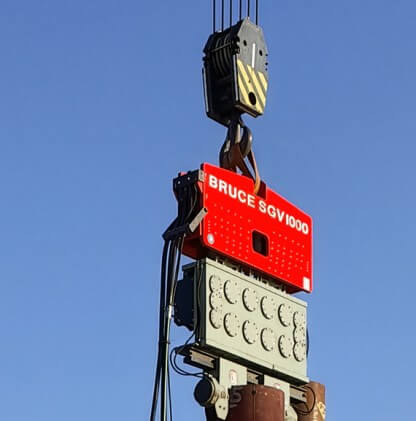
Standard crane-suspended vibratory hammer. Covers the majority of sheet piling and marine foundation projects. BRUCE SGH series.
Large-capacity crane-suspended vibratory hammer. Offshore and bridge foundation work requiring 2,000–4,610 kN centrifugal force output.
Hydraulic impact pile driver machine. Price scales with ram weight and stroke energy. Required for final bearing set on permanent piles.
Full pricing tables by model and buy vs. rent analysis: Hydraulic Pile Hammer Purchase Cost — 2026 Estimates →
How to Select the Right Pile Driver Machine
Choosing a pile driver machine is a multi-variable engineering decision. Use this decision framework as a starting point before finalizing procurement:
Step 1 — Confirm Soil Profile
Review your site investigation report (borehole logs, SPT N-values, CPT data). Granular soils below N = 30 are ideal for vibratory. Above N = 40 or in cohesive soils, plan for impact. Rock-line depth determines whether pre-augering is needed.
Step 2 — Define Pile Type and Required Set
Sheet piles and temporary works piles → vibratory is the primary choice. Permanent load-bearing piles requiring bearing certification → impact is mandatory for final set, even if vibro is used for initial penetration.
Step 3 — Assess Site Constraints
Urban zone with vibration ordinances → vibratory high-frequency model with real-time amplitude control. Confined access → excavator-mounted over crane-suspended. Marine or barge-mounted work → crane-suspended only.
Step 4 — Match Hydraulic Capacity to Carrier
For excavator-mounted models, confirm the host machine’s auxiliary hydraulic flow (lpm) and pressure (bar) meets the hammer’s motor rating. Insufficient hydraulic flow is the most common cause of under-performance and premature equipment failure in the field.
Critical for pile head integrity: Hydraulic Clamp Engineering & Piling Safety Standards →
Continue Your Research
FAQ — Pile Driver Machine
Official Specifications & Data Sheets
Full eccentric moment tables, centrifugal force outputs, hydraulic requirements, and dimensional drawings for 2026 vibratory pile driver machine models are available in the official catalogues: