7 Best Vibro Hammer Manufacturers:
US Customer Reviews & Reliability
“A COMPREHENSIVE AUDIT OF ASTM D4945 COMPLIANCE ACROSS THE UNITED STATES”
“In the US heavy construction sector, synthesizing customer reviews is a strategic procurement necessity. Tier 1 contractors do not merely evaluate hardware; they audit a manufacturer’s ability to satisfy ASTM piling standards, FHWA foundation guidelines, and document real-world project performance across diverse soil conditions.”
01. US Market Selection Criteria: Reliability Over Cost
In the United States heavy construction sector, evaluating vibro hammer manufacturers is an essential procurement strategy for federal infrastructure contracts. Geotechnical engineers and Tier 1 contractors do not merely evaluate hardware — they audit the manufacturer’s ability to satisfy ASTM piling standards and FHWA foundation guidelines. For projects from the McKinley Bridge to the Everglades, reliability and verifiable energy transfer documentation are the primary procurement filters.
GLOBAL BRAND RANKINGS
How do these US reviews impact the global top tier? Review the Best Vibratory Hammer Brands 2026 User Reviews & Ratings.
What US Contractors Prioritize in Manufacturer Reviews
US-based piling contractors consistently prioritize resonance suppression and centrifugal force stability over initial capital expenditure. Furthermore, real-world project references — particularly on DOT-funded bridge and highway contracts — carry significantly more weight than brochure specifications. A manufacturer that can document completed federally funded projects, with independently verified performance references, occupies a fundamentally stronger credibility position than one relying solely on theoretical specification data.
BRUCE Project References — US Federal Infrastructure
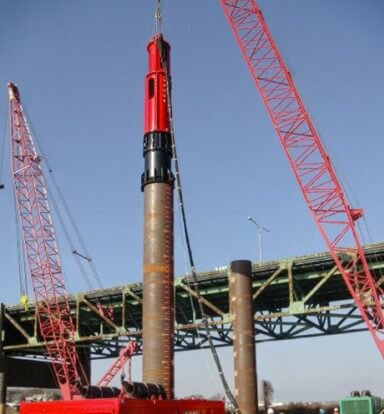
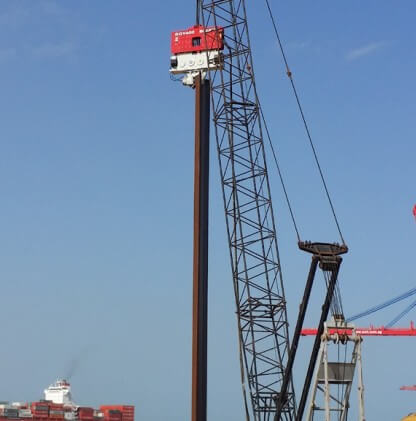
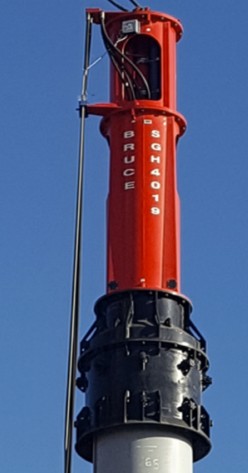
BRUCE has documented performance on multiple major US federal bridge projects. The SGH-4719 drove 72-inch diameter steel casing pipes to over 200 feet on the Sakonnet River Bridge (Rhode Island) — cited in Providence Journal and confirmed by official RI DOT announcement as the largest single DOT contract in state history at USD 163.7M. Additionally, the SGH-3013 drove 60-inch precast concrete cylinder piles on the Hathaway Bridge (Florida), documented in a Florida State University engineering thesis. The SGH-2015 was used by SKANSKA USA on the Williamsburg Bridge (Virginia) and the Chincoteague Channel Bridge (Virginia), with the latter published in Pile Driving Association Magazine.
02. ASTM D4945 & FHWA Technical Benchmarks
The credibility of piling equipment in the US market is anchored in ASTM D4945 — the standard test method for high-strain dynamic testing of deep foundations. For federally funded bridge and highway projects, energy transfer documentation at every blow is required by DOT structural auditors. Consequently, manufacturers whose equipment consistently delivers verifiable energy transfer data receive superior ratings in professional US field reviews.
IEA System — The ASTM D4945 Compliance Tool
The BRUCE IEA (Impact Energy Analysis) System is the optional energy monitoring system developed specifically to support ASTM D4945 compliance. It records real-time energy at every blow, providing the verifiable energy transfer log required by DOT structural auditors. Developed and launched by BRUCE, the IEA has been adopted as a standard monitoring system by the Hong Kong Housing Government and applied on major US bridge projects — providing the independently verified performance benchmark that procurement engineers require before specifying equipment on federally funded contracts.
Clamp Reliability — The Field Contractor Priority
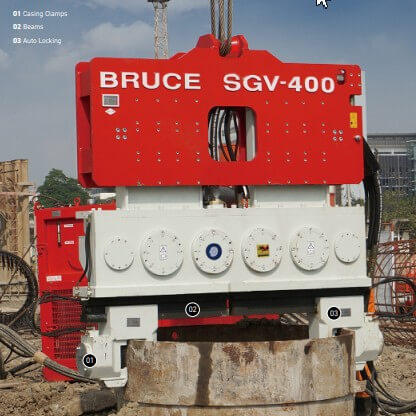
Elite manufacturers are consistently highlighted in US customer reviews for reliable clamping systems in marine and tidal environments. The BRUCE clamp cylinder includes a built-in check valve that maintains clamping pressure even in case of hose damage — preventing pile drop in demanding offshore and tidal conditions. Furthermore, high-grade alloy steel jaw inserts maintain grip on wet and salt-corroded pile surfaces — a field performance requirement that worn jaw inserts on pre-owned equipment cannot reliably satisfy on US coastal bridge projects.
03. Regional US Field Feedback: TX Clay vs. FL Sands
US field crews provide specific feedback based on regional geological challenges. Understanding these soil-specific requirements directly informs manufacturer selection for regional project pipelines.
Texas (Houston Clay Adhesion)
Reviews from Houston emphasize the need for high eccentric moment models capable of maintaining centrifugal force in stiff over-consolidated clay. In these conditions, the ability to adjust amplitude via the remote pendant’s flow dial — reducing vibration near existing pipelines while maintaining penetration rate — is the most valued operational feature for urban shoring projects.
Florida (Saturated Sands)
Coastal Florida contractors prioritize high-frequency models for saturated, non-cohesive strata. Field feedback consistently highlights real-time frequency adjustment via the remote control pendant as the most valued feature — allowing operators to manage soil liquefaction state and penetration rate as soil conditions change at depth without stopping the drive cycle.
Hydraulic System Reliability in High-Temperature Environments
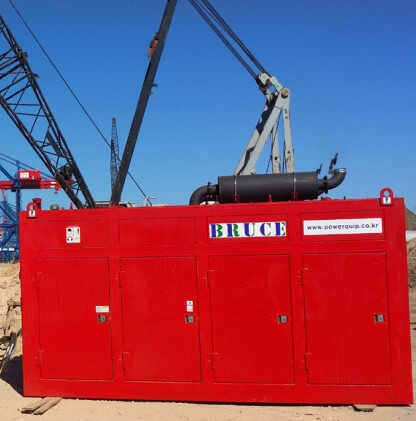
US Gulf Coast and Southern states present some of the most demanding thermal conditions for hydraulic piling equipment. The BRUCE PQ-V series power packs are designed for operation from -30°C to above 40°C — ensuring stable hydraulic performance across the temperature extremes of extended summer operation in Texas, Louisiana, and Florida. Consequently, hydraulic oil temperature management during the first operational hours is a standard commissioning step documented in the operation manual for these environments.
“We focus exclusively on NEW machinery because second-hand units often carry internal hydraulic contamination that compromises precision cooling and flow control — a critical failure risk in the 100°F+ heat of the American South.”
Evaluating Manufacturers for US Projects
1. VERIFY ASTM D4945 COMPLIANCE CAPABILITY
Request confirmation that the manufacturer offers the optional IEA energy monitoring system and can provide field-verified energy transfer data from comparable project deployments. Furthermore, confirm that the manufacturer holds documented US project references on DOT-funded contracts — performance on federally regulated projects is the most credible indicator of ASTM compliance capability. Used equipment catalogues often rely on theoretical peak specifications that do not survive field dynamic load testing.
2. AUDIT CONSUMABLE PARTS AVAILABILITY
Confirm that consumable part numbers — elastomers, clamp cylinder seals, hydraulic fittings, and drive cap cushions — are documented in the operation manual and available from the manufacturer. Additionally, verify that the manufacturer can support international shipping of replacement parts to US project sites without extended lead times. A manufacturer with an established export track record to over 80 countries has the logistics infrastructure to support US after-sales requirements reliably.
3. ANALYZE GEARBOX SYNCHRONIZATION AND ECCENTRIC WEIGHT DESIGN
Evaluate the gearbox design for balanced double-side eccentric weights — the configuration that cancels horizontal force components and produces purely vertical oscillation. This is the technical feature most consistently praised by US crane operators for protecting boom integrity and preventing lateral pile dancing that damages interlocks. Furthermore, confirm the eccentric weight material specification — alloy steel with precision machining provides significantly longer service life than standard steel components under heavy-use US coastal conditions.
Technical FAQ
Q: How do US contractors evaluate popular vibro hammer manufacturers?
“US contractors evaluate manufacturers by benchmarking energy transfer documentation against ASTM D4945 standards and verifying real-world project references on DOT-funded contracts.”
Field reviews consistently prioritize the equipment’s ability to maintain a consistent drive rate in resistive ground without hydraulic stalling — and the manufacturer’s ability to provide the IEA energy monitoring data required by DOT structural auditors. Furthermore, documented project references on comparable US bridge and coastal foundation projects carry significantly more credibility than catalog specifications alone.Q: Are these manufacturers eligible for FHWA and State DOT projects?
“Yes — BRUCE SGH and SGV series equipment has been deployed on multiple FHWA and State DOT-funded projects in Rhode Island, Florida, and Virginia.”
The SGH-4719 on the Sakonnet River Bridge (RI DOT), SGH-3013 on the Hathaway Bridge (Florida DOT), and SGH-2015 on the Chincoteague Channel Bridge (Virginia DOT) represent documented state DOT deployments. Furthermore, the optional IEA system provides the energy transfer documentation required for ASTM D4945 compliance on federally funded structural pile installations.Q: What vibro hammer specifications matter most for Gulf Coast coastal projects?
“High operating frequency for granular coastal sands, marine-rated hydraulic sealing, and biodegradable hydraulic oil compatibility for EPA coastal permit requirements.”
In saturated coastal sands, high-frequency operation maintains soil liquefaction more efficiently — allowing faster penetration rates with lower centrifugal force than in cohesive clay conditions. Additionally, biodegradable hydraulic oil compatibility is increasingly required under US EPA coastal construction permit conditions for piling in or near tidal zones. All BRUCE hydraulic components are confirmed compatible with biodegradable oils.Q: What is the most important clamp feature for US marine piling projects?
“A built-in clamp check valve that maintains clamping pressure even in case of hose damage — preventing pile drop in tidal and offshore conditions where repositioning is time-consuming and costly.”
Additionally, high-friction jaw inserts matched to the pile profile maintain grip on wet, algae-covered, and salt-corroded pile surfaces — conditions common on US East Coast and Gulf Coast marine projects. Confirming jaw insert material specification and compatibility with the specific pile section geometry before mobilization eliminates site-level delays during clamp configuration.