Strategic Investment in Sheet Pile Vibratory Hammers:
Fleet ROI & Procurement Guide 2026
“TRANSFORMING EQUIPMENT PROCUREMENT INTO A COMPETITIVE FINANCIAL ADVANTAGE”
“In the high-stakes world of deep foundations, ROI is not measured by the purchase price but by the minimization of project-critical downtime. A new sheet pile vibratory hammer is a revenue-generating asset that delivers consistent performance in the most resistive strata.”
01. Financial Logic of New Asset Procurement
In the 2026 infrastructure market, the decision to procure a sheet pile vibratory hammer is driven by the need for operational independence. Relying on aging rental fleets or pre-owned machinery introduces unpredictable downtime and project-critical delays. For contractors in the United States and United Kingdom, owning a factory-new vibratory unit enables a precise bidding strategy — ensuring that urban shoring and flood defense project timelines are met consistently.
Eliminating Mobilization Friction
A key financial advantage of ownership is the elimination of rental availability risk. Rental fleets are allocated on a first-come, first-served basis. Consequently, when a project window opens unexpectedly or a schedule accelerates, contractors without owned equipment face delays while waiting for available units. Furthermore, rental surcharges accumulate rapidly on extended projects — often exceeding the capital cost of ownership within a single contract cycle.
Optimizing your bidding strategy for 2026 infrastructure projects?
Review our Master Strategy for Infrastructure Bidding & Cost Estimation.
Performance Consistency Across Soil Conditions
New factory-certified sheet pile vibratory hammers deliver consistent centrifugal force output across the full working life of the machine. In contrast, used units with worn eccentric weight assemblies and degraded bearings produce harmonic drift — the operating frequency drops under load, soil liquefaction is not maintained, and the pile stalls mid-drive. Moreover, new equipment ships with verified hydraulic specifications, ensuring the machine matches the host carrier’s auxiliary circuit from day one without trial-and-error calibration on site.
02. Asset Depreciation and Total Cost of Ownership
A professional sheet pile vibratory hammer is a high-value industrial asset. However, the true financial picture is only visible through a Total Cost of Ownership (TCO) analysis — not the purchase price alone. TCO covers capital cost, consumable replacement frequency, hydraulic maintenance intervals, power pack fuel consumption, and the cost of unplanned mechanical downtime over the machine’s full service life.
Consumable Parts and Maintenance Intervals
For vibratory hammers, the primary consumable items are elastomer rubbers in the suppressor assembly, clamp cylinder seals, hydraulic fittings, and gearbox lubricant. New machines from established manufacturers ship with known part specifications and recommended replacement intervals. This allows maintenance planning from the first hour of operation. Additionally, the suppressor design on quality vibratory hammers allows elastomers to be replaced without major disassembly — reducing scheduled maintenance downtime on active project sites.
Gearbox Integrity and Long-Term Service Life
The gearbox is the highest-cost component in a vibratory hammer. Precision-machined alloy steel eccentrics and synchronized gears are designed for extended service life when properly maintained. In contrast, pre-owned units with undocumented maintenance histories carry the risk of invisible fatigue in eccentric shafts and gear teeth — defects that are undetectable without full disassembly. Consequently, used machinery may appear functional at purchase but fail under full operating load within the first hours of site deployment.
Key TCO Factors to Evaluate:
- • Hydraulic Power Pack: Match the power pack model to the hammer’s rated flow and pressure. Mismatched packs cause overheating and accelerated seal wear.
- • Elastomer Replacement Cycle: High-grade elastomers with mechanical stops last significantly longer than standard rubbers. Confirm specification before purchase.
- • Clamp Check Valve: A built-in check valve maintains clamping pressure even in case of hose damage — preventing pile drop and unplanned stops that cost time on site.
- • Biodegradable Oil Compatibility: All hydraulic components should be compatible with biodegradable oils for environmentally sensitive and permit-restricted project sites.
03. Global Compliance: ASTM D4945 & BS EN 12699
Deploying heavy piling machinery in 2026 requires strict adherence to regional engineering codes. Any sheet pile vibratory hammer for sale must satisfy technical energy transfer standards. For the US market, ASTM D4945 governs high-strain dynamic testing of deep foundations — establishing the energy transfer documentation required on federally funded bridge and highway projects. For the UK market, BS EN 12699 and ICE specifications set the equipment and operational standards for displacement pile installation.
Energy Monitoring and Structural Verification
For hydraulic impact hammers deployed on compliance-critical projects, optional IEA (Impact Energy Analysis) systems record real-time energy delivery at every blow. This data provides the verifiable energy transfer log required for structural auditing on government-funded infrastructure contracts. Importantly, pre-owned equipment without documented energy monitoring history cannot satisfy these audit requirements — making new equipment with IEA capability the only compliant option on many public sector contracts.
Urban Vibration Limits — BS 5228
In the UK, BS 5228 sets permitted vibration and noise levels for construction operations in proximity to existing structures and sensitive receptors. Vibratory hammers with variable-moment technology — allowing amplitude to be adjusted during operation via a remote control pendant — are essential for maintaining compliance within these limits while still achieving the centrifugal force needed to drive piles. Similarly, in the US, EPA and local municipal ordinances govern vibration levels on urban piling projects, particularly in coastal and marine environments.
Asset Evaluation Framework
1. AUDIT ECCENTRIC MOMENT AND CENTRIFUGAL FORCE
Request the full technical specification sheet. Verify the eccentric moment (kgm) and centrifugal force (kN) for the model. As a selection rule, centrifugal force should be at least 15 times the pile weight. For sheet pile work in medium-dense sand, confirm that the model’s frequency range covers the soil condition. Additionally, check that the power pack model matches the hammer’s rated hydraulic demand.
2. VERIFY HYDRAULIC COMPATIBILITY
Confirm the hammer’s motor demand — flow (lpm) and pressure (bar) — against the host carrier’s auxiliary circuit output. Furthermore, verify that the case drain connection point is accessible and that the drain line can be routed directly to the hydraulic tank without restrictions. Mismatched hydraulic specifications are the primary cause of motor seal failure in newly deployed equipment.
3. CONFIRM CLAMP TYPE AND PILE COMPATIBILITY
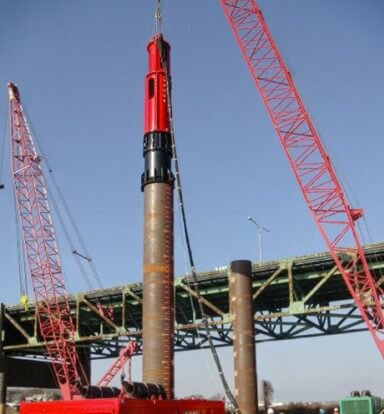
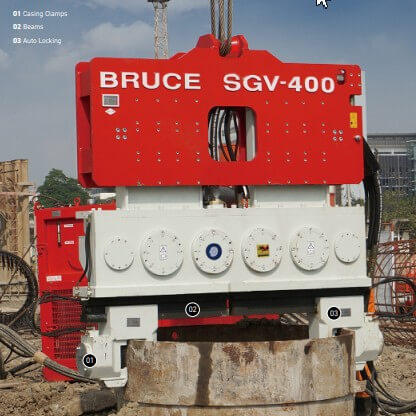
Identify your pile profile before specifying the clamp. Universal and sheet pile clamps handle flat interlocking profiles. Casing pile clamps with hydraulic auto-locking beams handle round casing and pipe piles. In addition, confirm that the jaw inserts are available for your specific pile section — clamp body compatibility does not automatically guarantee jaw availability for all pile geometries.
Strategic Procurement FAQ
Q: What is a sheet pile vibratory hammer and how does it work?
“A sheet pile vibratory hammer clamps onto the pile head and generates high-frequency vertical vibration to reduce soil friction — allowing the pile to penetrate under its own weight and the hammer’s downforce.”
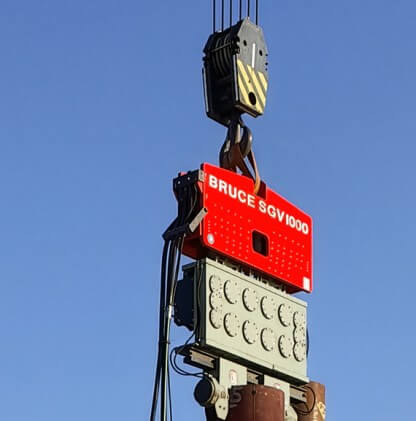
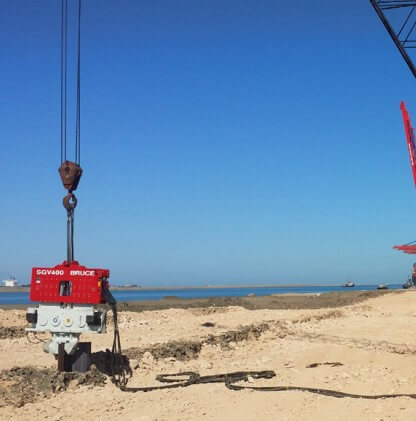
Inside the gearbox, balanced eccentric weights rotate in opposite directions. Horizontal force components cancel out, while vertical centrifugal force is transmitted directly into the pile. This temporarily liquefies the friction between the pile and surrounding soil. Consequently, the pile advances without impact energy — making vibratory hammers fast, low-noise, and well-suited for sheet piling in granular soils, temporary cofferdams, and pile extraction.Q: How do I select the right sheet pile vibratory hammer model?
“Select based on centrifugal force, eccentric moment, and pile weight — centrifugal force should be at least 15 times the pile weight.”
Additionally, confirm the power pack’s hydraulic output matches the hammer’s motor demand. For sheet piling in medium-dense sand at 10–20m depth, a mid-range model is typically sufficient. For heavy casing piles in dense marine conditions, a high-capacity crane-suspended model is required.Q: Can a sheet pile vibratory hammer also extract piles?
“Yes — extraction is one of the primary advantages of a vibratory hammer over an impact system.”
During extraction, the hammer clamps onto the pile and vibrates while the crane applies upward line pull. The vibration temporarily reduces skin friction along the pile shaft, allowing withdrawal. This makes vibratory hammers the standard choice for temporary works — cofferdams, trench shoring, and sheet pile walls — where piles must be removed and reused after construction.Q: Why buy new rather than rent a sheet pile vibratory hammer?
“Ownership eliminates rental availability risk, provides known machine history from day one, and removes the downtime uncertainty that comes with pre-owned equipment.”
Furthermore, owned equipment allows the contractor to specify the exact model matched to their typical project profile — rather than accepting whatever rental unit is available. Direct manufacturer support for parts and technical troubleshooting reduces resolution time when maintenance is required, protecting the project schedule.