UK Sheet Piling Engineering:
Vibratory Hammer Standards 2026
“INTEGRATING BS 8004:2015, FPS GUIDELINES, AND CIRCULAR ECONOMY GOALS”
“Optimising sheet pile installation in the UK requires a surgical balance between centrifugal force and amplitude. In 2026, the success of an infrastructure project is measured by its ability to penetrate stiff London Clay whilst maintaining strict compliance with BS 5228 vibration limits.”
01. UK Sheet Piling Standards: BS 8004 Context
In the United Kingdom, the design and execution of temporary and permanent earth retention systems relies on vibratory hammer sheet pile operations. Governed by BS 8004:2015 (Code of Practice for Foundations), piling works must demonstrate high driveability whilst maintaining the structural integrity of the steel sections. For civil engineering firms in England, choosing the right vibro hammer is a prerequisite for satisfying the Federation of Piling Specialists (FPS) quality audits.
TECHNICAL PILLAR HUB
How can side-grip technology assist in satisfying urban UK standards? Review the Side Grip Vibratory Hammer Guide for Urban Shoring.
Larssen and Z-Profile Sheet Piles — UK Installation Requirements
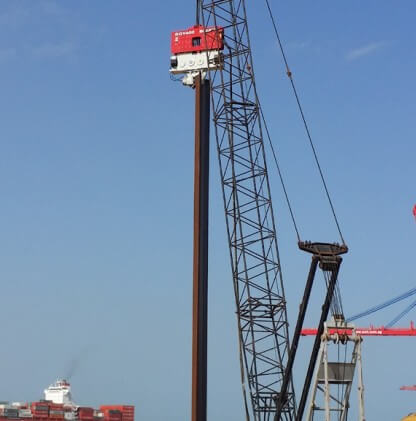
The deployment of piling equipment in the UK is increasingly focused on the efficient installation of Larssen and Z-profile sheet piles in urban centres including London, Manchester, and Birmingham. High-frequency vibratory hammers are the preferred installation method in granular strata, as they induce soil liquefaction efficiently without the percussive noise of drop hammers. Furthermore, the remote control pendant’s real-time flow adjust function allows operators to manage centrifugal force in real time — reducing amplitude near sensitive receptors and increasing it progressively in denser strata, satisfying BS 5228 vibration limits throughout the drive cycle.
SGV Series — UK Sheet Pile Clamp Compatibility
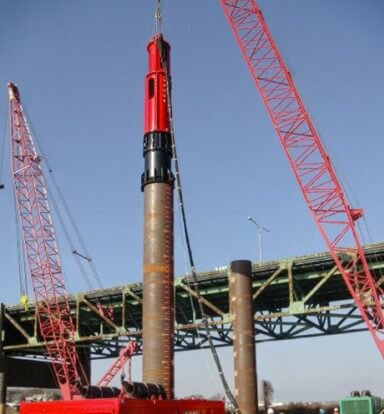
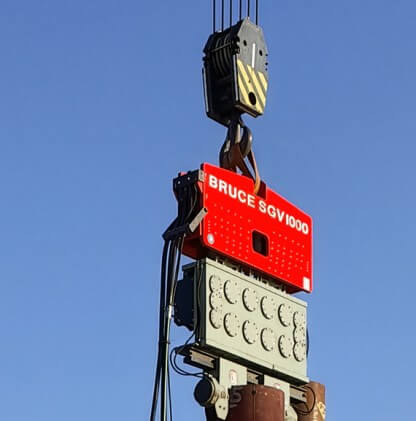
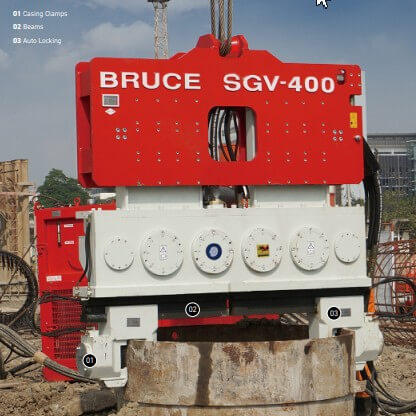
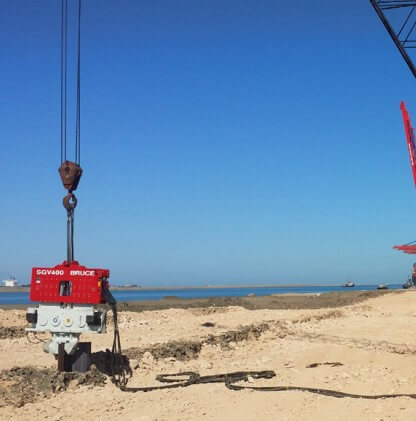
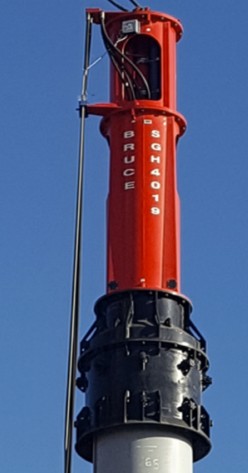
The BRUCE SGV crane-suspended series covers eccentric moments from 11.5 kgm (SGV-80) to 220 kgm (SGV-2000) and centrifugal forces from 510 kN to 4,610 kN. Universal Sheet Pile Clamps (60U to 320U) cover the full range of Larssen and Z-profile sections used on UK infrastructure projects. Additionally, all models include a built-in clamp check valve that maintains clamping pressure even in case of hose damage — preventing pile drop during extraction operations in the deep, saturated cofferdams common on Thames-side and estuarine projects.
02. Vibratory vs. Press-in Methods: Technical Synergy
While silent piling (press-in) is often discussed for UK urban zones, the vibratory hammer sheet pile method remains the most widely used solution across UK infrastructure — particularly where driving depth requirements exceed the capacity of press-in equipment, or where granular strata require soil liquefaction to achieve design depth. Furthermore, vibratory hammers offer a critical advantage over press-in for cofferdam projects: the ability to extract the sheet piles after the temporary works phase without additional equipment.
Eccentric Weight Synchronization — Purely Vertical Oscillation
Leading manufacturers provide hammers with counter-rotating balanced double-side eccentric weights — the configuration that cancels horizontal force components and produces purely vertical oscillation. This is the technical feature most consistently required by UK Network Rail and National Highways specifications, as lateral oscillation transmitted through the sheet pile interlock can cause adjacent piles to deviate from their designed vertical path — creating misalignment that compromises the watertightness of the cofferdam. Consequently, balanced eccentric weight design is a non-negotiable specification item on Network Rail and National Highways track-side and corridor sheet piling contracts.
Biodegradable Oil Compatibility — UK Environmental Permit Requirement
For UK sheet piling projects in or near watercourses — river flood defense walls, estuarine cofferdams, and canal bank retention schemes — Environment Agency permit conditions increasingly require biodegradable hydraulic fluids. All BRUCE SGV series hydraulic components are confirmed compatible with biodegradable hydraulic oils. Additionally, the SGV series produces no smoke during operation, directly reducing the environmental monitoring burden on riverside and estuarine construction permits where air quality conditions are also typically applied.
03. Interlock Friction & UK Soil Dynamics
A unique challenge in England is managing interlock friction in abrasive strata. In Glacial Till deposits across Northern England and the Scottish Borders, friction within the sheet pile clutches during driving creates cumulative drag that can stall penetration before design depth is achieved. Consequently, the centrifugal force selection rule — at least 15 times the pile weight — is the starting point for model selection, but abrasive high-friction soils may require upward adjustment based on the specific soil investigation data.
Remote Pendant Amplitude Control — Real-Time Friction Management
In the Thames Valley and East Anglian fens, contractors utilize real-time amplitude adjustment via the remote control pendant’s flow dial to manage penetration rate in variable soil profiles — increasing centrifugal force in denser gravel lenses and reducing it in softer alluvial bands above. This level of real-time control allows operators to maintain penetration rate without exceeding the BS 5228 vibration limits near Victorian residential properties — a balance that fixed-frequency used equipment cannot achieve.
“We focus exclusively on NEW equipment because pre-owned hammers often lack the sustained centrifugal force needed to overcome resistive interlock friction in abrasive UK glacial soils — leading to pile refusal and expensive remedial excavation.”
How-To: Optimising UK Sheet Pile Extraction
1. CONFIRM CLAMP ENGAGEMENT AND HSE LIFTING COMPLIANCE
HSE mandates a secondary safety chain for all suspended piling equipment. Before extraction commences, confirm full clamp jaw engagement with the sheet pile head — and verify that the built-in check valve has maintained clamping pressure if there has been any interruption to hydraulic supply. Furthermore, confirm the extraction line pull does not exceed the clamp’s rated static line pull for the specific pile section weight — oversized piles require a clamp upgrade, not additional hydraulic pressure.
2. MONITOR PPV DURING EXTRACTION NEAR SENSITIVE ASSETS
When extracting near London Underground assets, buried utilities, or historic structures, monitor Peak Particle Velocity (PPV) continuously against the limits specified in the BS 5228 vibration assessment and the Section 61 consent. Use the remote pendant’s flow adjust function to reduce centrifugal force if PPV approaches the trigger level — reducing vibration without stopping the extraction. Additionally, note that extraction generates higher elastomers stress than driving, so suppressor elastomer condition must be inspected before extraction commences to prevent failure under increased load.
3. EXECUTE VOID BACKFILLING PER BS 8004
As each sheet pile is withdrawn from UK till or granular soils, grout or controlled low-strength material must be placed to fill the resulting void. This is a mandatory safety step under BS 8004 and is typically specified in the method statement submitted to the local authority or Network Rail as part of the works approval. Furthermore, in urban London clay, void collapse after extraction without immediate backfilling can trigger ground settlement that affects adjacent building foundations — making this step a contractual requirement, not merely a best practice.
UK Technical FAQ
Q: Are vibratory hammers permitted for Network Rail cofferdam works?
“Yes — vibratory hammers are the industry standard for sheet pile cofferdam construction on Network Rail projects, provided a vibration monitoring plan satisfying NR/L2/CIV/003 standards is in place.”
The remote pendant’s real-time amplitude control allows PPV management throughout the drive and extraction cycle without stopping the hammer. Furthermore, the suppressor assembly’s elastomer isolation decouples the vibrating gearbox from the crane — minimising transmitted vibration to track-adjacent structures throughout the piling operation.Q: Can vibratory hammers drive sheet piles into over-consolidated London Clay?
“Yes — high eccentric moment models provide the amplitude needed to overcome cohesive particle bonding and side-skin adhesion in stiff London Clay at depth.”
As the selection rule, centrifugal force should be at least 15 times the pile weight — and stiff clay conditions may require a higher-capacity model than granular soil conditions for the same pile specification. Consequently, confirming model selection against the project soil bore log N-values at the design tip elevation is essential before mobilisation on London Clay sites.Q: What clamp type is required for Larssen and Z-profile sheet piles on UK projects?
“Universal Sheet Pile Clamps (60U to 320U) cover the full range of Larssen and Z-profile sections used on UK infrastructure projects.”
Clamp jaw type must be confirmed at order stage based on the specific pile section in the project schedule. Furthermore, the built-in clamp check valve — which maintains clamping pressure even in case of hose damage — is a critical safety feature for UK cofferdam extraction operations where dropped piles cause significant HSE incident reporting obligations and project delays.Q: How does the suppressor assembly protect adjacent structures during urban UK sheet piling?
“The suppressor assembly’s high-grade elastomers mechanically decouple the vibrating gearbox from the crane hook — reducing transmitted vibration to the crane structure and adjacent ground surface throughout the drive and extraction cycle.”
Mechanical stops in the suppressor design prevent elastomers from over-stretching during extraction — the highest-stress phase of the vibratory hammer operating cycle. Elastomer condition must be visually inspected before each shift, as degraded elastomers transmit vibration directly to the crane structure and increase the risk of BS 5228 PPV exceedance near sensitive Victorian foundations.