Vibratory Hammer Resource Hub:
2026 Technical Brochure, Catalogue, & Manual
“ENABLING MECHANICAL PRECISION THROUGH COMPREHENSIVE ASSET DOCUMENTATION”
“Technical documentation is the blueprint for project continuity. In the 2026 foundation industry, a comprehensive manual or engineering catalogue is not just a reference — it is a critical tool for verifying kinetic energy transfer and satisfying strict geotechnical compliance audits.”
01. The Industrial Vibratory Hammer Brochure
A professional vibratory hammer brochure serves as the bridge between a project’s high-level vision and its mechanical execution. In the 2026 infrastructure landscape, decision-makers in the United States and United Kingdom use these resources to verify a manufacturer’s technological capability. Specifically, the brochure must detail how the power pack, gearbox, and suppressor systems interact to deliver consistent performance in resistive strata — and how the remote control pendant enables real-time adaptation to changing soil conditions during the drive.
KNOWLEDGE BASE
To understand the fundamental principles described in our brochures, review the Full Meaning and Mechanics of Vibration Technology in our technical pillar guide.
SGV Series — What the Brochure Covers
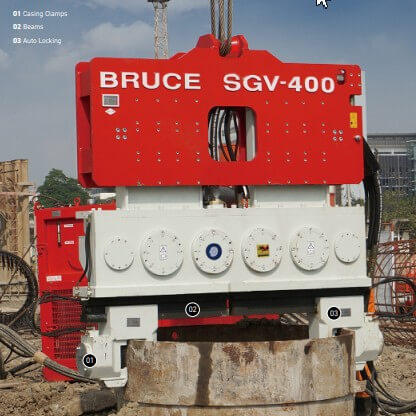
The SGV crane-suspended vibratory hammer series spans eccentric moments from 11.5 kgm (SGV-80) to 220 kgm (SGV-2000) and centrifugal forces from 510 kN to 4,610 kN. The brochure covers each model’s maximum frequency (vpm), maximum amplitude, hydraulic power requirement (kW), and matched PQ-V power pack specification. Furthermore, it details clamp options — Universal and Sheet Pile Clamps (60U to 320U) and Casing Pile Clamps with hydraulic auto-locking beams (2x40D to 4x160D) — allowing procurement officers to confirm compatibility with the specific pile profile before order placement.
Sustainability and Environmental Compliance
Current brochures include sustainability metrics that are increasingly required for project permit applications. All BRUCE hydraulic components are compatible with biodegradable hydraulic oils — meeting European environmental regulations and reducing contamination risk on coastal and sensitive project sites. Additionally, compared to diesel hammers, BRUCE hydraulic vibratory systems produce no smoke and significantly lower noise levels. This directly supports urban construction permit requirements in both the US and UK, where environmental impact documentation is a standard part of the planning approval process.
02. The Engineering Catalogue: Quantitative Data Analysis
While the brochure offers vision, the vibratory hammer catalogue delivers the raw data required for geotechnical modeling. For contractors operating under ASTM D4945 or BS EN 12699, the catalogue is a vital source for eccentric moment, centrifugal force, amplitude, and frequency values. These metrics are essential for pile driveability analysis, ensuring the selected equipment can achieve design bearing capacities without exceeding the structural yield point of the piles.
SGV Model Selection Chart
The engineering catalogue includes a model selection chart — with pile weight on one axis and driving depth on the other — that maps specific SGV models to typical project conditions. For example, a 3.5-ton sheet pile driven to 20m in medium-dense sand corresponds to the SGV-300 (centrifugal force: 92 tons / maximum amplitude: 0.866 inches / power pack: PQ-400V). Consequently, procurement officers can use the catalogue to confirm model selection before submitting a technical quote request — reducing back-and-forth between the engineering desk and the field team.
Excavator-Mounted Series Specifications
The catalogue additionally covers the SGV excavator-mounted series — SGV-40, SGV-60, and SGV-80E — designed for 20 to 50 ton excavators. Required oil flow ranges from 210 lpm to 350 lpm depending on model. Tilting models (SGV-40T, SGV-60T) include 360° hydraulic rotation and 90° hydraulic tilt specifications, along with carrier weight range and hydraulic connection requirements. Furthermore, the catalogue specifies the power pack options — PQ-200V and PQ-250V — for projects where a separate power source is required rather than the excavator’s auxiliary circuit.
03. The Operation Manual: Asset Lifecycle & Maintenance
The vibratory hammer manual is the primary source for field operations and asset longevity. For fleet managers, the manual provides critical maintenance schedules — hydraulic oil filtration intervals, elastomer inspection schedules, clamp jaw torque settings, and gearbox lubricant replacement cycles — that determine the machine’s service life and operating reliability.
Elastomer Maintenance — The Suppressor Assembly
The suppressor assembly’s elastomer rubbers are the primary vibration isolation component in crane-suspended vibratory hammers. The manual specifies inspection intervals based on operating hours and extraction load cycles — as elastomers are subject to increased stress during pile extraction compared to driving. Mechanical stops are designed to prevent elastomers from over-stretching during extraction, extending service life. Nevertheless, visual inspection of elastomer condition before each shift is standard procedure, as degraded elastomers transmit excessive vibration to the crane structure and accelerate crane wire rope wear.
Gearbox and Hydraulic Circuit Maintenance
The gearbox lubricant must be maintained at the correct level and replaced at the intervals specified in the manual. Contaminated or depleted gear oil causes accelerated wear on the eccentric shafts and gear teeth — ultimately leading to harmonic drift and frequency instability under load. Additionally, the hydraulic filter must be replaced according to the scheduled interval, as metal particulates generated by normal wear accumulate in the circuit and can damage the hydraulic motor seals if not captured by the filter element. Both consumable items are available from qualified suppliers and specified by part number in the manual.
“We focus exclusively on NEW equipment because factory-current operation manuals contain the exact hydraulic pressure tolerances, elastomer inspection intervals, and clamp torque settings mandatory for 2026 compliance-critical projects.”
Technical Fleet Synchronization Protocols
1. CONFIRM HYDRAULIC FLOW FROM THE CATALOGUE
Cross-reference the carrier’s auxiliary flow (lpm) and pressure (bar) output against the catalogue’s rated motor demand for the selected SGV model. For excavator-mounted models, required oil flow ranges from 210 lpm to 350 lpm depending on the specific model. Furthermore, confirm that the case drain line can be routed directly from the hammer motor to the hydraulic tank — not to the return line — before deployment. This connection is non-negotiable and must be verified against the manual’s installation diagram.
2. VERIFY COMPLIANCE FEATURES IN THE BROCHURE
Identify the elastomer suppressor specification, biodegradable oil compatibility, and remote pendant flow control capability in the brochure. These features ensure the unit satisfies BS 5228 vibration limits for urban sites and environmental permit conditions for coastal projects. Additionally, confirm that the clamp type specified in the brochure matches the pile profile required for the project — Universal clamps for sheet piles and H-beams, casing clamps for round pipe piles.
3. REVIEW MAINTENANCE INTERVALS IN THE MANUAL
Before mobilization, confirm the scheduled maintenance intervals for elastomers, gearbox lubricant, hydraulic filter, and clamp jaw torque from the operation manual. Specifically, note the hours-based replacement schedules for each consumable item and pre-order sufficient spare parts to cover the anticipated project duration without supply chain delays. This proactive approach eliminates unplanned downtime caused by consumable depletion on active project sites.
Technical Resource FAQ
Q: Where can I access the 2026 technical catalogue for vibratory hammers?
“The official technical catalogue, brochures, and operation manuals are available directly from the manufacturer’s technical hub at powerquip.co.kr.”
The technical library includes SGV series brochures, full model specification catalogues, and operation manuals covering installation, maintenance, and troubleshooting procedures. Consequently, procurement officers can confirm model specifications, power pack matching, and clamp compatibility before submitting a formal quote request — reducing back-and-forth between the engineering desk and the field team.Q: What parameters should I check in the vibratory hammer catalogue for model selection?
“Check eccentric moment, centrifugal force, maximum frequency, and hydraulic power requirement — then confirm the matched power pack model.”
As a selection rule, centrifugal force should be at least 15 times the pile weight. Furthermore, confirm the maximum operating pressure (bar) against the host carrier’s hydraulic circuit rating, and verify that the clamp jaw option covers the specific pile profile in your project schedule.Q: What are the key maintenance items covered in the vibratory hammer operation manual?
“The manual covers elastomer inspection, gearbox lubricant replacement, hydraulic filter intervals, clamp jaw torque settings, and case drain line installation.”
Elastomers are inspected before each shift and replaced at the hours-based interval specified in the manual. Gearbox lubricant and hydraulic filter replacement intervals are based on operating hours. Additionally, the manual specifies the case drain line routing and the correct hydraulic fittings required for the specific model — all critical installation steps that must be confirmed before first operation.Q: How does the vibratory hammer brochure support environmental compliance documentation?
“The brochure confirms biodegradable oil compatibility, noise and vibration compliance, and ESG operational standards — documentation increasingly required for coastal and urban project permits.”
All BRUCE hydraulic components are confirmed as compatible with biodegradable hydraulic oils in the brochure — meeting European environmental regulations and US coastal permit requirements. Furthermore, the suppressor assembly’s elastomer isolation system and the remote pendant’s amplitude control capability are documented features that directly support BS 5228 vibration compliance submissions for UK urban shoring projects.