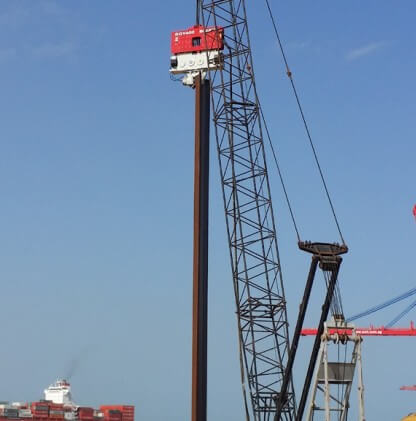
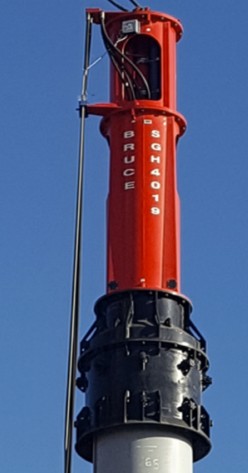
Vibratory Pile Extractor:
Site Remediation & Asset Recovery
“RECOVERING UNDERGROUND ASSETS THROUGH ADVANCED KINETIC WITHDRAWAL TECHNOLOGY”
“Extraction is the final audit of a piling project. In 2026, a high-efficiency vibratory pile extractor is not just a tool for steel recovery; it is the primary engine for satisfying environmental ESG mandates and clearing the subterranean path for future development.”
01. The Physics of Frictional Reduction in Pile Withdrawal
The vibratory pile extractor operates on the inverse principle of installation. While driving focuses on overcoming tip resistance, extraction is a battle against accumulated skin friction. Over time, soil particles bond with the pile surface through a process of effective stress gain. A specialized vibratory extractor breaks this bond by inducing rapid oscillations that temporarily liquefy the immediate soil layer, allowing for withdrawal with significantly lower line pull.
TECHNICAL PILLAR GUIDE
How can side-grip versatility assist in complex urban extractions? Review the Side Grip Vibratory Hammer Guide for Urban Shoring.
The key engineering advantage of vibration-assisted extraction is the reduction of effective stress between the pile surface and the surrounding soil. As the eccentric weights rotate, the resulting vertical oscillation temporarily disrupts the grain-to-grain contact that creates skin friction. This allows the crane’s line pull to act on a pile with dramatically reduced soil grip — rather than fighting the full static friction load.
This principle is particularly important when dealing with aged steel sheet piles that may have suffered structural thinning due to corrosion. Precise amplitude and frequency control during the break-away phase is essential to prevent pile buckling or fracture during initial withdrawal — a risk that increases significantly when the vibration system lacks stable frequency output under load.
02. Remediation & Environmental Benefits
In 2026, sustainable construction mandates in the United States and United Kingdom prioritize the complete removal of temporary foundations. Leaving steel in the ground is increasingly penalized under municipal environment agency guidelines. A high-efficiency vibratory pile extractor ensures that the site is returned to its natural state, facilitating clear ground certificates for future development.
Vibratory extraction also supports material recovery. Steel sheet piles and casing piles removed in good condition can be cleaned, inspected, and redeployed on subsequent projects. This directly reduces material procurement costs and lowers the project’s embodied carbon footprint — a measurable contribution to ESG reporting requirements now standard on major public infrastructure contracts in the US and UK.
The risk of using poorly maintained extractors on remediation sites is hydraulic contamination. Units with degraded seals can leak hydraulic fluid, re-contaminating soil that has already undergone expensive purification treatment. Factory-sealed equipment with verified hydraulic integrity is the practical standard for environmentally sensitive extraction work.
03. Urban Safety: Foundations near Sensitive Assets
Extracting piles in dense urban zones requires surgical precision. The vibration must be managed to avoid soil subsidence — the unwanted settling of ground around the extracted pile, which can trigger cracks in adjacent foundations. Modern extractors utilize variable-moment technology to gradually increase amplitude, allowing the operator to approach soil liquefaction incrementally rather than applying full centrifugal force immediately.
In zones governed by BS 5228 (UK) and ASTM vibration limits, the ability to adjust frequency and amplitude via a remote control pendant is essential. This allows the operator to stay within permitted vibration levels while maintaining sufficient energy to break pile-soil adhesion. High-frequency operation above the natural resonance frequency of adjacent structures further reduces transmitted vibration to surrounding buildings and buried utilities.
“We focus exclusively on NEW equipment because second-hand extractors often lack the precise frequency control required to prevent pile drag — a major cause of subterranean void formation in urban clay.”
Hospital-adjacent and rail-adjacent projects represent the most demanding urban extraction environments. A proven real-world example is the SGV-40 excavator-mounted vibratory hammer deployment at Christchurch Public Hospital in New Zealand, where 6m sheet piles were driven and extracted in close proximity to MRI and brain scanner equipment — with zero vibration complaints from the hospital facility.
How-To: High-Efficiency Extraction Protocol
1. ANALYZE ACCUMULATED SKIN FRICTION
Determine the age of the pile and the soil type. Silty clays in Manchester or Houston often require longer vibration durations to initiate liquefaction compared to sandy strata. Stable frequency output throughout the break-away phase is critical — frequency drop under load is a primary cause of pile damage during initial withdrawal.
2. MATCH LINE PULL TO AMPLITUDE
Coordinate the crane’s hoist speed with the extractor’s frequency. Withdrawing too fast without sufficient vibration leads to pile breakage at the weld or interlock. Remote control pendants on current models allow operators to adjust pump flow — and therefore centrifugal force — in real time, synchronizing upward pull with the vibration cycle.
3. IMPLEMENT VOID FILLING PROTOCOLS
As the pile is withdrawn, the resulting void must be filled with grout or sand immediately. This is a mandatory safety step for foundations near live rail assets and active roadways to prevent surface settlement. The filling protocol should be confirmed with the geotechnical engineer prior to extraction commencement.
Technical Recovery FAQ
Q: Can a standard vibratory hammer be used as a pile extractor?
“Yes — vibratory hammers are designed for both driving and extraction. The same vibration principle that reduces friction during installation also enables withdrawal.”
During extraction, the vibratory hammer clamps onto the pile head and generates high-frequency vertical oscillation. This temporarily reduces the skin friction that has built up along the full pile length. The crane then applies upward line pull against a pile that is, in effect, temporarily decoupled from the surrounding soil. Most vibratory hammers include a maximum rated line pull — this determines the maximum pile weight and adhesion load the system can handle during extraction. For deep extractions in stiff clay, a high-capacity model with large eccentric moment and adequate cooling is required to prevent hydraulic overheating during extended operation.Q: What is the risk of pile breakage during withdrawal?
“Pile breakage during extraction occurs when static line pull exceeds the pile’s yield strength — vibration reduces this risk by lowering the total force required to initiate movement.”
The critical phase is the initial break-away — the moment the pile first begins to move after long-term soil consolidation. If the extractor cannot maintain consistent frequency under the combined load of crane pull and soil resistance, the vibratory force drops. The crane then effectively applies pure static tension to the pile, increasing the risk of fracture at a weld joint or corroded section. Maintaining stable frequency output and gradually increasing crane pull in coordination with the vibration cycle is the standard field protocol for preventing this failure mode. Corroded or structurally compromised piles require slower, more controlled extraction procedures.Q: How does soil type affect extraction difficulty?
“Sandy and granular soils respond quickly to vibration. Stiff clay and silty soils require longer vibration duration and higher amplitude to initiate the break-away phase.”
In granular soils — sands and loose silts — the vibration rapidly disrupts grain contact and reduces friction. The pile moves relatively easily under moderate line pull. In cohesive soils such as stiff clay or silty clay, the vibration must work against plastic shear strength rather than granular friction. This requires a larger eccentric moment and extended vibration time before the pile begins to move. Pile age is also a factor — longer-installed piles have undergone greater consolidation and soil bonding, requiring higher centrifugal force to initiate withdrawal. The selection rule for extraction mirrors pile driving: centrifugal force should be matched to the estimated total skin friction load along the full pile length.Q: What happens to the void left behind after pile extraction?
“The void left by pile extraction must be filled immediately with grout or sand to prevent ground settlement and surface subsidence.”
As the pile is withdrawn, the annular void along the pile shaft can cause surrounding soil to collapse inward. In cohesive soils this process is slower, but in loose sands and silts it can occur rapidly. For projects adjacent to live rail, active roadways, or existing structures, void filling is a mandatory geotechnical protocol. The filling material — grout, sand, or bentonite-cement mix — is confirmed by the geotechnical engineer based on soil conditions and proximity to existing foundations. Failure to fill voids promptly is a primary cause of post-extraction settlement damage in urban extraction projects.