Vibro Hammer Quote Checklist: 12 Details Buyers Should Prepare
- Describe the pile, ground conditions and installation or extraction task.
- Identify the carrier or crane and the available hydraulic power source.
- Ask suppliers to define the complete equipment package and exclusions.
- State the delivery location, required date and commissioning expectations.
1. Define what the equipment must do
Start with the work itself: installing new sheet piles, extracting temporary piles, handling pipe piles or completing a combination of tasks. Include any restrictions on lifting, working height, access and operating hours. A supplier needs these details to evaluate the equipment arrangement rather than simply selecting a model from pile length.
State which requirements are confirmed and which remain assumptions. If the geotechnical report or carrier details are still pending, ask for a preliminary recommendation with a written list of information required before final selection.
2. The 12-point vibro hammer quote checklist
| Information to provide | Useful details | Why it matters |
|---|---|---|
| 1. Work scope | Installation, extraction or both; temporary or permanent works. | Clarifies the operating task and equipment arrangement. |
| 2. Pile profile | Section drawing, material, dimensions and interlock details where applicable. | Supports clamp and interface selection. |
| 3. Pile length and mass | Overall length, individual pile mass and any splices. | Informs handling and carrier or crane review. |
| 4. Quantity and programme | Pile count, planned working hours and target completion date. | Defines the duty cycle and production expectations. |
| 5. Ground information | Borehole logs, CPT or SPT records, groundwater and known obstructions. | Helps assess installation difficulty and uncertainty. |
| 6. Installation criteria | Target depth, tolerances, acceptance criteria and approved contingency methods. | Clarifies what successful installation must demonstrate. |
| 7. Carrier or crane | Make, model, configuration and relevant capacity information. | Supports mounting, lifting and stability review. |
| 8. Hydraulic supply | Available attachment flow and pressure, return circuit details, or proposed power pack. | Allows the complete hydraulic system to be assessed. |
| 9. Site constraints | Headroom, access, platform conditions, nearby structures and utilities. | Identifies practical limits on equipment use. |
| 10. Environmental requirements | Project noise and vibration limits, monitoring requirements and permitted working hours. | Defines monitoring and method-selection requirements. |
| 11. Delivery requirements | Destination, required arrival date, unloading facilities and preferred delivery basis. | Separates equipment price from logistics assumptions. |
| 12. Support scope | Commissioning, training, documentation, initial spares and warranty expectations. | Makes supplier responsibilities easier to compare. |
3. Request a complete package breakdown
Ask the supplier to identify the hammer model, clamp arrangement, mounting equipment, hoses, controls and hydraulic power source. The quotation should say which components are supplied, which are customer-supplied and which require separate confirmation.
For an excavator-mounted system, request a written compatibility review for the actual carrier configuration. For a crane-suspended system, ask for the equipment weights, approved lifting arrangement and power-pack requirements needed by the project team.
One quotation may include a power pack, hose set and commissioning visit while another covers the hammer only. Build a comparison sheet with “included,” “excluded” and “to be confirmed” beside every component.
4. Separate equipment price from delivered project cost
A purchase decision may involve freight, insurance, import charges, unloading, installation, commissioning, consumables and service travel in addition to the equipment itself. Ask each supplier to state the named delivery location and the commercial delivery term used in its proposal.
Record quote validity, payment milestones, production lead time and transport assumptions separately. Treat indicative production rates as assumptions requiring project validation, especially where ground conditions vary across the site.
5. Copy this brief into your enquiry
Project location: [Country, city and site]
Task: [Installation / extraction / both]
Piles: [Profile, length, mass and quantity; drawings available]
Ground information: [Available reports and known uncertainties]
Carrier or crane: [Make, model and configuration]
Hydraulic supply: [Available data or power-pack requirement]
Site restrictions: [Access, headroom, noise and vibration requirements]
Required delivery: [Destination and date]
Please quote: [Equipment, accessories, commissioning, training and initial spares, with exclusions listed]
6. Check the documents behind the recommendation
Request the applicable datasheet and a clear explanation of the proposed configuration. A brochure helps identify equipment families, but final selection should address the actual pile, carrier and site conditions.
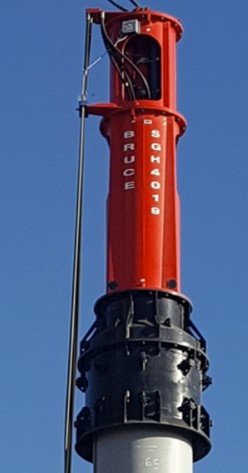
For BRUCE equipment, the manufacturer’s brochure catalogue provides a starting point for reviewing available product documentation. Confirm the current revision and configuration with the supplier.
Frequently asked questions
Can I request a quote without a soil report?
You can request a preliminary proposal, but identify the missing ground information. Equipment suitability and productivity assumptions may need revision when the geotechnical data becomes available.
Is pile length enough to select a vibro hammer?
No. Pile geometry, mass, ground conditions, hydraulic supply, handling arrangement and project acceptance requirements also matter.
Should I compare only the quoted hammer price?
Compare the complete scope and delivered cost. Accessories, power source, commissioning and support can differ substantially between proposals.
Prepare a project-specific equipment enquiry
Use the checklist above when contacting BRUCE / PowerQuip. Include confirmed project details and mark unknown items clearly so the supplier can identify what needs verification.
Send Project Details to BRUCE / PowerQuip