What is Vibro? Understanding the Meaning,
Mechanics, and Industrial Applications
“DECODING THE PHYSICS OF OSCILLATION AND SOIL LIQUEFACTION IN MODERN INFRASTRUCTURE”
“Vibro-technology is more than simple oscillation; it is the strategic application of centrifugal force to induce transient soil liquefaction. In 2026, mastering the mechanics of vibration is the ultimate competitive advantage for deep foundation engineers.”
01. Etymology & Technical Meaning of Vibro
To answer what is vibro, we must look at its Latin roots. The term originates from vibrare, meaning “to set in tremulous motion.” In 2026 geotechnical engineering, vibro meaning specifically refers to the application of vertical harmonic oscillations to a pile or casing to overcome ground resistance. This is not random shaking — it is a controlled mechanical phenomenon where centrifugal force is converted into high-frequency kinetic energy that temporarily reduces soil friction.
Vibro vs. Impact — A Fundamental Distinction
Unlike traditional impact methods that deliver discrete percussive blows, vibro technology provides continuous energy transfer. The pile advances progressively as vibration maintains the soil liquefaction state along the full pile length — rather than relying on a single compressive stress wave per blow. Consequently, vibratory drivers are significantly faster than impact hammers in granular soils, and are the only pile driving method that also enables efficient extraction for temporary works. For a detailed academic foundation, engineers often refer to the scientific definition of vibration.
STEP-BY-STEP MECHANICS
How does this energy translate into penetration? Explore our detailed guide on How a Vibratory Hammer Works in Pile Driving.
02. Industrial Mechanics: The Vibratory Pile Driver
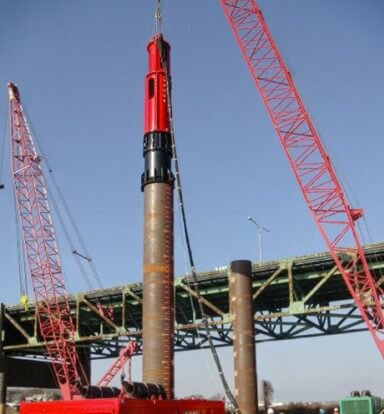
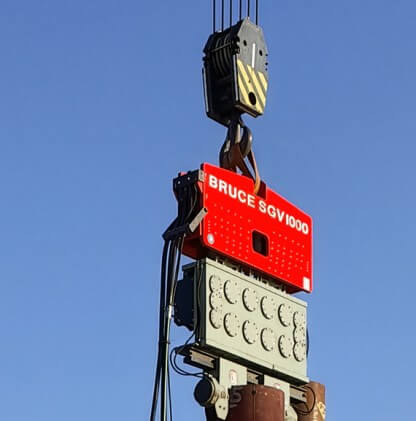
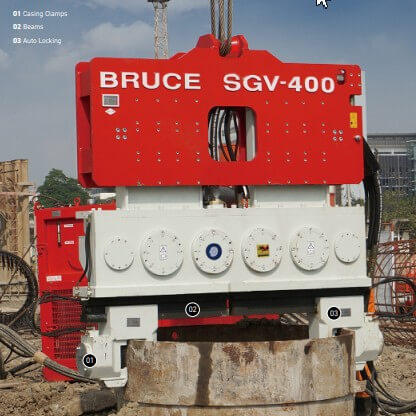
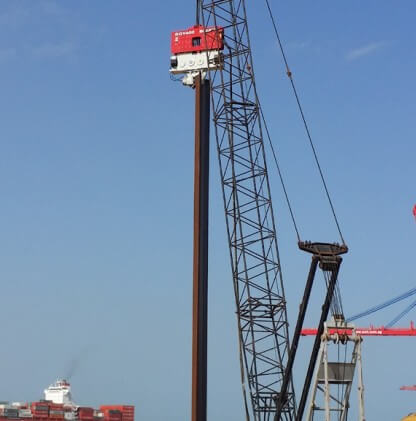
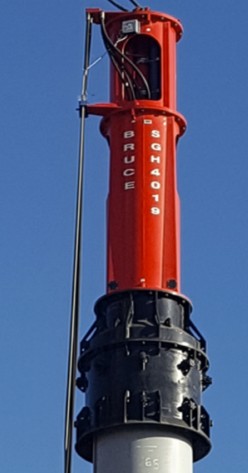
In deep foundation engineering, the meaning of vibro is most directly embodied in the vibratory pile driver. The mechanical core consists of counter-rotating eccentric weights driven by high-pressure hydraulic motors. These weights rotate in opposite phases so that horizontal force components cancel each other out, while vertical forces combine to create a powerful oscillation that is transmitted directly into the pile through the clamp.
Key Operating Parameters
Three parameters define the performance of a vibratory pile driver. Eccentric moment determines the amplitude — the physical displacement of the pile per vibration cycle. Centrifugal force determines penetration capability against soil resistance. As a general rule, centrifugal force should be at least 15 times the pile weight. Operating frequency (vpm) determines how effectively the soil liquefaction state is maintained at depth. Furthermore, the remote control pendant’s flow adjust dial allows the operator to modify all three parameters in real time from the cab, matching machine output to actual soil resistance at every depth.
Carrier Integration — Crane-Suspended vs Excavator-Mounted
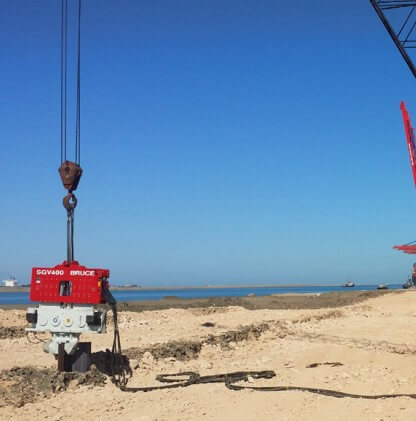
The efficiency of a vibratory driver depends on its carrier integration. Crane-suspended models deliver the highest centrifugal force — up to 4,610 kN — for heavy offshore and bridge foundation work, deploying from marine vessels and barge platforms. Excavator-mounted models connect directly to the host machine’s hydraulic supply without a separate power pack, offering faster repositioning for urban and confined site applications. In both cases, the hydraulic flow (lpm) and pressure (bar) must be matched to the hammer’s motor rating to maintain stable operating frequency under soil load.
GEOLOGICAL INTERACTION AUDIT
For a deep dive into carrier-to-soil interaction, read our technical report on Excavator Vibro Hammer Engineering & Soil Mechanics.
03. The Physics of Vibration & Soil Liquefaction
The vibro effect achieves pile penetration through soil liquefaction. As the hammer oscillates, it creates rapid pore-water pressure fluctuations in the soil surrounding the pile. This temporarily reduces the effective stress between soil particles — transforming the solid soil matrix into a state of reduced friction. Consequently, the pile can advance under the combined weight of the hammer and the pile itself, without requiring the compressive energy of an impact blow.
Soil Type and Liquefaction Response
The speed and completeness of soil liquefaction varies significantly by soil type. In loose sand and granular silt, liquefaction occurs rapidly and the pile advances quickly under moderate centrifugal force. In medium-dense conditions, a higher-capacity model is required to maintain penetration rate as depth increases and skin friction accumulates. In stiff clay, the soil does not liquefy readily — instead, the vibratory force must work against plastic shear strength, requiring a high-amplitude model and extended vibration time before penetration resumes. In these cases, transitioning to a hydraulic impact hammer for final set is the standard engineering protocol.
Mechanical Resonance and Urban Vibration Management
When the driver’s operating frequency approaches the natural frequency of adjacent structures, transmitted vibration to surrounding buildings increases. High-frequency operation above the structural resonance frequency reduces this risk — making high-frequency vibratory hammers the preferred method in urban zones governed by BS 5228 (UK) and local municipal vibration ordinances (US). The remote pendant’s real-time amplitude control allows operators to reduce output near sensitive receptors without stopping the drive cycle. For academic context on mechanical resonance, engineers often reference the Encyclopedia Britannica’s entry on vibration physics.
“Understanding mechanical resonance is the difference between efficient piling and site refusal. When the hammer’s frequency is matched to actual soil conditions, penetration rate is maximized and structural vibration to adjacent buildings is minimized.”
04. 2026 Technical Resource Hub & Catalogues
To support 2026 infrastructure planning, technical data has been centralized into specialized resource directories. These hubs provide the ASTM and BS EN compliance documentation required for federal and municipal projects. Additionally, full product brochures and performance specifications are available for download.
For a comprehensive overview of engineering standards and company history, review the Vibro Hammer Company Brochure & Technical Catalogue.
Vibration Mechanics FAQ
Q: What does vibro mean in construction and foundation engineering?
“In construction, vibro refers to the controlled application of high-frequency vertical oscillation to drive or extract piles by temporarily reducing soil friction.”
The term derives from the Latin vibrare — to set in tremulous motion. In foundation engineering specifically, vibro technology converts centrifugal force into soil liquefaction, allowing piles to advance without impact energy. Furthermore, it enables extraction — making it the only pile installation method that supports full pile reuse after temporary works.Q: Is vibro technology suitable for urban high-density zones?
“Yes — vibratory hammers are the preferred method for urban shoring because they generate continuous harmonic vibration rather than percussive shockwaves.”
The suppressor assembly uses high-grade elastomer rubbers to isolate vibration from the crane or excavator, protecting adjacent structures. Moreover, the remote pendant’s real-time amplitude control allows operators to reduce output near sensitive buildings and buried utilities while maintaining penetration — making vibro technology compliant with BS 5228 and urban municipal vibration limits.Q: What is the difference between vibro frequency and amplitude?
“Frequency is how many vibration cycles occur per minute. Amplitude is the physical distance the pile moves per cycle — and amplitude is the primary driver of penetration in cohesive soils.”
Higher frequency maintains soil liquefaction efficiently in granular soils. In stiff clay, higher amplitude — determined by eccentric moment — is the critical parameter for breaking cohesive particle bonding. Both parameters are adjustable in real time via the remote control pendant, allowing the operator to optimize the drive for changing soil conditions at depth.Q: When should a vibro hammer be used instead of a hydraulic impact hammer?
“Use a vibro hammer when speed, noise control, and pile extraction capability are the priorities. Use an impact hammer when final bearing capacity must be verified by blow count.”
Vibro hammers are the standard choice for sheet piling in granular soils, temporary cofferdams, and any works requiring pile extraction. Impact hammers are required for final set and structural verification in hard strata and on permanent load-bearing piles. In addition, both systems are often deployed in sequence on the same project — vibro for initial penetration, impact for final set.