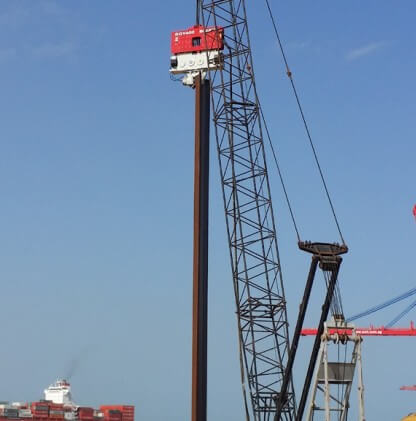
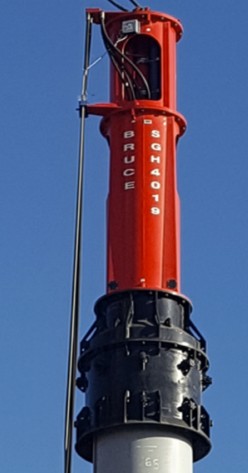
Sheet Pile Cofferdam for Network Rail Shoring:
UK Track-Side Contractor Guide 2026
“NR/L2/CIV/003 VIBRATION STANDARDS, BS EN 12699 COMPLIANCE, AND POSSESSION WINDOW FIELD PROTOCOL”
01. Network Rail Shoring — The Track-Side Cofferdam Requirement
Sheet pile cofferdams alongside active Network Rail infrastructure represent one of the most technically demanding piling environments in UK civil engineering. The combination of live train operations, proximity to buried signalling and telecommunications assets, overhead line equipment, and the strict vibration monitoring requirements of NR/L2/CIV/003 creates a regulatory and operational framework that eliminates most conventional piling methods from consideration. Vibratory hammers — specifically high-frequency hydraulic models with real-time remote amplitude control — are the industry standard for track-side cofferdam installation precisely because they offer the combination of penetration rate and vibration management capability that possession window productivity demands.
Network Rail’s investment programme through Control Period 7 (CP7, 2024–2029) includes significant drainage improvement, track foundation renewal, and lineside structure replacement work across the UK strategic rail network — the majority of which requires temporary cofferdam shoring to allow in-ground drainage and foundation work adjacent to operational track. These projects are typically delivered through Network Rail’s Principal Contractors under the NR/L2/CIV/003 earthworks and geotechnical standard, which imposes specific peak particle velocity (PPV) thresholds for construction vibration at track level that must be monitored continuously during piling operations.
Why Possession Windows Define Equipment Selection
Unlike highway construction where piling can proceed continuously during standard working hours, Network Rail track-side cofferdam installation is constrained by the possession window schedule — the periods during which the adjacent track is taken out of service for safe working. Full possessions, partial possessions, and open-line working restrictions each impose different constraints on plant size, working radius from the running rail, and the duration available for each piling sequence. A vibratory hammer that cannot maintain consistent penetration rate from the first pile of a possession — due to hydraulic warm-up time, carrier incompatibility issues, or worn gearbox components that cause frequency drop under load — wastes irreplaceable possession time that cannot be recovered within the agreed track access window.
New factory-calibrated equipment with verified hydraulic specifications and factory-confirmed carrier matching is consequently the only technically acceptable option for possession-constrained Network Rail cofferdam piling. Pre-mobilisation confirmation of hydraulic flow, operating pressure, and case drain routing — all documented in the BRUCE SGV operation manual — eliminates the risk of first-pile hydraulic issues that compress an already time-critical possession programme.
02. NR Vibration Standards and PPV Management
NR/L2/CIV/003 sets peak particle velocity (PPV) thresholds at track level during construction operations adjacent to operational railway. These thresholds are not guidance values — they are hard limits that trigger an automatic work stoppage if exceeded during continuous vibration monitoring. For vibratory sheet pile installation, the PPV generated at track level is a function of the hammer’s centrifugal force, operating frequency, distance from the pile to the monitoring point, and the dynamic amplification characteristics of the soil profile between the pile and the track formation. Managing PPV within NR/L2/CIV/003 limits while maintaining sufficient centrifugal force to achieve design embedment in UK rail corridor soils is the fundamental engineering challenge of Network Rail cofferdam piling.
The remote control pendant on BRUCE SGV series vibratory hammers addresses this challenge directly. The flow adjust dial allows the operator to reduce hydraulic pump flow — and consequently centrifugal force and amplitude — in real time when the continuous PPV monitoring system approaches the NR trigger level, without stopping the vibration cycle. This proportional response capability is the critical operational feature that distinguishes suitable Network Rail piling equipment from fixed-frequency alternatives, which offer no intermediate response between full operation and complete shutdown when PPV thresholds are approached.
Suppressor Elastomers and Ground-Borne Vibration Isolation
The suppressor assembly’s high-grade elastomers with mechanical stops mechanically decouple the vibrating gearbox from the crane hook, reducing the proportion of eccentric force transmitted to the ground surface through the crane structure and suspension system. This baseline isolation performance is documented in the BRUCE SGV technical specification and can be included in the NR/L2/CIV/003 vibration assessment submitted to the Network Rail Infrastructure Protection team as part of the construction method statement approval process. Degraded elastomers in pre-owned equipment cannot provide verifiable isolation performance — the absence of maintenance records makes it impossible to confirm whether the elastomers are within the manufacturer’s specified condition, which is a documentation requirement for NR method statement submission.
High-frequency operation above the natural resonance frequency of adjacent track and structure components additionally reduces transmitted PPV by preventing sympathetic resonance amplification in the rail and sleeper system. BRUCE SGV crane-suspended models operate within the 1,380 to 2,000 vpm frequency range, and excavator-mounted models reach 3,100 to 3,300 vpm — ranges that are typically above the resonance frequencies of standard Network Rail track panel assemblies, providing a measurable vibration management advantage compared to lower-frequency vibratory alternatives.
03. UK Rail Corridor Soil Profiles — London to Manchester
The UK strategic rail network traverses a geologically diverse range of soil and rock profiles, and the vibro hammer configuration required for Network Rail cofferdam piling varies significantly between different corridor locations. Understanding the dominant geological environment of the specific rail corridor is the starting point for pre-mobilisation equipment selection.
Southern and Eastern Routes — London Clay and Thames Gravels
Network Rail cofferdam projects on the Southern and Eastern routes — covering the ECML south of Peterborough, the Anglia routes, and the Southeastern network — predominantly encounter London Clay in the upper horizon, with Thames Valley gravels and Thanet Sand horizons at depth in the Thames Basin. London Clay presents high cohesive shear strength and significant skin adhesion after even short installation periods, requiring high eccentric moment models to break the cohesive particle bonding at the pile-soil interface and maintain penetration rate through the full cofferdam embedment depth. The centrifugal force selection rule of at least 15 times the pile weight is a conservative baseline in stiff London Clay — for deep cofferdam embedment requirements below the water table, an upward adjustment to 20 or 25 times the pile weight is commonly required to maintain acceptable penetration rates through the full drive sequence.
North West and Trans-Pennine Routes — Till and Mudstone
Network Rail cofferdam projects on the West Coast Main Line north of Rugby, the Trans-Pennine routes, and the Northern network encounter the glacially deposited tills and Mercia Mudstone formations characteristic of the North West Midlands and Lancashire geology. Glacial till in the Manchester Basin and Cheshire Plain contains erratic gravel and cobble inclusions that create unpredictable impact loads on the hammer gearbox during driving — an environment where precision-machined alloy steel eccentric weights in factory-certified new equipment provide significantly better fatigue resistance than the worn gear tooth profiles common in pre-owned equipment with undocumented maintenance histories. The Mercia Mudstone horizons encountered on deeper cofferdam embedment requirements in this region present high driving resistance in the weathered upper zone and very high resistance in the unweathered lower horizon — conditions that may require transitioning to hydraulic impact methods for final set if vibratory penetration reaches refusal before design tip elevation.
04. Possession Window Field Protocol — Maximising Drive Rate
The productivity of Network Rail cofferdam piling is measured in pile panels installed per possession window — a metric that depends entirely on the hammer being ready to drive from the first minute of the possession. Pre-possession preparation protocol for track-side vibratory hammer operation should include visual inspection and confirmation of suppressor elastomer condition, verification of hydraulic oil temperature reaching the operational range before the first pile is positioned, confirmation of remote pendant function and flow adjust response, and physical verification of the case drain line routing to the hydraulic tank. Each of these checks takes less than fifteen minutes in total and eliminates the most common causes of first-pile delay that compress possession window productivity.
During the possession, the remote pendant operator should coordinate with the continuous PPV monitoring operative to establish the relationship between flow adjust dial position and measured PPV at the NR monitoring instrument location during the first pile of each possession. This calibration — which typically takes one full pile drive — allows the operator to set the flow adjust dial at the maximum position that keeps PPV below the NR trigger level for the subsequent piles in the sequence, maximising centrifugal force and penetration rate within the regulatory constraint for the remainder of the possession window.
Cofferdam Extraction During Possession — Planning and Elastomer Condition
Temporary Network Rail cofferdam sheet pile extraction is typically planned as a separate possession sequence after the permanent drainage or foundation works within the cofferdam are complete. Extraction generates higher mechanical stress on the suppressor elastomers than driving — the upward crane pull combined with the vibration cycle creates combined tensile and eccentric loading on the elastomer rubbers that accelerates degradation if the elastomers are already approaching the end of their service life from the installation phase. Confirming elastomer condition before each extraction possession and having replacement elastomers available on site eliminates the risk of elastomer failure mid-extraction that would force a possession overrun — a significant commercial and contractual risk on Network Rail track access agreements.
For technical specifications, NR method statement documentation support, and pre-mobilisation model selection for your Network Rail cofferdam project, contact the BRUCE engineering desk at powerquip.co.kr/contact-us/. Full SGV series product specifications are available at powerquip.co.kr/products/vibro-hammer/features-2/.
Network Rail Cofferdam Piling FAQ
Q: What PPV threshold does NR/L2/CIV/003 set for vibratory piling adjacent to operational track?
“NR/L2/CIV/003 sets PPV trigger levels at track level that must be monitored continuously — the specific threshold depends on track type, formation sensitivity, and the proximity of signalling assets, and is agreed with Network Rail Infrastructure Protection during method statement approval.”
The remote pendant’s real-time flow adjust is the primary operational response when PPV approaches the trigger level — reducing centrifugal force proportionally without stopping the vibration cycle and losing possession time.Q: Can vibratory hammer driving documentation be included in a Network Rail NR/L2/CIV/003 method statement?
“Yes — the BRUCE SGV technical specification sheets provide the hammer model, centrifugal force rating, frequency range, and suppressor elastomer isolation performance data required for NR method statement submission.”
ISO 9001 certification documentation and suppressor performance data from the manufacturer are typically required by Network Rail Infrastructure Protection reviewers to verify that the proposed equipment meets the vibration management standard claimed in the method statement.Q: How many sheet pile panels can realistically be installed in a standard Network Rail full possession?
“Productivity per possession depends on pile section, soil conditions, possession duration, and PPV headroom available at the NR monitoring location — it cannot be stated as a universal figure without site-specific data.”
In medium-dense sand with adequate PPV headroom and a properly commissioned hammer, experienced Network Rail piling crews typically achieve consistent productivity from the second pile onward once the first-pile PPV calibration establishes the correct flow adjust setting for the possession.Q: Why is new equipment essential for Network Rail possession-constrained cofferdam piling rather than pre-owned alternatives?
“Pre-owned equipment with worn gearbox components causes harmonic drift under load — frequency drop that collapses soil liquefaction and stalls the pile during the possession, wasting irreplaceable track access time.”
New factory-calibrated equipment with verified hydraulic specifications eliminates this failure mode. The NR method statement documentation requirement for verified suppressor performance data additionally cannot be met by pre-owned equipment without current manufacturer-confirmed elastomer specifications.