Sheet Pile Retaining Wall:
US DOT Contractor Field Guide 2026
“VIBRO HAMMER SELECTION, FHWA COMPLIANCE, AND SOIL-SPECIFIC PROTOCOL FOR US HIGHWAY RETAINING STRUCTURES”
01. Sheet Pile Retaining Walls on US DOT Highway Projects
Sheet pile retaining walls are one of the most frequently specified earth retention solutions on US DOT highway improvement and widening programs. Compared to cast-in-place concrete retaining walls and mechanically stabilized earth (MSE) systems, steel sheet pile walls offer faster installation, lower temporary works requirements, and the flexibility to be installed in restricted right-of-way conditions where traditional formwork and staged earthwork methods are impractical. On urban highway corridor widening projects — where live traffic must be maintained adjacent to the construction zone throughout the retaining wall installation phase — the speed and minimal surface disruption of vibratory sheet pile installation is a decisive procurement advantage.
FHWA design guidance for sheet pile retaining walls on federally funded highway projects references AASHTO LRFD Bridge Design Specifications for structural pile capacity and wall system design. For the geotechnical contractor, the primary field performance requirement is achieving the design embedment depth specified in the geotechnical report — the depth at which the sheet pile provides the passive earth pressure resistance required for wall stability. This embedment depth drives the vibratory hammer size selection, as it determines both the total skin friction that must be overcome during driving and the centrifugal force required to maintain penetration rate through the full driving sequence from surface to design tip elevation.
Temporary vs. Permanent Sheet Pile Retaining Walls — Different Equipment Priorities
US DOT highway projects use sheet pile retaining walls in two configurations that require different vibratory hammer operational priorities. Temporary sheet pile walls for cut-and-cover excavations — such as underpass construction, utility crossing installations, and grade separation structures — require a hammer with strong extraction capability, as the temporary wall must be recovered after the permanent structure is backfilled. Permanent sheet pile retaining walls for embankment support and cut slope stabilization require a hammer focused on achieving full design embedment at the first attempt, as the piles are not intended for extraction and must reach final set at the specified tip elevation on the initial drive. Understanding which application type applies to each wall panel sequence before mobilization allows the field superintendent to configure the remote pendant amplitude settings appropriately for each phase of the retaining wall installation program.
02. Regional US Soil Conditions for Retaining Wall Piling
The soil conditions encountered in US DOT highway corridor retaining wall projects vary significantly by region, and vibratory hammer model selection must reflect the specific geological profile of each project location rather than a generic national standard. The three primary soil environments for US highway retaining wall sheet piling — Mid-Atlantic coastal plain, Southeastern Piedmont, and Midwest glaciated terrain — each present distinct driving resistance profiles that require different hammer configurations to achieve consistent design embedment.
Mid-Atlantic Coastal Plain — Layered Sand and Clay
In the Mid-Atlantic states — covering the I-95 corridor from Virginia to New Jersey — highway retaining wall projects encounter coastal plain deposits of alternating fine sand, silt, and stiff clay layers. The upper sand horizons are typically loose to medium-dense and respond readily to high-frequency vibratory driving, allowing rapid penetration through the upper portion of the wall embedment zone. The underlying clay layers, however, require a transition to higher eccentric moment operation to maintain penetration rate — a transition that the remote pendant’s real-time flow adjust facilitates without stopping the drive cycle. Pile verticality in these layered profiles requires careful monitoring, as the transition from soft to stiff layers can cause pile deflection if the hammer is not maintaining consistent vertical centrifugal force throughout the drive.
Midwest and Great Plains — Glacial Till and Dense Sand
Highway retaining wall projects in the Midwest and Great Plains states — covering major interstate corridor improvements in Illinois, Indiana, Ohio, and Iowa — encounter glacially deposited soils including dense till, outwash sand and gravel, and overconsolidated lacustrine clay. Dense glacial till presents high and unpredictable driving resistance, with erratic gravel and cobble inclusions that can cause sudden impact loads on the hammer gearbox during the drive cycle. New factory-calibrated equipment with precision-machined alloy steel eccentric weights and synchronized gearbox assemblies is essential for sustained operation in these conditions — pre-owned equipment with worn gear tooth profiles cannot maintain frequency stability under the shock loads generated by till driving, leading to harmonic drift and pile stall before design embedment is reached.
In the dense glacial outwash sand and gravel horizons characteristic of the Chicago metropolitan area and the I-90 corridor, high-frequency vibratory operation is the dominant penetration mechanism — maintaining soil liquefaction in the granular matrix between gravel particles to allow pile advancement through the horizon. The BRUCE SGV series remote pendant flow control allows operators to increase centrifugal force progressively as penetration resistance increases with depth, preventing premature stall in the gravel horizon before the design embedment level is reached in the underlying dense sand or clay.
03. Vibro Hammer Selection and Carrier Configuration
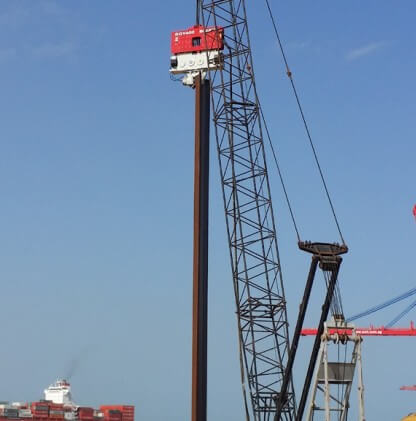
Vibratory hammer selection for US DOT highway retaining wall projects is determined by the combination of sheet pile section weight, design embedment depth, and the dominant soil resistance at the design tip elevation. As a baseline selection rule, centrifugal force should be at least 15 times the pile weight — but for US highway retaining wall projects where the design tip falls in dense or stiff soil horizons, the effective centrifugal force requirement at depth typically demands an upward adjustment from this baseline to account for accumulated skin friction and end-bearing resistance at the design tip.
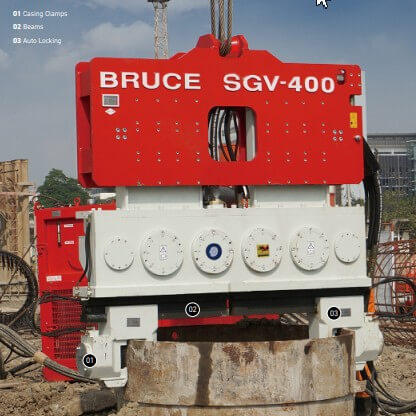
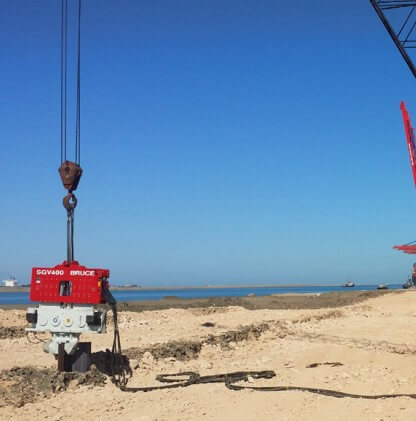
For US DOT highway retaining wall projects, the choice between crane-suspended and excavator-mounted vibratory hammer configurations is driven by the project’s physical context. Urban highway corridor widening projects — where the retaining wall is being installed within a narrow right-of-way alongside live traffic — typically favor excavator-mounted configurations for their compact footprint, faster repositioning between pile locations, and elimination of the separate crane mobilization cost. The BRUCE SGV excavator-mounted series (SGV-40, SGV-60, SGV-80E) covers the 20 to 50-ton excavator weight class and connects directly to the host machine’s auxiliary hydraulic circuit without a separate power pack, reducing the equipment mobilization footprint to a single machine for projects where access constraints make crane deployment impractical.
Low-Clearance Retaining Wall Sites — Side Grip Technology
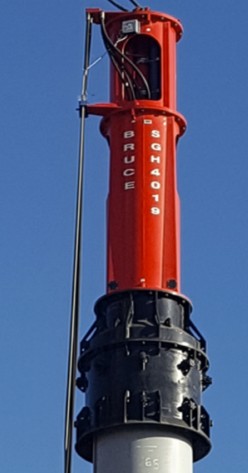
A subset of US DOT highway retaining wall projects present overhead clearance constraints that prevent the use of conventional top-clamp vibratory hammers — specifically underpass reconstruction projects, bridge abutment replacement adjacent to existing superstructures, and retaining walls installed inside existing cut-slope formations where overhead power lines or structure clearances restrict vertical equipment reach. For these applications, side-grip vibratory hammer technology — which clamps the sheet pile laterally rather than from the top — eliminates the overhead clearance requirement of conventional configurations and allows full-length sheet pile installation within restricted height zones that standard equipment cannot access.
Full technical specifications for the BRUCE SGV crane-suspended, excavator-mounted, and tilting model series — including centrifugal force ratings, required hydraulic flow and pressure for each carrier weight class, and clamp jaw compatibility with standard US sheet pile sections — are available at powerquip.co.kr/products/vibro-hammer/features-2/.
04. FHWA Compliance and Urban Site Protocol
Sheet pile retaining wall installation on federally funded US DOT highway projects is subject to FHWA construction quality assurance requirements that include documentation of pile driving equipment, driving criteria, and pile installation logs. For vibratory hammer installation of sheet pile retaining walls, the primary documentation requirements are the hammer model and centrifugal force rating, the operating frequency at the time of driving, and penetration rate records at each pile location confirming that design embedment was achieved. These records are typically submitted to the State DOT resident engineer as part of the pile installation report required under the geotechnical special provisions of the FHWA-funded highway contract.
On urban US DOT highway retaining wall projects adjacent to existing residential neighborhoods, commercial districts, or sensitive institutional uses — schools, hospitals, and care facilities — local noise ordinances and construction hour restrictions apply concurrently with the FHWA documentation requirements. BRUCE hydraulic vibratory systems produce significantly lower baseline noise than diesel hammer alternatives, directly reducing the permit monitoring burden on urban highway corridor retaining wall projects where community relations and construction noise complaints can affect project scheduling and contractor performance evaluations by State DOT resident engineers.
Pile Verticality and Interlock Integrity — Urban Retaining Wall Quality Requirements
Permanent sheet pile retaining walls on US DOT highway projects require strict pile verticality tolerances — typically within 1% of plumb — to ensure that the interlocking connections between adjacent piles maintain their structural continuity and watertightness across the full wall length. Balanced double-side eccentric weights in the vibratory hammer gearbox cancel horizontal force components and produce purely vertical oscillation — the configuration that prevents lateral pile deviation during driving and protects interlock integrity in the completed wall. Pre-owned equipment with worn synchronization gear profiles develops harmonic drift under load, creating lateral oscillation that causes pile deviation from vertical alignment and damages interlocks — a quality failure that requires costly remediation on permanent DOT retaining wall structures.
The suppressor assembly’s elastomer isolation system additionally protects adjacent highway infrastructure from construction vibration during retaining wall installation. On US DOT projects where the new retaining wall is being installed adjacent to an existing highway pavement, bridge abutment, or buried utility corridor, transmitted ground vibration from vibratory pile driving must be managed within the limits specified in the FHWA geotechnical special provisions to prevent damage to adjacent existing structures. The remote pendant’s real-time amplitude control allows vibration management near sensitive adjacent infrastructure without stopping the drive cycle — maintaining installation productivity while satisfying the construction vibration monitoring requirements of the FHWA-funded highway contract.
To discuss vibratory hammer selection, FHWA documentation support, and commissioning assistance for your US DOT retaining wall project, contact the BRUCE engineering desk at powerquip.co.kr/contact-us/.
Retaining Wall Piling FAQ
Q: What documentation does FHWA require for vibratory sheet pile retaining wall installation on federally funded highway projects?
“FHWA typically requires hammer model and centrifugal force rating, operating frequency at time of driving, and penetration rate records confirming design embedment was achieved at each pile location.”
These records are submitted to the State DOT resident engineer as part of the pile installation report under the geotechnical special provisions. BRUCE provides full technical specification sheets for all SGV models in formats suitable for FHWA project documentation submission.Q: When should an excavator-mounted vibratory hammer be chosen over a crane-suspended model for US DOT retaining wall work?
“Excavator-mounted models are preferred for urban highway corridor projects where right-of-way constraints, overhead clearances, or live traffic management make crane deployment impractical.”
The BRUCE SGV excavator-mounted series covers the 20 to 50-ton carrier weight class and eliminates the separate power pack mobilization requirement. For sheet pile sections and embedment depths within the SGV excavator-mounted series capacity range, the excavator configuration typically reduces total mobilization cost and repositioning time significantly compared to crane-suspended alternatives.Q: How does pile verticality tolerance affect vibratory hammer selection for permanent US DOT retaining walls?
“Balanced double-side eccentric weights producing purely vertical oscillation are the critical specification for permanent retaining wall installation — lateral oscillation from worn gear profiles causes pile deviation and interlock damage.”
New factory-calibrated equipment maintains eccentric weight balance from first deployment. Pre-owned equipment with worn synchronization gears cannot guarantee the purely vertical oscillation required for FHWA pile verticality tolerance compliance on permanent retaining wall structures.Q: How should contractors manage construction vibration adjacent to existing US highway pavement during sheet pile retaining wall installation?
“Use the remote pendant’s real-time flow adjust to reduce centrifugal force and amplitude when driving adjacent to existing pavement, abutments, or buried utilities — maintaining penetration rate while keeping transmitted vibration within FHWA special provision limits.”
The suppressor elastomer assembly provides baseline vibration isolation between the hammer gearbox and the crane structure. Visual inspection of elastomers before each shift is standard protocol — degraded elastomers reduce isolation performance and increase transmitted ground vibration to adjacent highway infrastructure during active driving.