Vibro Hammer for US Coastal Flood Defense:
Hurricane Barrier Sheet Pile Guide 2026
“SHEET PILE SELECTION, USACE COMPLIANCE, AND FIELD PROTOCOL FOR GULF COAST AND ATLANTIC SEABOARD PROJECTS”
01. Coastal Flood Defense Piling — The US Infrastructure Priority
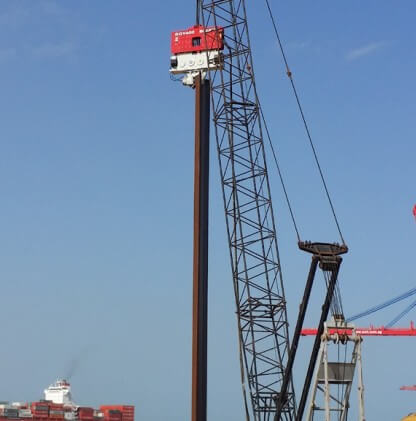
Coastal flood defense infrastructure has become one of the largest categories of civil engineering investment in the United States following successive hurricane seasons across the Gulf Coast and Atlantic Seaboard. The US Army Corps of Engineers (USACE) is administering multi-billion dollar coastal storm risk management programs across Louisiana, Texas, Florida, New Jersey, and New York — the majority of which rely on steel sheet pile flood walls, hurricane barriers, and surge protection levees as the primary structural defense element. Vibratory hammers are the installation method of choice for these projects, where the combination of high penetration speed in saturated coastal soils, low noise and vibration output, and pile extraction capability for temporary works phases makes them technically and commercially superior to impact alternatives.
The scale of individual USACE coastal risk management contracts has increased significantly in the 2020s. Projects such as the Lake Pontchartrain and Vicinity Hurricane Protection improvements in Louisiana, the New York-New Jersey Harbor and Tributaries Study, and the Corpus Christi Ship Channel Storm Surge Barrier in Texas represent multi-year construction programs where piling contractors must maintain sustained sheet pile installation productivity across extended site mobilizations. In these environments, equipment reliability and the ability to maintain centrifugal force stability under continuous operation are the defining procurement criteria — not initial unit price.
Temporary Cofferdam vs. Permanent Flood Wall — Piling Equipment Differences
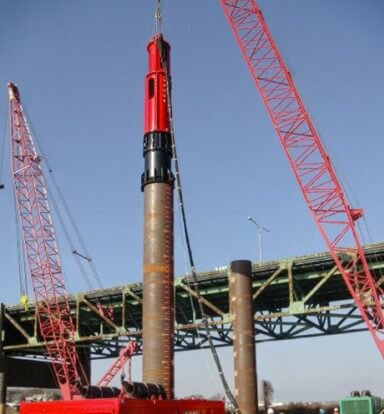
US coastal flood defense programs involve two distinct sheet pile applications that require different vibratory hammer configurations. Temporary cofferdams for construction access — protecting in-water work areas during seawall and barrier construction — require a hammer with strong extraction capability, as the temporary sheet piles must be recovered after the permanent structure is complete. Permanent flood wall sheet pile installation requires a hammer optimized for driving to refusal at maximum penetration depth, where extraction is not required but achieving final set in the dense sand and clay layers below the storm surge waterline is the primary performance criterion. Matching the hammer to the specific application — rather than using a single configuration for both — directly affects project productivity and equipment utilization efficiency across a multi-year coastal defense program.
02. Gulf Coast and Atlantic Seaboard Soil Conditions
Coastal flood defense piling on the US Gulf Coast and Atlantic Seaboard encounters some of the most challenging soil profiles in North American foundation engineering. The Mississippi Delta region of Louisiana presents very soft organic clays and loose silts with SPT N-values below 5 in the upper 10 metres — conditions where vibratory penetration is rapid but maintaining pile alignment and preventing over-driving requires continuous amplitude management via the remote control pendant. Below these soft upper layers, dense sand and shell hash horizons create sudden increases in driving resistance that can stall a hammer not sized for the peak load demand at depth.
Along the Texas Gulf Coast — particularly in the Corpus Christi and Houston-Galveston regions — the soil profile transitions from loose to medium-dense sand in the upper horizon to stiff overconsolidated clay at depth, reflecting the regional geology of the Beaumont and Gulf Coast Formations. These clay layers require high eccentric moment models to break cohesive particle bonding and maintain penetration rate through the driving depth required for permanent flood wall embedment. Furthermore, the high groundwater table throughout the Gulf Coast region means that equipment hydraulic sealing and biodegradable oil compatibility are operational necessities from the first day of site mobilization, not optional specifications.
Atlantic Seaboard — Mid-Atlantic and Northeastern Conditions
On the Mid-Atlantic and Northeastern Seaboard — covering the New Jersey barrier island coastline, Long Island Sound, and the Connecticut River tidal zone — flood defense sheet pile projects encounter glacially deposited soils that are significantly denser and more variable than Gulf Coast profiles. Glacial till and outwash sand and gravel layers create high and unpredictable driving resistance that demands a hammer with sufficient centrifugal force reserve to drive through erratic gravel horizons without stalling. The dense urban context of Northeastern coastal cities — with legacy buried utilities, historic structure foundations, and active commercial waterfronts adjacent to flood wall construction zones — additionally requires vibration management capability that fixed-frequency equipment cannot provide.
In New York Harbor and the Hudson River estuary, USACE permit conditions for in-water flood defense work intersect with New York State DEC requirements, EPA coastal permit conditions, and New York City Department of Environmental Protection oversight — creating one of the most complex regulatory environments for piling equipment operation in the US. Biodegradable hydraulic oil compatibility, no-smoke operation, and real-time amplitude control via the remote pendant are all operationally required to maintain permit compliance throughout the construction phase on these projects.
03. Vibratory Hammer Specification for Flood Barrier Sheet Piling
Vibratory hammer selection for US coastal flood defense projects must account for the full range of soil conditions encountered from the surface to the design embedment depth — not just the dominant upper stratum. The selection rule that centrifugal force should be at least 15 times the pile weight provides the baseline, but coastal flood wall projects frequently require an upward adjustment from this baseline to account for the dense sub-layers encountered at final embedment depth. Specifying a hammer sized only for the soft upper horizon will result in pile stall when the dense sand or clay layer is reached — a schedule-critical failure on USACE permit-restricted in-water work programs.
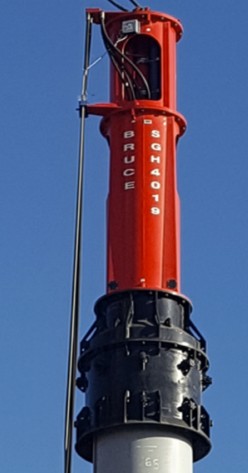
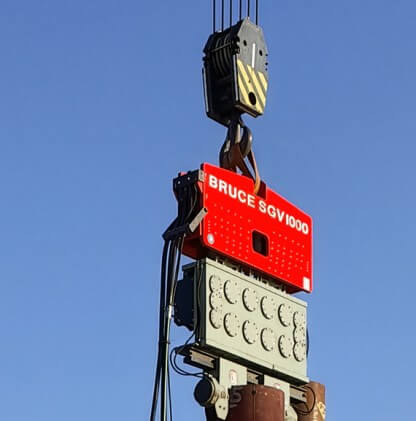
The BRUCE SGV crane-suspended series covers centrifugal forces from 510 kN to 4,610 kN across the SGV-80 to SGV-2000 model range. For permanent flood wall sheet pile installation on major USACE coastal storm risk management programs, the mid-to-high capacity models in this range — with eccentric moments from 80 kgm upward — provide the centrifugal force and amplitude combination required to achieve design embedment in the variable soil profiles characteristic of Gulf Coast and Atlantic Seaboard coastal flood defense sites. All SGV models include a built-in clamp check valve that maintains clamping pressure independently of hose pressure — a critical safety feature for tidal zone operation where current and wave action can shift the hammer position during the drive cycle.
Power Pack Specification for Extended Coastal Site Operations
BRUCE PQ-V series power packs matched to the SGV crane-suspended models are designed for operation from -30°C to above 40°C — covering the full ambient temperature range encountered across US coastal flood defense programs from Louisiana summer heat through to Northeastern autumn and early winter construction seasons. This thermal operating range is particularly relevant on Gulf Coast projects where continuous summer operation in ambient temperatures above 38°C places sustained thermal load on hydraulic circuits that power packs with narrower operating specifications cannot sustain without oil temperature exceedances. All PQ-V power packs are compatible with biodegradable hydraulic oils, satisfying USACE and EPA permit conditions for in-water work without post-purchase hydraulic circuit modification.
For detailed SGV model and power pack specifications matched to your project pile schedule and coastal soil data, the full technical product range is available at powerquip.co.kr/products/vibro-hammer/features-2/.
04. USACE Permit Compliance and Environmental Protocol
All in-water piling operations on US coastal flood defense projects fall under USACE Section 404 (Clean Water Act) and Section 10 (Rivers and Harbors Act) permit jurisdiction. These permits impose specific construction method requirements that directly affect vibratory hammer specification and operational protocol. The most common equipment-specific permit conditions on 2026 coastal flood defense programs include mandatory use of biodegradable hydraulic fluids for all equipment operating in or adjacent to navigable waters, restricted in-water work windows to protect fisheries and sensitive aquatic habitats during spawning and migration seasons, and real-time noise and vibration monitoring requirements on projects adjacent to residential communities and sensitive ecological zones.
The underwater acoustic impact of piling operations has become an increasingly prominent permit condition on USACE coastal projects in regions with protected marine mammal habitats — particularly in the Northeast where North Atlantic right whale critical habitat zones overlap with coastal infrastructure corridors. Vibratory hammers generate significantly lower underwater acoustic pressure than hydraulic impact hammers, making them the preferred installation method under NOAA and USFWS consultation requirements on projects in or adjacent to essential fish habitat and critical habitat designations. For permanent flood wall sections where final embedment in hard strata requires impact driving for bearing verification, the combined approach — vibratory hammer for initial penetration through the soft and medium strata, impact hammer for final set in the dense lower layer — is the standard field protocol that satisfies both production schedule requirements and NOAA acoustic impact thresholds.
Silt Curtain and Turbidity Management During Sheet Pile Installation
USACE permits for coastal flood defense sheet pile installation in tidal and estuarine zones typically require silt curtain deployment around the active piling area to contain sediment disturbance during driving. Vibratory hammers generate less sediment disturbance than impact hammers in soft coastal soils — a measurable environmental advantage that simplifies silt curtain sizing and turbidity monitoring compliance on USACE-regulated in-water construction programs. The no-smoke operation of hydraulic vibratory systems additionally reduces the air quality monitoring burden on coastal flood defense construction sites where EPA and state air quality permit conditions apply concurrently with in-water work restrictions.
For pre-mobilization technical consultation on USACE permit compliance, biodegradable oil specification, and vibratory hammer selection for your coastal flood defense project, contact the BRUCE engineering desk at powerquip.co.kr/contact-us/.
Coastal Flood Defense Piling FAQ
Q: Why are vibratory hammers preferred over impact hammers for USACE coastal flood defense sheet piling?
“Vibratory hammers generate lower underwater acoustic pressure than impact hammers — a critical advantage on USACE projects in NOAA-designated essential fish habitat and marine mammal critical habitat zones.”
Additionally, vibratory hammers achieve higher penetration rates in the saturated granular soils characteristic of Gulf Coast and Atlantic Seaboard flood defense sites, and provide pile extraction capability for temporary cofferdam recovery after the permanent flood wall is complete.Q: What soil conditions are most challenging for vibratory hammer performance on US coastal flood defense projects?
“Dense sub-surface clay and shell hash horizons below the soft upper strata are the primary challenge — requiring upward adjustment from the baseline 15x pile weight centrifugal force selection rule.”
Specifying a hammer sized only for the soft upper horizon results in stall when the dense lower layer is reached. Confirming model selection against the full soil bore log at design embedment depth prevents this failure mode on USACE coastal flood defense contracts.Q: Is biodegradable hydraulic oil a mandatory requirement on all USACE coastal flood defense piling projects?
“It is an increasingly standard USACE Section 404 permit condition for in-water work on navigable waterways — and should be specified at equipment order stage, not addressed post-mobilization.”
All BRUCE SGV hydraulic components and PQ-V power packs are confirmed compatible with biodegradable hydraulic oils, satisfying this requirement without hydraulic circuit modification or post-purchase adaptation.Q: How does the combined vibratory and impact approach satisfy both NOAA acoustic thresholds and DOT bearing verification requirements?
“Vibratory hammers handle initial penetration through soft and medium strata with low underwater noise — impact hammers complete final set in dense layers where ASTM D4945 blow count verification is required.”
This combined protocol is the standard field approach on major USACE coastal flood defense contracts where both environmental permit acoustic limits and structural pile capacity certification requirements apply simultaneously. BRUCE supplies both SGV vibratory and SGH impact series from a single manufacturer source, simplifying compliance documentation across both equipment types.