Cofferdam Piling for US Highway Bridge Replacement:
2026 Contractor Field Guide
“ASTM D4945 COMPLIANCE, VIBRO HAMMER SELECTION, AND FIELD PROTOCOL FOR US DOT PROJECTS”
01. Why Cofferdam Piling Defines US Bridge Replacement Timelines
On US DOT highway bridge replacement contracts, the cofferdam is the first permanent decision made on site. Before a single pier footing can be poured, contractors must establish a dry working environment within the river channel or tidal zone — and the speed and precision of sheet pile cofferdam installation directly sets the pace for everything that follows. In 2026, with federal infrastructure funding accelerating bridge replacement programs across the Northeast, Southeast, and Gulf Coast corridors, the ability to mobilize and execute cofferdam piling without schedule delay has become a primary competitive differentiator for US foundation contractors.
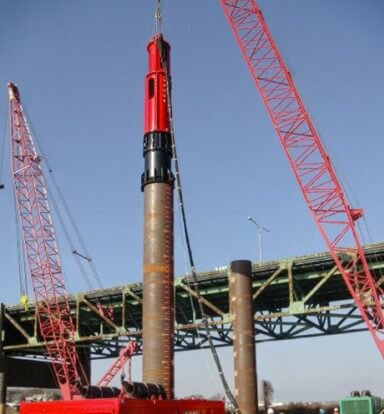
Vibratory hammers are the industry-standard method for sheet pile cofferdam installation in the granular and silty soils that dominate US river bridge sites. In saturated sands and loose silts — conditions typical of the Mississippi Delta, the Atlantic Coastal Plain, and the Chesapeake Bay watershed — high-frequency vibratory driving achieves penetration rates that impact methods cannot match, while producing the low noise and vibration profile required on live-traffic bridge sites where adjacent lanes remain open throughout construction.
The Planning Window — Tidal and River Stage Constraints
US bridge cofferdam projects on tidal rivers and navigable waterways operate within permit windows issued by the US Army Corps of Engineers (USACE). These windows typically restrict in-water work to specific seasons to protect fisheries and aquatic habitats — creating concentrated mobilization and execution periods where equipment downtime carries compounded schedule risk. A vibratory hammer that fails to maintain operating frequency under load on day one of a USACE permit window can trigger schedule consequences that affect the entire project critical path, including concrete pours, formwork, and superstructure steel erection.
Furthermore, river stage fluctuations on inland bridge sites in the Midwest and South create variable pore water pressure conditions that affect vibratory penetration rate throughout the drive cycle. The remote control pendant’s real-time flow adjust function — which allows operators to vary centrifugal force and amplitude without stopping the hammer — is the primary operational tool for managing penetration rate across these changing conditions without unplanned stoppages.
02. Vibro Hammer Selection for US River and Coastal Bridge Sites
Selecting the correct vibratory hammer for a US bridge cofferdam project requires matching three parameters to the site-specific soil profile: centrifugal force, eccentric moment, and operating frequency. The starting selection rule — confirmed across BRUCE SGV series deployments on US DOT projects — is that centrifugal force should be at least 15 times the pile weight. For standard Larssen sheet piles in medium-dense sand at 10 to 15 metre penetration depth, a mid-range crane-suspended model is typically sufficient. For heavier Z-profile sections in stiff alluvial clay at greater depths, a higher-capacity model with larger eccentric moment is required to maintain penetration rate through the cohesive horizon.
On US coastal bridge sites — particularly along the Gulf Coast and Atlantic Seaboard where the soil profile alternates between loose marine sands and stiff organic clays — the ability to adjust amplitude in real time is more operationally critical than peak centrifugal force rating. A hammer that can reduce centrifugal force in soft upper strata to prevent over-driving, then increase it progressively as the pile encounters denser material at depth, allows the operator to maintain a consistent drive rate across variable soil conditions without stopping the cycle to re-set the hammer configuration.
Crane-Suspended vs. Excavator-Mounted for Bridge Cofferdam Work
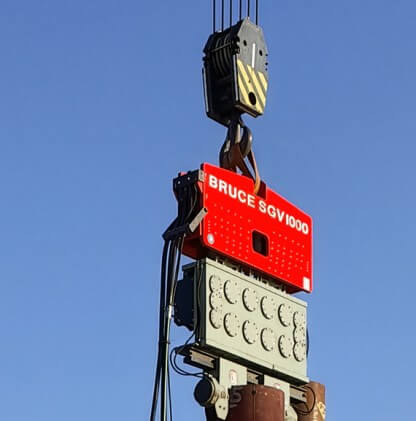
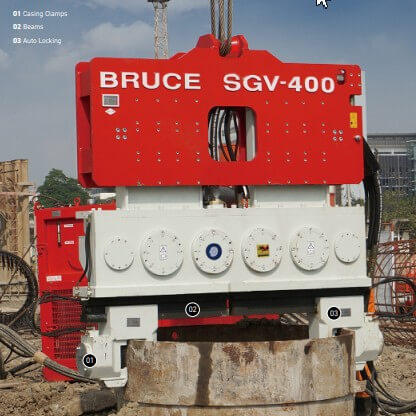
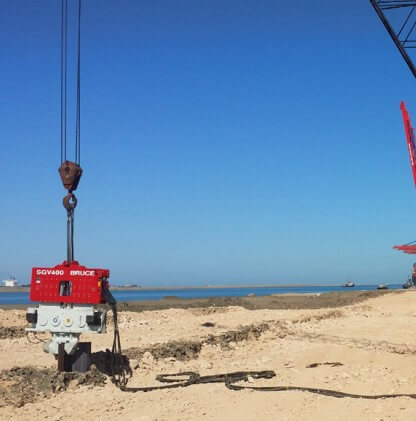
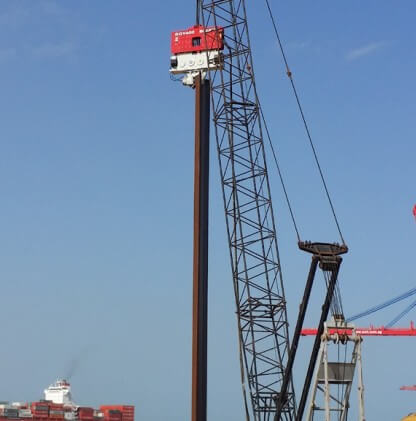
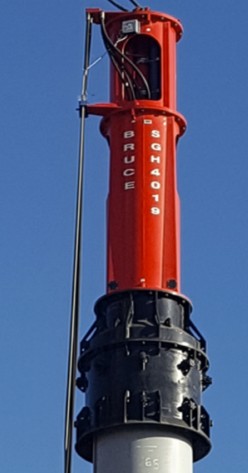
For major bridge cofferdam projects requiring large sheet pile sections and significant penetration depth, crane-suspended vibratory hammers provide the centrifugal force range and vertical clearance that excavator-mounted units cannot reach. The BRUCE SGV crane-suspended series covers centrifugal forces from 510 kN (SGV-80) to 4,610 kN (SGV-2000) — covering the full range of US bridge cofferdam sheet pile requirements from light temporary shoring through to large-diameter steel casing cofferdams on major river crossing projects.
For smaller bridge replacement projects on secondary highways — where site access is constrained and a full crane setup is impractical — the excavator-mounted SGV series (SGV-40, SGV-60, SGV-80E) connects directly to the host machine’s auxiliary hydraulic circuit without a separate power pack, reducing both mobilization equipment and setup time. The tilting models (SGV-40T, SGV-60T) with 360° hydraulic rotation and 90° hydraulic tilt allow a single operator to pick up sheet piles from the ground stack, tilt them vertical, and drive them without a secondary crane or ground crew for pile positioning — a significant productivity advantage on confined bridge replacement sites where working space is limited by live traffic lanes and temporary traffic management.
For technical specifications and model selection support based on your project pile schedule and soil data, the BRUCE engineering desk provides pre-mobilization model confirmation at powerquip.co.kr/products/vibro-hammer/features-2/.
03. ASTM Compliance and Field Protocol
US DOT highway bridge replacement contracts funded under FHWA programs require driven pile bearing capacity verification per ASTM D4945 (High-Strain Dynamic Testing of Deep Foundations). While vibratory hammers are used for sheet pile cofferdam installation — which does not require ASTM D4945 blow count certification — the bearing piles installed within the cofferdam typically do. On projects where both vibratory sheet pile installation and hydraulic impact hammer bearing pile work occur on the same site, having equipment from a single manufacturer with documented ASTM D4945 compliance capability simplifies the procurement, commissioning, and technical documentation process significantly.
The optional IEA (Impact Energy Analysis) System — developed by BRUCE and adopted as a standard monitoring system by the Hong Kong Housing Government — records real-time energy at every blow during hydraulic impact hammer operation, providing the verifiable energy transfer log required for ASTM D4945 structural auditing. Field measurements on SGH-1015 and SGH-1415 deployments confirmed energy transfer rates of up to 90%, providing the quantitative baseline for GRLWEAP wave equation analysis and AASHTO LRFD pile capacity certification on US DOT-funded bridge contracts.
USACE Permit Conditions — Biodegradable Oil and Noise Management
USACE Section 404 permits for in-water bridge cofferdam work on navigable waterways increasingly require biodegradable hydraulic fluids for all equipment operating in or adjacent to the water column. All BRUCE SGV and SGH hydraulic components are confirmed compatible with biodegradable hydraulic oils — satisfying this requirement without post-purchase equipment modification or hydraulic circuit adaptation. On projects subject to EPA coastal construction permit conditions in addition to USACE oversight, the combination of biodegradable oil compatibility and no-smoke hydraulic operation directly reduces the environmental monitoring burden during the cofferdam installation phase.
For bridge cofferdam projects on urban river crossings in cities such as Providence, Jacksonville, or Pittsburgh — where the cofferdam site is adjacent to residential areas or active commercial waterfronts — local noise ordinances apply simultaneously with USACE permit conditions. BRUCE hydraulic vibratory systems produce significantly lower baseline noise than diesel hammer alternatives, and the remote pendant’s real-time amplitude control allows further noise reduction near sensitive receptors without halting the drive cycle.
04. Extraction and Site Restoration after Bridge Construction
Sheet pile extraction is one of the defining operational advantages of vibratory hammers over impact pile driving systems. After the bridge substructure is complete and the cofferdam is dewatered and stripped, the same vibratory hammer used for installation is used to extract the sheet piles — allowing the steel sections to be recovered, inspected, and redeployed on subsequent projects. This extraction capability is a major cost factor in temporary works planning for US bridge replacement contracts, where the sheet pile quantity per cofferdam cell can represent a significant proportion of the temporary works materials budget.
During extraction, the vibratory hammer clamps onto the sheet pile head and vibrates while the crane applies upward line pull. The vibration temporarily reduces skin friction along the full pile length — the same liquefaction principle used during driving — allowing the pile to be drawn upward with significantly lower crane pull force than static extraction methods require. The clamp check valve maintains hydraulic clamping pressure independently of hose pressure during the extraction cycle, preventing pile drop in tidal conditions where current or wave action can shift the hammer position relative to the pile head during the withdrawal sequence.
Void Filling Protocol — USACE and State DOT Requirements
As each sheet pile is extracted from a US bridge cofferdam, the resulting void along the pile shaft must be filled immediately with approved backfill material — typically grout, sand, or controlled low-strength material — to prevent surface settlement and scour around the new bridge foundations. On river bridge sites in the US where the cofferdam is adjacent to the new pier footings, void collapse after extraction without immediate backfill can trigger settlement that affects the completed concrete substructure. This protocol is typically specified in the method statement submitted to the State DOT and USACE as part of the cofferdam removal plan, and must be confirmed with the project geotechnical engineer before extraction commences.
For technical consultation on vibro hammer selection, ASTM compliance documentation, and field commissioning support for US bridge cofferdam projects, contact the BRUCE engineering desk directly at powerquip.co.kr/contact-us/.
Cofferdam Piling FAQ
Q: What vibratory hammer size is required for a standard US highway bridge cofferdam?
“Centrifugal force should be at least 15 times the pile weight — model selection is confirmed against the pile section, penetration depth, and soil bore log N-values at the design tip elevation.”
For standard Larssen sheet piles in medium-dense river sand at 10 to 15 metre depth, a mid-range crane-suspended SGV model is typically sufficient. Heavier Z-profiles in stiff alluvial clay require a higher-capacity model with larger eccentric moment. The BRUCE engineering desk provides pre-mobilization model confirmation based on project-specific data.Q: Do USACE permit conditions require biodegradable hydraulic oil for cofferdam vibratory hammers?
“Increasingly yes — USACE Section 404 permits for in-water work on navigable waterways are including biodegradable hydraulic fluid requirements as a standard permit condition.”
All BRUCE SGV hydraulic components are confirmed compatible with biodegradable hydraulic oils, satisfying this requirement without modification. Confirming oil specification at order stage ensures the equipment arrives site-ready for USACE permit compliance on the first day of in-water operation.Q: Can the same vibratory hammer be used for both cofferdam installation and pile extraction on a US bridge project?
“Yes — vibratory hammers are designed for both driving and extraction. The same hammer and clamp assembly used for installation extracts the piles after bridge construction is complete.”
The clamp check valve maintains clamping pressure independently during extraction, preventing pile drop. Suppressor elastomers must be inspected before extraction commences, as extraction generates higher stress on the suppressor assembly than driving.Q: How does river stage variation affect vibratory hammer performance on US inland bridge sites?
“Rising river stage increases pore water pressure in the adjacent soil profile, temporarily reducing effective stress — which can increase penetration rate but may also cause over-driving in soft upper strata.”
The remote pendant’s real-time flow adjust allows operators to reduce centrifugal force during high-stage conditions to prevent over-driving, and increase it during low-stage when effective stress is higher and penetration resistance increases. Monitoring hydraulic oil temperature during extended high-stage driving is standard field protocol on Gulf Coast and Midwest river bridge sites.