Piling Equipment Import 2026:
A Technical Guide to Sourcing ICE Vibratory Hammer Alternatives from Korean Manufacturers
“NAVIGATING CUSTOMS COMPLIANCE, TECHNICAL VERIFICATION, AND SPECIFICATION-EQUIVALENT PROCUREMENT FOR US AND UK FOUNDATION CONTRACTORS”
“The strategic case for piling equipment import in 2026 is not built on cost alone — it is built on documentation. Procurement engineers who can verify ISO 9001 certified manufacturing, independently confirmed project references, and ASTM- or BS EN-compliant technical data packages have the foundation to specify Korean-manufactured vibratory hammers alongside European alternatives with full engineering confidence.”
01. The 2026 Case for Direct Piling Equipment Import
The global market for piling equipment import has entered a structural inflection point in 2026. For the preceding two decades, the procurement of high-performance vibratory hammers in the United States and United Kingdom was concentrated among a small group of established European and Japanese manufacturers operating through regional distributor networks. However, three converging forces are accelerating the shift toward direct-import procurement from Asian — and specifically Korean — manufacturers: documented ISO 9001 certified production quality, independently verified project references on government-funded infrastructure, and the growing capability of Korean exporters to provide the compliance documentation packages required by engineering-led procurement teams on federally regulated projects.
The Deep Foundations Institute (DFI) — the principal US professional organization for deep foundation engineering — has consistently noted in its technical seminars that equipment selection is increasingly driven by verifiable energy transfer data, not by country of origin or distributor brand familiarity. Consequently, a Korean-manufactured vibratory hammer that can present ASTM D4945 compliant energy monitoring capability, ISO 9001 certified manufacturing, and independently published US DOT project references occupies the same technical shortlist as European alternatives — provided the import process is correctly executed and the compliance documentation is complete. For reference on technical standards in this field, the Deep Foundations Institute publishes annually updated guidance on pile driving equipment verification.
Why European Distributor Channels Are Being Supplemented
The traditional European distributor model for piling equipment served the market effectively when the primary procurement criterion was brand recognition and local after-sales service. In 2026, however, three structural disadvantages have emerged. First, European distributor margins add a significant premium to equipment that is already capital-intensive — compressing the contractor’s project financial model before the machine reaches the site. Second, distributor stock limitations frequently create lead time gaps on project-critical equipment, forcing contractors to accept suboptimal model substitutions or extended delivery schedules. Third, and most critically for compliance-driven procurement: distributor-sourced pre-owned equipment often carries incomplete maintenance documentation that cannot satisfy the energy transfer verification requirements of ASTM D4945 or the ICE (Institution of Civil Engineers) Specification for Piling and Embedded Retaining Walls. Consequently, direct-import procurement from ISO-certified Korean manufacturers — where every unit ships with factory-fresh documentation — is becoming the preferred model for Tier 1 contractors who require complete compliance traceability.
The Korean Manufacturing Credibility Baseline
Korea’s heavy industrial manufacturing sector has achieved international credibility across shipbuilding, offshore structures, and heavy construction equipment over the past three decades. The Korean Ministry of Trade, Industry and Energy maintains a Specialized Trading Company designation system — a government-issued credential that confirms a manufacturer’s export compliance infrastructure, financial stability, and international trade track record. For procurement engineers evaluating piling equipment import options, this designation provides an independently verifiable quality signal that complements ISO 9001 certification in establishing supplier credibility. Furthermore, membership in the Korea International Trade Association (KITA) provides an additional institutional accountability layer for Korean piling equipment exporters operating in the US and UK markets.
TECHNICAL REFERENCE
For a comprehensive overview of vibratory hammer specification and model selection across soil types, review the complete guide to vibro meaning and industrial mechanics — the foundational technical reference for understanding equipment specifications before commencing import procurement.
02. ICE Specification Requirements and What They Mean for Importers
The Institution of Civil Engineers (ICE) Specification for Piling and Embedded Retaining Walls — first published in 1996 and updated in subsequent editions — sets the baseline contractual and technical requirements for piling operations on major UK infrastructure projects. For importers sourcing vibratory hammer alternatives, understanding what “ICE specification” requires from the equipment is essential, because compliance is verified at the engineering specification stage — before the commercial tender is issued. Consequently, procurement teams that arrive at tender with imported equipment lacking ICE-compliant technical documentation face the risk of specification rejection at the cost plan review stage.
What ICE Specification Requires from Vibratory Hammer Equipment
The ICE Specification addresses vibratory hammer selection through the lens of pile structural protection — the hammer must be correctly sized to prevent over-stressing of the pile section during the drive cycle, particularly during initial embedment near existing foundations. Specifically, the specification requires that the contractor demonstrate the hammer’s centrifugal force, eccentric moment, and operating frequency have been matched to the pile weight and soil investigation data at the design tip elevation. Furthermore, where bearing capacity must be formally certified — on National Highways SRN contracts and Network Rail foundation upgrades — the ICE Specification expects energy transfer documentation compatible with dynamic load test analysis, equivalent to the ASTM D4945 High-Strain Dynamic Testing standard applied in the US market.
For imported equipment, the critical implication is this: the ICE Specification does not restrict equipment by country of manufacture — it restricts equipment by the completeness of its technical documentation. A Korean-manufactured vibratory hammer with factory-certified eccentric moment data, a verified suppressor elastomer specification, documented hydraulic motor demand figures, and a confirmed power pack matching table satisfies ICE specification requirements as fully as a European alternative. The procurement risk for importers is not the equipment’s origin — it is the documentation gap that arises when equipment is sourced through informal channels or without direct manufacturer support.
BS EN 12699:2015 — The Parallel European Standard
Alongside the ICE Specification, BS EN 12699:2015 (Execution of Special Geotechnical Works — Displacement Piles) sets the execution standard for driven pile installation across the UK and EU. Imported vibratory hammers used on BS EN 12699 regulated projects must be verifiably compatible with the hammer sizing methodology prescribed in the standard — which maps pile weight, soil type, and design penetration depth to required centrifugal force and eccentric moment parameters. Additionally, pile driving records must be maintained throughout the drive cycle, requiring the hammer operator to have access to reliable real-time performance data. Consequently, imported equipment that includes a remote control pendant with digital blow counter and dwell control directly supports BS EN 12699 record-keeping requirements without additional field instrumentation.
“The ICE Specification for Piling does not distinguish between European and non-European equipment by origin. It distinguishes by documentation. A direct-import Korean vibratory hammer with complete factory-certified technical data satisfies ICE procurement requirements — and is evaluated on identical terms to established European alternatives.”
03. Technical Evaluation Framework for Imported Vibratory Hammers
Before initiating piling equipment import procurement, procurement engineers must establish a rigorous technical evaluation framework. This framework protects against the primary risk in import procurement: receiving equipment that meets the headline centrifugal force specification but fails under operational load due to undisclosed manufacturing tolerances, inferior consumable specifications, or hydraulic system incompatibility with the intended carrier machine. The following parameters constitute the minimum technical evaluation checklist for any vibratory hammer import decision.
I. Eccentric Moment, Centrifugal Force, and Frequency Range
These three parameters are the core technical specifications of any vibratory hammer. Eccentric moment (expressed in kgm) determines amplitude — the physical vertical displacement of the pile per vibration cycle. Higher amplitude is required for stiff cohesive soils such as London Clay or Houston over-consolidated clay, where the vibration must work against plastic shear strength rather than granular friction. Centrifugal force (expressed in kN) determines the penetration capability against soil resistance. As a documented selection rule applied across both ICE and ASTM-regulated projects, centrifugal force should be at least 15 times the pile weight — a threshold that ensures adequate soil liquefaction energy under the full pile weight and skin friction load at design tip depth. Operating frequency (expressed in vibrations per minute, vpm) determines how efficiently the soil liquefaction state is maintained at depth. The physics of mechanical vibration establish that frequency and amplitude interact — higher frequency with lower amplitude is preferred for granular soils, while higher amplitude with stable frequency is required in cohesive clays.
II. Gearbox Synchronization and Eccentric Weight Material
The gearbox is the highest-cost component in a vibratory hammer and the primary determinant of long-term reliability under continuous heavy use. In an import procurement context, this component requires careful evaluation because it cannot be inspected visually without full disassembly. Two indicators of gearbox quality are verifiable through documentation: eccentric weight material specification (alloy steel vs. standard steel) and synchronization gear tooth profile geometry. Precision-machined alloy steel eccentrics and synchronized gears are designed for extended service life — field documentation from established Korean manufacturers records gear service life exceeding 20 years under correct maintenance, a performance standard comparable to major European manufacturers. Furthermore, balanced double-side eccentric weight configuration — which cancels horizontal force components and produces purely vertical oscillation — is a critical specification for ICE-regulated UK urban piling, as lateral oscillation transmitted through the sheet pile interlock can compromise cofferdam watertightness and cause adjacent pile deviation beyond tolerance.
III. Suppressor Assembly and Elastomer Specification
The suppressor assembly mechanically decouples the vibrating gearbox from the crane hook through elastomer rubber blocks. For imported equipment, two suppressor specifications require verification. First, elastomer grade: high-grade elastomers with mechanical stops prevent over-stretching during extraction — the highest-stress phase of the operating cycle — extending service life and maintaining consistent vibration isolation performance across the project duration. For excavator-mounted models, a minimum of 90% vibration isolation is the industry benchmark for protecting the carrier machine from eccentric forces. Second, mechanical stop specification: mechanical stops that prevent elastomer over-extension are a design feature that distinguishes professional-grade equipment from budget-tier alternatives. Importers should request the elastomer part number and replacement interval specification from the manufacturer before order placement — any manufacturer unable to provide this data is unlikely to support after-sales parts supply reliably.
IV. Hydraulic Motor Demand and Power Pack Specification
The hydraulic motor demand — expressed as rated oil flow (lpm) at operating pressure (bar) — must be verified against the intended carrier’s auxiliary circuit output before import order placement. This verification step is non-negotiable for two reasons. First, under-flow causes the eccentric weights to lose rotational speed under soil load — operating frequency drops, soil liquefaction collapses at depth, and the pile stalls mid-drive. Second, over-flow creates excess backpressure in the hammer’s hydraulic motor, accelerating seal wear and generating heat in both the hammer and the excavator’s hydraulic system. Furthermore, a dedicated case drain line — routed directly from the hammer motor housing to the hydraulic tank, not to the return line — is a non-negotiable installation requirement on all excavator-mounted vibratory hammer installations. Any restriction in the case drain path causes internal motor pressure to build, destroying shaft seals and requiring full motor replacement. Request the motor demand specification table and case drain routing diagram from the exporting manufacturer as part of the technical documentation package.
Minimum Technical Documentation Checklist for Import Procurement:
- Full model specification sheet: eccentric moment (kgm), centrifugal force (kN), max frequency (vpm), amplitude (mm), hydraulic power requirement (kW)
- Matched power pack model: engine output (HP/kW), max oil flow (lpm), operating pressure (bar), temperature operating range
- Clamp jaw compatibility table: pile section sizes covered by Universal and Casing Pile clamps
- Elastomer specification: grade, part number, replacement interval (hours-based)
- Case drain line routing diagram and hydraulic fitting specifications
- ISO 9001 certificate (current, covering the manufacturing facility)
- Operation and maintenance manual (English version)
- Biodegradable hydraulic oil compatibility confirmation
04. Regulatory and Customs Compliance: US and UK Import Requirements
Successful piling equipment import requires compliance with two parallel frameworks: the commercial import regulations of the receiving country (customs classification, duties, and port handling) and the technical standards required for the equipment to be deployed on regulated infrastructure projects. For both the United States and United Kingdom markets, procurement engineers must understand both layers before committing to factory-direct import.
US Import Classification and Customs Requirements
Vibratory pile hammers imported into the United States are classified under Harmonized Tariff Schedule (HTS) Chapter 84 — Machinery and Mechanical Appliances. The specific subheading depends on the equipment’s operational category, but hydraulic vibratory hammers are generally classified under HTS 8430 (Other moving, grading, levelling, scraping, excavating, tamping, compacting, extracting or boring machinery). Importers must obtain a formal customs ruling from US Customs and Border Protection (CBP) if the correct HTS classification is uncertain — misclassification results in incorrect duty assessment and potential penalties. For guidance on US import procedures, the US International Trade Administration provides the authoritative regulatory framework for heavy industrial equipment imports. Furthermore, all equipment shipped under CIF terms from Korea requires a commercial invoice, packing list, certificate of origin, and bill of lading — all of which should be prepared by the exporting manufacturer as standard elements of the export documentation package.
ASTM D4945 Compliance for US Federal Projects
For imported piling equipment to be deployed on US federally funded bridge and highway projects, it must support ASTM D4945 (High-Strain Dynamic Testing of Deep Foundations) compliance. The ASTM International standard requires that energy transfer to the pile head be verifiable by field instrumentation at every blow — a requirement that effectively mandates an impact energy monitoring system for DOT-regulated structural pile installations. Imported hydraulic impact hammers must therefore either include an integrated energy monitoring capability or be compatible with third-party Pile Driving Analyzer (PDA) instrumentation. Importers should request written confirmation from the manufacturer that the equipment’s ram stroke control system generates a consistent compressive stress wave suitable for PDA analysis — inconsistent energy delivery in equipment with worn components produces unreliable PDA data, triggering expensive site re-testing that far exceeds any cost saving from imported equipment.
UK Import Requirements: UKCA, BS EN, and HSE Documentation
Post-Brexit, the United Kingdom has its own conformity assessment framework (UKCA) for construction equipment placed on the GB market. For heavy industrial piling machinery imported from Korea, the specific UKCA conformity requirements depend on the applicable product safety directives — the Machinery Directive equivalent (Machinery Regulations 2008) is the primary framework. The UK Health and Safety Executive (HSE) maintains guidance on machinery safety and conformity assessment requirements for imported construction equipment. Furthermore, for vibratory hammers deployed on Network Rail or National Highways projects, the equipment’s vibration isolation performance must be documented in a format compatible with BS 5228 Peak Particle Velocity (PPV) assessment submissions — specifically, the suppressor assembly’s isolation efficiency and the remote pendant’s amplitude control capability. Importers should verify these specifications are confirmed in the manufacturer’s English-language operation manual before the equipment arrives at port, as post-import documentation requests to Korean manufacturers create avoidable delays in project mobilization.
Environmental Permit Requirements: Biodegradable Oil Compliance
Both the US Environmental Protection Agency (EPA) and the UK Environment Agency impose non-toxic hydraulic fluid requirements on piling operations near watercourses, tidal zones, and environmentally sensitive habitats. Imported vibratory hammers deployed on US coastal and UK estuarine projects must be confirmed as compatible with biodegradable hydraulic oils before arriving on site. This compatibility must be formally documented in the manufacturer’s technical specification — verbal confirmation is insufficient for permit compliance purposes. Importers should include a signed biodegradable oil compatibility declaration in the technical documentation package requested at order stage.
05. BRUCE Piling Equipment: A Field-Verified Korean Import Option
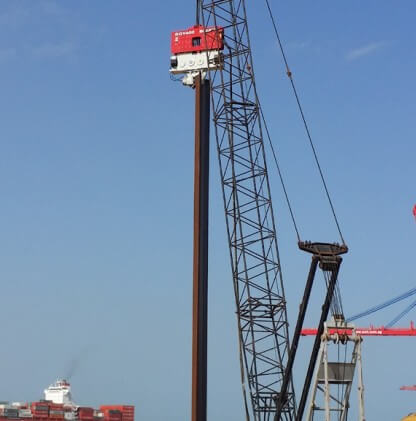
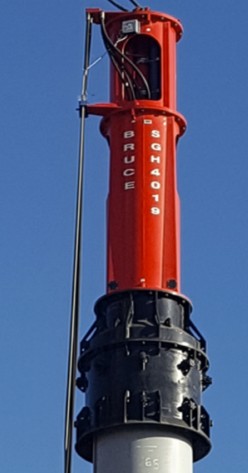
BRUCE Piling Equipment — manufactured by Powerquip Industrial Co., Ltd. in Siheung, Gyeonggi-do, Korea — represents the most extensively documented Korean piling equipment option available for direct piling equipment import to the US and UK markets. ISO 9001 certified since 2004, with a manufacturing history of 27 years, BRUCE has supplied vibratory and hydraulic impact hammers to projects across more than 80 countries. The combination of ISO certification, government-level recognition, and independently published project references in peer-reviewed engineering documentation provides a EEAT (Experience, Expertise, Authoritativeness, and Trustworthiness) profile that procurement engineers can present to engineering specification committees alongside major European alternatives.
SGV Series — ICE-Compliant Vibratory Hammer Specifications
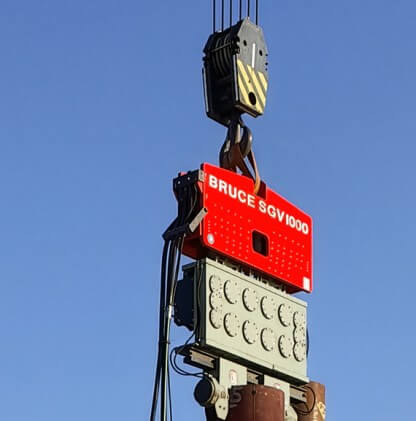
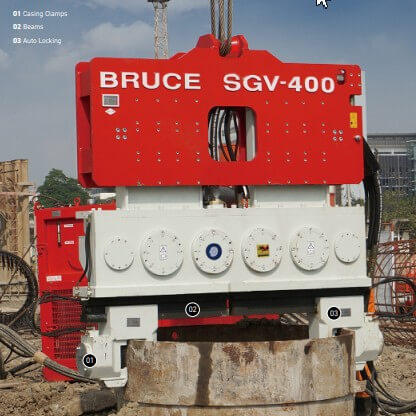
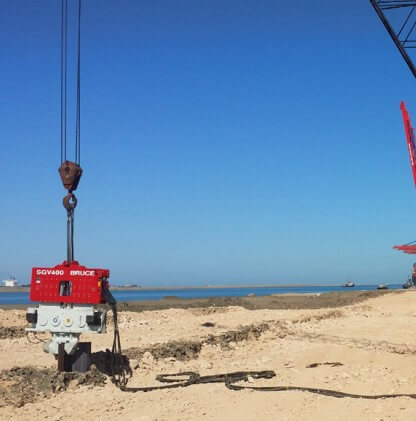
The BRUCE SGV crane-suspended series spans eccentric moments from 11.5 kgm (SGV-80) to 220 kgm (SGV-2000) and centrifugal forces from 510 kN to 4,610 kN — covering the full range of UK and US foundation project types from light urban cofferdam sheet piling through to major offshore casing pile installation. Universal Sheet Pile Clamps (60U to 320U) and Casing Pile Clamps (2x40D to 4x160D) cover the full range of Larssen, Z-profile, H-beam, and casing pile sections specified on UK National Highways and US DOT bridge contracts. Additionally, the SGV excavator-mounted series (SGV-40, SGV-60, SGV-80E) targets the 20 to 50-ton carrier market, connecting directly to the host machine’s auxiliary hydraulic circuit without a separate power pack. Tilting models (SGV-40T, SGV-60T) address low-clearance and confined urban sites with 360° hydraulic rotation and 90° hydraulic tilt. Consequently, as an ICE vibratory hammer alternative, the SGV series covers equivalent application segments — from urban rail shoring to marine cofferdam construction — within a single manufacturer relationship.
SGH Series — ASTM D4945 Ready Impact Hammers
The BRUCE SGH hydraulic impact hammer series covers energies from 12 kNm (1.2 ton.m) to 1,178 kNm (120 ton.m), with ram weights from 7 tons (SGH-0712) to 47 tons (SGH-4719). The optional IEA (Impact Energy Analysis) System — developed by BRUCE and adopted as a standard monitoring tool by the Hong Kong Housing Government — records real-time energy at every blow, providing the verifiable energy transfer log required for ASTM D4945 compliance. Field measurements on SGH-1015 and SGH-1415 deployments confirmed energy transfer rates of up to 90% — a performance benchmark directly comparable to major European impact hammer manufacturers. Mounting configurations include Fixed Leader, Crane Suspended, U-Type Leads, and Offshore Leader, covering all standard UK and US project types.
Verified US DOT and Government Project References
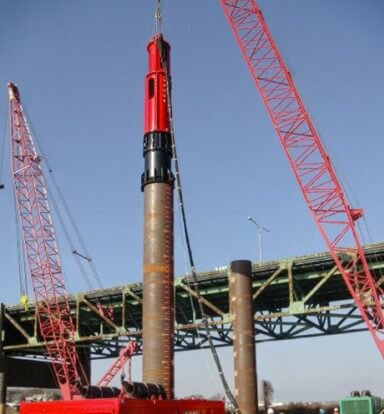
Independently verifiable project references are the primary EEAT differentiator for BRUCE in import procurement presentations. The SGH-4719 drove 72-inch diameter steel casing piles to over 200 feet depth on the Sakonnet River Bridge (Rhode Island) — the largest single contract in RI DOT history at USD 163.7M, cited in Providence Journal and confirmed by official RI DOT announcement. The SGH-3013 drove 60-inch precast concrete cylinder piles on the Hathaway Bridge (Florida), documented in a Florida State University College of Engineering thesis. The SGH-2015 was used by SKANSKA USA on the Williamsburg Bridge (Virginia) and by American Bridge Company on the Chincoteague Channel Bridge (Virginia), with the latter published in Pile Driving Association Magazine. In Korea, the SGH-3015 powered the Incheon Bridge — 18.248km, ranked among the world’s longest bridges at completion. Furthermore, the SGV-40 excavator-mounted vibro hammer was deployed at Christchurch Public Hospital (New Zealand), driving and extracting 6m sheet piles in close proximity to MRI and brain scanner equipment with zero vibration complaints — documented through a formal appreciation letter from Allied Construction Ltd.
BRAND COMPARISON CONTEXT
For how BRUCE specifications compare to the broader market in user-reviewed brand ratings, review the 2026 Best Vibratory Hammer Brands User Reviews and Ratings — which covers the technical criteria used by procurement engineers globally.
06. Evaluating the ICE Vibratory Hammer Alternative Decision
The decision to source an ICE vibratory hammer alternative through direct import from a Korean manufacturer is fundamentally a risk management exercise — the procurement engineer must weigh the technical equivalency of the imported equipment against the documentation completeness risk and the logistics complexity of factory-direct procurement. This section provides the analytical framework for making this decision with engineering rigour rather than commercial impulse.
Technical Equivalency Assessment
Technical equivalency between a Korean-manufactured vibratory hammer and an established European alternative is assessed across five dimensions: centrifugal force range, eccentric moment range, suppressor isolation performance, hydraulic motor demand specifications, and available clamp compatibility. Where specifications are equivalent on all five dimensions and the Korean manufacturer can provide ISO 9001 certified production documentation, the equipment is technically interchangeable for ICE and BS EN 12699 regulated applications — subject to the importer obtaining a complete English-language technical documentation package before equipment arrives at port. The Deep Foundations Institute technical library provides reference data for vibratory hammer performance benchmarking that can be used to structure the equivalency assessment systematically.
Commercial Factors: When Direct Import Outperforms Distributor Channels
Direct import procurement from a Korean manufacturer outperforms the European distributor channel under three specific commercial conditions. First, when the project requires a new machine with complete factory-certified documentation — used distributor inventory cannot provide this. Second, when the equipment specification is non-standard — large-diameter casing pile clamps or offshore leader mounting configurations that are not held in distributor stock require factory-direct order in any case. Third, when the project timeline accommodates a four-to-eight-week ocean freight transit from Korea — projects with longer procurement windows benefit most from the price transparency of factory-direct pricing versus distributor margin-loaded quotations. Furthermore, factory-direct procurement from Korea provides access to the manufacturer’s engineering desk for model selection confirmation, power pack matching verification, and technical documentation preparation — a level of specification support that most regional distributors cannot replicate.
Risk Mitigation: The Documentation-First Approach
The primary risk in any piling equipment import decision is documentation incompleteness — the equipment arrives on site, but the technical documentation required for specification approval, permit submission, or compliance auditing is absent or in Korean only. Mitigating this risk requires a documentation-first procurement protocol: before the commercial order is placed, the importer must receive and review the full English-language technical documentation package — including ISO 9001 certificate, operation manual, specification sheets, power pack matching table, and biodegradable oil compatibility declaration. Only upon satisfactory review of this package should the purchase order be issued. Consequently, importers should build a documentation review period of two to three weeks into the procurement timeline before factory dispatch — this period allows engineering desk verification of all technical parameters and identification of any documentation gaps before the equipment is in transit.
07. How-To: The Piling Equipment Import Process Step by Step
STEP 1 — DEFINE THE TECHNICAL SPECIFICATION
Compile the project pile schedule: pile profile (Z, U, H-beam, or casing), pile weight per unit, design tip elevation, and soil bore log SPT N-values at tip elevation. From this data, calculate the minimum required centrifugal force (≥15× pile weight as a baseline) and identify the eccentric moment class required for the soil type. Furthermore, confirm the intended carrier machine’s auxiliary hydraulic flow (lpm) and operating pressure (bar) — these figures determine power pack and motor compatibility before any manufacturer is approached. Document these requirements in a formal technical brief that will be submitted to the Korean manufacturer’s engineering desk for model confirmation.
STEP 2 — OBTAIN AND REVIEW THE FACTORY TECHNICAL DOCUMENTATION PACKAGE
Request the full English-language technical documentation package from the manufacturer’s engineering desk before order placement. This package must include: model specification sheet, power pack matching table, clamp jaw compatibility table, elastomer grade and replacement interval, operation manual (English), ISO 9001 certificate (current), biodegradable oil compatibility declaration, and dimensional drawings for customs classification purposes. Do not accept verbal confirmation of any specification — all technical parameters must be in writing from the manufacturer. Additionally, request the case drain line routing diagram and confirm the hydraulic fitting specifications against your carrier machine’s tank return port configuration before the order is finalized.
STEP 3 — CONFIRM REGULATORY COMPLIANCE REQUIREMENTS
Based on the project’s regulatory framework, confirm which compliance documentation the equipment must carry on arrival. For US DOT projects: confirm IEA energy monitoring capability for ASTM D4945 requirements and obtain the technical specification data required for GRLWEAP wave equation modeling. For UK projects: confirm BS EN 12699 documentation compatibility, suppressor performance data for BS 5228 PPV assessments, and Silence Cap Housing availability for BS 5228 Section 61 noise consent submissions. For both markets: confirm the manufacturer’s government recognition credentials (where applicable) and trade association memberships — these provide independently verifiable supplier credibility for engineering specification submissions.
STEP 4 — NEGOTIATE SHIPPING TERMS AND PREPARE CUSTOMS DOCUMENTATION
Negotiate CIF (Cost, Insurance, Freight) or FOB (Free On Board) terms based on your logistics capability. CIF provides a single landed cost that simplifies budget submission to the project owner — the manufacturer handles freight booking and marine insurance to the destination port. FOB provides flexibility to use preferred freight forwarders but requires the importer to manage ocean freight booking, marine insurance, and port handling independently. For either term, confirm that the manufacturer prepares: commercial invoice (with Incoterms specified), packing list, certificate of origin, and bill of lading. Furthermore, obtain an HS code ruling from your customs broker before the shipment is dispatched — this prevents clearance delays and incorrect duty assessment on arrival.
STEP 5 — COMMISSIONING VERIFICATION ON ARRIVAL
Before the equipment enters service on the first project, execute a structured commissioning verification protocol. Confirm hydraulic flow and pressure from the carrier matches the hammer’s rated motor demand. Connect and route the case drain line per the manufacturer’s installation diagram. Confirm clamp jaw compatibility with the first project pile profile. Inspect suppressor elastomers before first operation — confirm condition against the new-unit baseline in the operation manual. Run the hammer at low flow for the first 30 minutes of operation while monitoring hydraulic oil temperature — if temperature rises abnormally, reduce flow incrementally until the system stabilizes. Document this commissioning record for inclusion in the project compliance file.
08. Regional Deep-Dive: US FHWA and UK Network Rail Import Compliance
United States — FHWA and State DOT
Federal Highway Administration (FHWA) funded projects require wave equation analysis (GRLWEAP) for pile driveability verification, dynamic monitoring during pile installation (ASTM D4945), and restrike testing for final capacity confirmation. Imported equipment must carry specifications compatible with GRLWEAP analysis — specifically ram weight, stroke range, cushion specifications, and rated energy output. The optional IEA energy monitoring system provides the real-time energy log required by DOT structural auditors. Furthermore, state DOT engineering departments may request independently verified project references from the equipment manufacturer — BRUCE’s documented RI DOT, Florida DOT, and Virginia DOT project deployments directly satisfy this requirement.
United Kingdom — Network Rail and National Highways
Network Rail’s NR/L2/CIV/003 standard governs vibration monitoring on track-adjacent piling works. Imported vibratory hammers must demonstrate real-time amplitude control capability via remote pendant — allowing PPV to be managed within NR monitoring thresholds without stopping the drive cycle. National Highways (SRN) contracts additionally require dynamic monitoring equivalent to ASTM D4945 for permanent driven pile installations. The suppressor assembly’s vibration isolation specification must be documented in formats compatible with HSE Construction Phase Plan submissions and BS 5228 Section 61 consent applications. Imported equipment from Korea that includes the full English-language technical documentation package can satisfy all these requirements without additional engineering preparation.
Total Landed Cost Framework — Import vs Distributor Channel
A rigorous Total Landed Cost analysis for piling equipment import from Korea must include: factory price (FOB Siheung), ocean freight and marine insurance (CIF differential), destination port handling and customs clearance, inland haulage to project site, import duties (HS code dependent), and commissioning costs. Against this landed cost must be compared the distributor’s delivered price — which incorporates the distributor’s procurement margin, local storage costs, and typically a pre-owned or ex-demonstration unit rather than a factory-new machine. Consequently, for new equipment procurement, the factory-direct landed cost from Korea is frequently competitive with new-unit European distributor pricing even after accounting for ocean freight — because the distributor’s margin on new equipment often exceeds the freight differential. Furthermore, the documentation quality advantage of factory-direct new equipment — complete manufacturer-backed technical package, current ISO 9001 certificate, and known manufacturing date — provides a compliance traceability benefit that pre-owned distributor stock cannot replicate.
Piling Equipment Import FAQ
Q: What is the minimum documentation package required for piling equipment import to satisfy ICE specification procurement?
“ICE specification procurement requires: full English-language technical specification sheet, ISO 9001 certificate, operation manual, suppressor isolation data, remote pendant amplitude control documentation, and biodegradable oil compatibility declaration.”
The ICE Specification does not restrict equipment by country of manufacture — it restricts by documentation completeness. A Korean-manufactured vibratory hammer providing this full documentation package satisfies ICE procurement requirements on the same terms as European alternatives. Importers should request all documentation in English before order placement — post-arrival documentation requests create avoidable mobilization delays on time-critical UK infrastructure projects.Q: How does the piling equipment import process differ for US FHWA projects versus UK Network Rail projects?
“US FHWA projects require ASTM D4945 energy transfer documentation and GRLWEAP-compatible specifications. UK Network Rail projects require BS 5228 PPV assessment data and NR/L2/CIV/003 monitoring compatibility.”
For US projects, the primary import documentation need is an IEA-capable impact hammer or GRLWEAP-ready specification data. For UK projects, the suppressor assembly’s vibration isolation specification and the remote pendant’s real-time amplitude control capability are the critical technical features for NR monitoring compliance. Furthermore, UK Environment Agency permit conditions additionally require biodegradable hydraulic oil compatibility confirmation — a document that must be included in the import technical package before site deployment on river-adjacent and estuarine piling projects.Q: What are the key technical differences between a Korean-manufactured ICE vibratory hammer alternative and established European models?
“Specification-equivalent Korean alternatives match European models across centrifugal force, eccentric moment, and suppressor isolation — the primary technical differentiator is the depth of independently verified project references in the target market.”
BRUCE SGV and SGH series cover equivalent centrifugal force ranges (510 kN to 4,610 kN vibratory; 12 kNm to 1,178 kNm impact) to major European manufacturers. The technical evaluation for procurement engineers should focus on: ISO 9001 certificate currency, availability of English-language operation manuals, confirmed US or UK government project references, and verified biodegradable oil compatibility. Where all four criteria are satisfied, the Korean alternative is specification-equivalent for ICE and ASTM D4945 regulated applications.Q: How long does piling equipment import from Korea to US or UK ports typically take, and what logistics factors affect the timeline?
“Ocean freight from Siheung, Korea to US East Coast or UK ports typically runs four to six weeks — procurement engineers should build an eight-to-ten-week total procurement timeline including documentation review, order placement, production scheduling, and transit.”
Factory production scheduling is the primary variable — if the specific model is in stock, dispatch can occur within two weeks of order. For custom configurations (non-standard clamp types or offshore leader mounting), four to six weeks of production time should be added. Additionally, customs clearance at destination port typically adds five to ten business days — early submission of the customs entry with all documentation prevents clearance delays that push into the project programme. CIF pricing from the Korean manufacturer provides full freight and insurance transparency, eliminating post-shipment cost surprises.