Vibratory Hammer in the United States — Complete Technical Guide to Vibro Pile Driving Equipment
Technical reference for U.S. pile driving contractors, geotechnical engineers, inspectors, equipment managers, marine contractors and procurement teams.
1. What Is a Vibratory Hammer?
A vibratory hammer—also called a vibro hammer, vibratory pile driver, or vibratory driver/extractor—is a pile installation and extraction machine that transfers continuous vertical vibration into a pile instead of delivering repeated impact blows.
Across the United States, vibratory hammers are widely used for sheet piling, temporary cofferdams, steel pipe piles, H-piles, casing installation, marine construction, retaining systems, bridge foundation temporary works, and pile extraction. They are especially valuable when contractors need fast production, reversible installation, controlled pile handling, and lower peak noise than conventional impact driving.
However, a vibratory hammer should not simply be treated as a faster version of an impact hammer. The two systems interact with the pile-soil system differently, are often used for different engineering objectives, and on many U.S. projects are used sequentially.
2. How a Vibratory Hammer Actually Works
The heart of a vibratory hammer is the exciter assembly, often referred to as the gearbox. Inside the exciter are eccentric masses mounted on rotating shafts. Because the center of mass is offset from the shaft centerline, rotation creates centrifugal force.
In simplified terms, centrifugal force increases with eccentric mass, eccentric radius, and—most importantly—the square of rotational speed. This is why hammer performance cannot be evaluated from motor horsepower alone.
Counter-Rotating Eccentrics
The rotating eccentric shafts are synchronized so that unwanted horizontal components oppose one another while vertical components align and combine. The result is a rapidly alternating vertical force applied to the pile.
The Pile Becomes Part of the Vibrating System
Once the clamp is engaged, the hammer and pile behave as a coupled vibrating system. The pile repeatedly moves downward and upward through small displacement cycles, disturbing the pile-soil interface and reducing resistance enough for gravity, hammer weight, dynamic force and available crowd or line-pull force to move the pile.
3. Does a Vibro Hammer “Liquefy” the Soil?
The word liquefaction is commonly used in marketing explanations of vibratory pile driving, but it should be used carefully. A vibratory hammer does not necessarily produce geotechnical liquefaction in the same sense as earthquake-induced liquefaction.
A more technically useful description is that cyclic pile motion rearranges soil particles and temporarily reduces pile-soil interface resistance. In loose and medium-dense sands, this can dramatically lower shaft friction and allow rapid penetration.
Loose to Medium Sand
Generally favorable for vibratory installation.
Silty Sand
Often favorable, depending on fines content and groundwater.
Dense Sand / Gravel
Possible, but greater force or eccentric moment may be required.
Clay / Rock
Performance becomes increasingly project-specific; rock is not a primary vibratory application.
Actual hammer selection should always use the project geotechnical profile rather than soil name alone. SPT N-values, CPT resistance, layer thickness, pile section, embedment depth, pile toe geometry and groundwater conditions all matter.
4. Four Numbers That Matter Most: Force, Eccentric Moment, Frequency and Amplitude
4.1 Centrifugal Force
Centrifugal force is the peak dynamic force generated by the rotating eccentrics at operating speed. In U.S. submittals it may be shown in pounds-force or tons-force, often accompanied by kilonewtons.
4.2 Eccentric Moment
Eccentric moment is a fundamental indicator of the hammer’s ability to generate displacement amplitude. For larger piles and difficult soils, eccentric moment often becomes as important as nominal centrifugal force.
4.3 Operating Frequency
Frequency describes how many vibration cycles occur each minute. U.S. equipment specifications normally use vpm — vibrations per minute. Startup and shutdown deserve special attention because the hammer passes through lower frequencies before reaching operating speed.
4.4 Amplitude
Amplitude is the magnitude of the hammer’s cyclic movement. Frequency determines how rapidly the system cycles, while eccentric moment and vibrating mass strongly influence how far it moves per cycle.
5. Major Components of a Hydraulic Vibratory Hammer
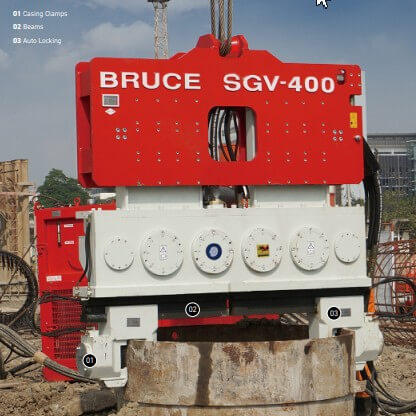
Exciter / Gearbox
Contains eccentric shafts, bearings, synchronizing gears, lubrication systems and structural housings.
Hydraulic Motors
Rotate the eccentric system. Motor displacement, pressure and oil flow affect operating speed under load.
Suppressor
Isolates much of the exciter vibration from the crane or carrier through elastomeric elements.
Hydraulic Clamp
Transfers vibration into the pile. Sufficient clamp force is essential for energy transfer and safe handling.
Large crane-suspended hammers normally use a separate hydraulic power pack, while many excavator-mounted models use the excavator’s auxiliary hydraulic system. Modern systems are operated through remote controls or pendants.
6. Crane-Suspended vs. Excavator-Mounted Vibratory Hammers
Crane-Suspended Vibratory Hammer
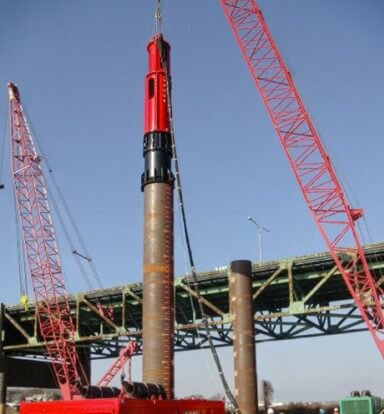
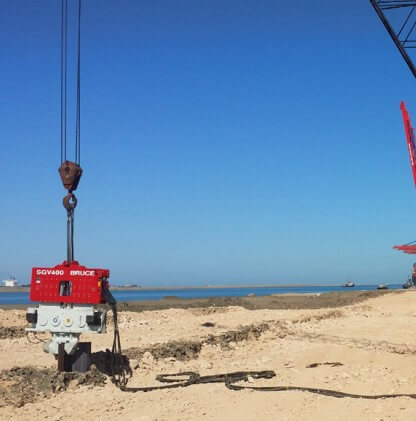
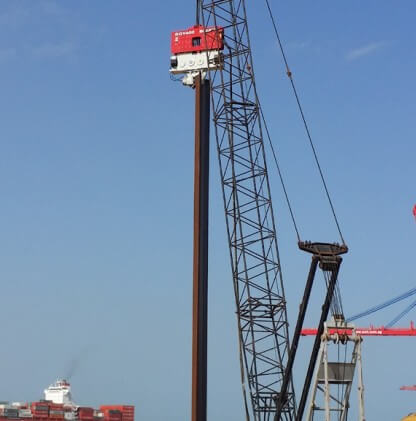
Crane-suspended systems are the traditional choice for large-scale marine and heavy civil piling. They are appropriate where piles are long or heavy, large centrifugal force is required, extraction capacity is high, offshore or barge operation is involved, or large pipe and casing piles are being installed.
Excavator-Mounted Vibratory Hammer
Excavator-mounted hammers are widely used for sheet pile walls, utility excavation support, smaller cofferdams, urban shoring and temporary works. Before installation, contractors must confirm that the carrier can deliver the required hydraulic flow and pressure.
Side-Grip Systems
Side-grip vibratory drivers allow an excavator to pick, position, drive and extract piles using a side-mounted gripping assembly. Their major advantage is material-handling efficiency and reduced dependence on a separate crane.
7. Fixed-Moment, High-Frequency and Variable-Moment Hammers
Fixed-moment: simple eccentric configuration, commonly used for general piling.
High-frequency: used where contractors want to reduce low-frequency response around sensitive structures.
Variable-moment: allows eccentric moment to be reduced during startup and shutdown, helping the machine pass through critical frequency ranges with lower vibration output.
8. What Piles Can a Vibratory Hammer Drive?
- Steel sheet piles: one of the most common vibratory applications in North America.
- Steel pipe piles: often driven with heavy-duty clamps or double-clamp systems.
- H-piles: suitable depending on soil, pile section and project acceptance criteria.
- Casing: commonly installed and extracted for drilled shafts, marine foundations and excavation support.
- Timber and concrete: possible in selected cases, but pile section and clamp-induced local stresses must be evaluated carefully.
9. Vibratory Hammer vs. Impact Hammer
Vibratory Hammer
- Fast penetration in suitable soils
- Can extract piles
- Excellent sheet-pile productivity
- Lower peak impact noise
- Useful for casing and temporary works
Impact Hammer
- Effective in dense layers
- Supports final set
- Useful for bearing verification
- Compatible with high-strain dynamic measurements
- Common for permanent load-bearing piles
A common heavy-civil strategy is to position and pre-drive the pile using vibration, then complete installation with an impact hammer where required by soil conditions or project specifications.
10. Important U.S. Limitation: Vibratory Driving Is Not Automatically Bearing-Capacity Verification
A vibratory hammer can install a pile successfully without automatically providing the same driving-resistance information generated by an impact hammer.
This does not mean vibratory hammers cannot install permanent piles. It means the project designer and contract specifications determine how final pile capacity or acceptance must be verified.
- impact driving criteria;
- restrike testing;
- static load testing;
- dynamic testing;
- project-specific instrumentation;
- engineering analysis accepted by the owner.
11. ASTM D4945 and Dynamic Testing
ASTM D4945 is commonly referenced in the United States for high-strain dynamic testing of deep foundations. It is strongly associated with impact-driven pile testing because the method evaluates force and velocity response generated during a high-strain event.
On many U.S. bridge and heavy foundation projects, the vibratory hammer performs efficient initial installation while an impact hammer performs final driving or restrike where dynamic instrumentation is specified.
12. OSHA Requirements for U.S. Pile Driving
U.S. contractors must consider federal occupational safety requirements. 29 CFR 1926.603 addresses pile-driving equipment, including overhead protection, hammer blocking, lead safety, rig stability, hose connections, signalmen, suspended piles and operations from barges and floats.
OSHA has also interpreted §1926.603(a)(10) to mean that safety chains or equivalent means apply to pressurized hydraulic hose connections on pile-driving hammers.
13. U.S. Marine Construction: Section 10 and Section 404
The U.S. Army Corps of Engineers administers Section 10 of the Rivers and Harbors Act for work and structures in navigable waters of the United States. Section 404 of the Clean Water Act regulates discharge of dredged or fill material into waters of the United States.
Whether a particular pile-driving activity triggers Section 404 depends on the activity and associated discharge—not simply on the fact that a vibratory hammer is being used.
14. Underwater Noise and U.S. Environmental Review
Vibratory pile driving is generally treated as a continuous acoustic source, while impact pile driving is treated as an impulsive source. Lower peak pressure does not mean zero environmental impact.
Marine projects may require acoustic modeling, monitoring zones, protected-species observers, shutdown procedures, seasonal restrictions and source verification measurements.
15. Ground Vibration Around Buildings and Utilities
Ground response is affected by pile geometry, hammer frequency, eccentric moment, soil stiffness, groundwater, distance, underground structures and building natural frequency.
For vibration-sensitive U.S. projects, good practice may include preconstruction building surveys, geophones, peak particle velocity monitoring, trigger levels, variable-moment operation and revised operating frequency.
16. How to Select a Vibratory Hammer for a U.S. Project
Step 1 — Define the Pile
Provide pile type, section designation, total weight, length, wall thickness, diameter or width, required penetration and installation/extraction requirement.
Step 2 — Review the Geotechnical Profile
Provide soil classification, layer depths, SPT N-values, CPT data where available, groundwater, gravel/cobble layers, refusal layers and bedrock depth.
Step 3 — Define Acceptance Requirements
Clarify whether tip elevation alone is required, whether an impact hammer will finish the pile, and whether PDA, restrike, static or other testing is required.
Step 4 — Check Access and Carrier
For crane suspension, review crane capacity, hook height, boom geometry, line pull and power-pack location. For excavator mounting, review carrier weight, auxiliary flow, pressure, return pressure and cooling.
Step 5 — Review Environmental Constraints
Include nearby occupied buildings, utilities, historic structures, marine fauna, underwater acoustics and work-hour restrictions.
17. Is the “15× Pile Weight Rule” Enough?
Some manufacturers and field references use a preliminary screening rule relating centrifugal force to pile weight. Such rules can be useful for early equipment screening, but they are not substitutes for engineering selection.
For project-specific model selection, see the BRUCE Vibratory Hammer FAQ and model-selection reference.
18. U.S. Units Contractors Should Request
| Parameter | U.S. Customary | Metric |
|---|---|---|
| Centrifugal Force | lbf / tons-force | kN |
| Eccentric Moment | in-lb / lb-ft | kg·m / N·m |
| Frequency | vpm | vpm |
| Amplitude | inches | mm |
| Hydraulic Pressure | psi | bar |
| Oil Flow | U.S. gpm | L/min |
| Power | hp | kW |
| Operating Weight | lb | kg |
19. Example of a Modern Heavy-Duty Vibratory Hammer Range
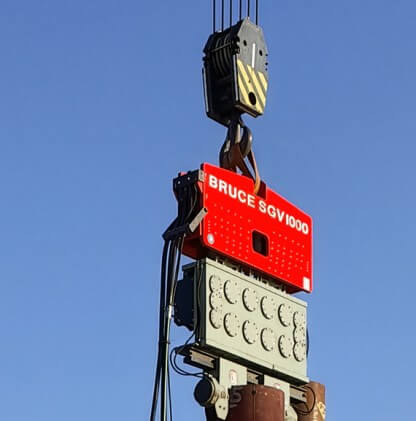
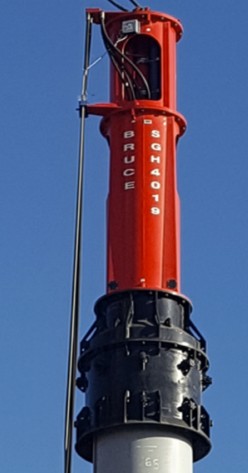
Modern hydraulic vibratory systems span a wide operating envelope. As one manufacturer example, BRUCE’s SGV crane-suspended series includes compact and heavy-duty models for sheet pile, casing and marine work.
Published manufacturer data includes models ranging from the SGV-80 at approximately 510 kN centrifugal force to the SGV-2000 at approximately 4,610 kN.
BRUCE U.S. Vibratory Hammer engineering reference
BRUCE SGV Series vibratory hammer specifications
20. Clamp Selection Is Part of Hammer Selection
A vibratory hammer without the correct clamp is not a complete piling system. Sheet piles, H-piles and large-diameter pipes may require different jaw geometry, clamp forces or double-clamp arrangements.
If the clamp slips, energy transfer decreases, pile surfaces can be damaged, jaws can overheat and safety risk increases.
21. Power-Pack Matching
For a crane-suspended hydraulic hammer, verify rated flow, rated pressure, engine power, cooling capacity, reservoir size, filtration, hose size and hose length.
Long hydraulic hose runs increase pressure loss, while continuous vibratory operation creates significant thermal load. Cooling capacity must be adequate for the actual duty cycle.
22. Pre-Drive Checklist for a U.S. Vibro Hammer Crew
- Verify approved hammer model and submittal
- Confirm pile section
- Inspect clamp jaws
- Check suppressor elastomers
- Confirm hydraulic connections
- Install required hose restraints
- Check power-pack fuel and oil
- Confirm hydraulic fluid requirements
- Inspect crane rigging
- Establish exclusion zone
- Confirm signalperson
- Review utility and structure constraints
- Confirm vibration monitors if required
- Confirm environmental observers if required
23. Troubleshooting Slow Penetration
- Insufficient hydraulic flow
- Low hydraulic pressure
- Clamp slippage
- Soil transition
- Binding sheet-pile interlock
- Excessive pile weight
- Underground obstruction
- Incorrect hammer selection
Do not simply increase output indefinitely. Review hydraulic parameters, penetration records, soil profile and clamp condition before changing the installation method.
24. When Should You Stop Vibratory Driving?
Stop and investigate when penetration suddenly decreases, the pile moves laterally, the clamp slips, hydraulic temperature rises abnormally, monitoring reaches trigger levels, visible distress occurs, an obstruction is suspected, or environmental shutdown criteria are reached.
25. Vibratory Hammer Use on U.S. Bridge Projects
Typical bridge applications include sheet-pile cofferdams, temporary shoring, casing installation and temporary marine access structures.
Permanent load-bearing piles may require a separate acceptance procedure. U.S. bridge contractors must distinguish between installation equipment and capacity verification equipment.
26. Marine and Port Applications
Common marine projects include docks, piers, ferry terminals, container terminals, bulkheads, seawalls, dolphins, temporary templates and cofferdams.
Vibratory pile driving is often selected as part of a broader means-and-methods strategy for controlling productivity, peak noise and environmental impacts.
27. Vibratory Pile Driving and Offshore Work
Offshore pile installation presents additional challenges including large pile diameter, long unsupported lengths, vessel motion, underwater operation, acoustic impacts and weather windows.
Vibratory hammers may facilitate initial positioning and penetration, while impact hammers may complete deeper driving where required.
28. Noise: Vibratory Does Not Mean Silent
One of the most common marketing mistakes is calling vibratory piling “silent.” It is not. The more defensible engineering statement is that vibratory operation avoids the high-amplitude discrete impact events associated with impact hammers.
29. Environmental Hydraulic Fluid
Biodegradable or environmentally acceptable hydraulic fluids may be required or preferred on some marine and environmentally sensitive projects. Using such a fluid does not automatically make equipment “USACE compliant” or “EPA approved.” Project-specific requirements control.
30. Vibratory Hammer Procurement Checklist
Equipment Data
Manufacturer, model, serial, year, eccentric moment, centrifugal force, frequency, amplitude and operating weight.
Hydraulic Data
Pressure, flow, power-pack output, hose sizes and return pressure.
Clamp Data
Clamp model, jaw type, clamp force and approved pile profiles.
Documentation
Operating manual, maintenance manual, hydraulic schematic, dimensions and inspection intervals.
31. U.S. Terminology: Vibratory Hammer vs. Vibro Hammer
Both terms are used internationally. In U.S. engineering and DOT documents, vibratory hammer, vibratory pile driver and vibratory driver/extractor are more common technical terms. Vibro hammer remains a widely understood industry synonym.
32. What Makes a Good Vibratory Hammer Manufacturer?
For U.S. procurement, evaluate more than brochure force ratings. A professional supplier should provide complete engineering data, application review, clamp engineering, hydraulic integration, project documentation, parts support and comparable project references.
One example is BRUCE Piling Equipment, whose published SGV range includes crane-suspended and excavator-mounted vibratory hammer systems for sheet pile, H-pile and casing applications.
33. Frequently Asked Questions
What is a vibratory hammer?
A pile driving and extraction machine that uses synchronized eccentric rotating weights to generate vertical vibration.
Is a vibro hammer the same as a vibratory hammer?
Yes. “Vibro hammer” is an industry synonym. U.S. engineering documents more commonly use “vibratory hammer” or “vibratory driver/extractor.”
What soil is best for vibratory pile driving?
Loose to medium-dense granular soils generally respond very well. Performance becomes more project-dependent in dense sand, gravel and cohesive soil.
Can a vibratory hammer drive sheet piles?
Yes. Sheet pile installation and extraction are among the most common vibratory hammer applications.
Can vibratory hammers extract piles?
Yes. Extraction is one of the major advantages of vibratory systems.
Is a vibratory hammer quieter than an impact hammer?
It generally avoids the high peak impulses associated with repeated impact blows, but it still produces significant continuous airborne and underwater sound.
Is vibratory driving acceptable for permanent foundation piles?
It can be, but the owner, engineer and project specification determine the required installation and acceptance method.
What information should be sent for hammer selection?
Pile type, dimensions, weight, length, embedment depth, soil profile, SPT/CPT data, installation or extraction requirement and carrier information.
34. Final Engineering Perspective
A vibratory hammer is one of the most productive tools available to the modern U.S. pile-driving industry, but successful application depends on understanding the complete pile-soil-machine system.
The correct machine is not necessarily the hammer with the highest centrifugal-force rating. Successful pile installation depends on centrifugal force, eccentric moment, frequency, amplitude, pile mass, pile geometry, clamp force, soil resistance, hydraulic supply and project acceptance criteria.
Technical References
- Federal Highway Administration — Design and Construction of Driven Pile Foundations
- Caltrans — Foundation Manual, Chapter 7: Driven Piles
- OSHA — 29 CFR 1926.603, Pile Driving Equipment
- U.S. Army Corps of Engineers — Regulatory Permitting
- U.S. Environmental Protection Agency — Clean Water Act Section 404
- NOAA Fisheries — Acoustic Technical Guidance
- Pile Driving Contractors Association — U.S. driven-pile industry resources
- BRUCE SGV Series — Manufacturer Technical Specifications