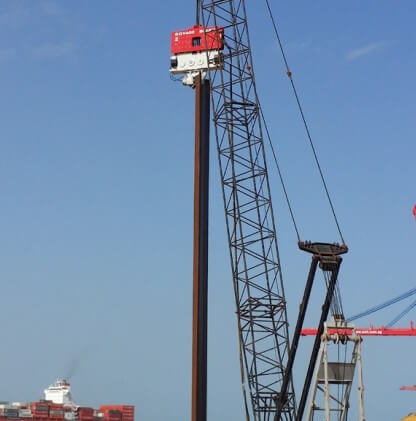
Vibratory Hammer for U.S. Sheet Pile & Pipe Pile Projects
A practical guide for U.S. contractors, foundation teams and equipment buyers evaluating vibratory hammers for sheet pile and steel pipe pile driving, difficult penetration, extraction and project-specific equipment selection.
A vibratory hammer can efficiently drive and extract compatible steel sheet piles and pipe piles when hammer capacity, pile geometry, clamp configuration, hydraulic power and soil conditions are properly matched. Slow penetration or vibratory refusal does not by itself prove that a pile has reached its required geotechnical capacity.
1. Why Vibratory Hammers Are Widely Used for Steel Sheet Piles
Steel sheet piling is one of the principal applications for hydraulic vibratory hammers because vibration can be transferred directly from the hammer through a rigid clamp into the steel pile. Sheet piles are used in cofferdams, excavation support, retaining walls, marine works, flood-control structures and other temporary or permanent construction.
Inside the hammer, synchronized eccentric weights generate continuous oscillation. The clamp transfers the vertical component of this motion into the pile. When the pile and soil conditions respond favorably, this motion reduces the resistance that prevents vertical pile movement.
Unlike an impact hammer, a vibratory hammer does not rely on individual ram blows. This difference is important when evaluating penetration, refusal and the transition from vibratory installation to another pile-driving method.
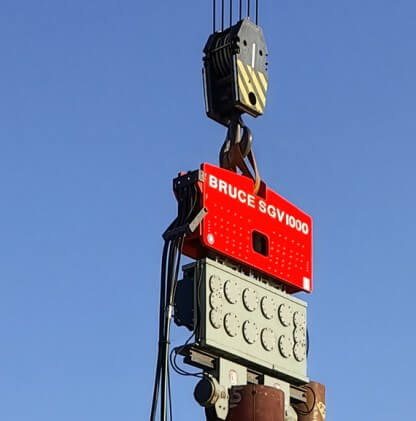
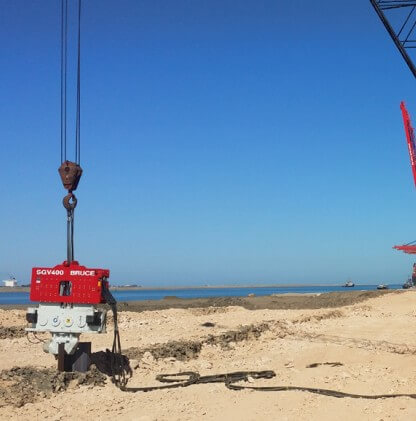
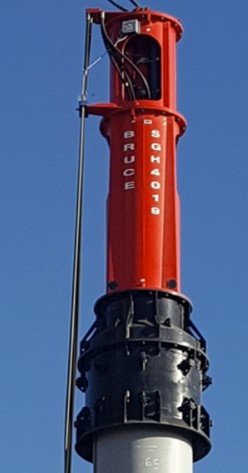
BRUCE identifies sheet piles, H-beams and casing piles among the applications of its hydraulic vibratory hammer range. Published SGV specifications include centrifugal force, frequency, amplitude, hydraulic requirements and extraction line pull.
For definitions, working principles and additional selection questions, see the BRUCE Vibratory Hammer Technical Guide & FAQ .
2. Pipe Pile Driving Requires More Than Centrifugal Force
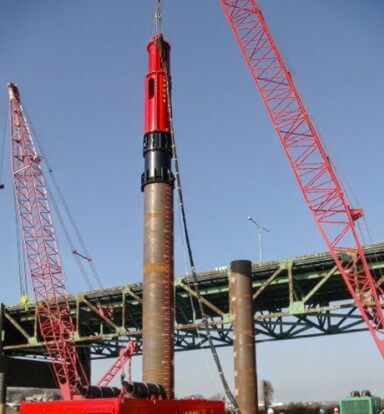
A vibratory hammer that performs well with a sheet pile should not automatically be assumed suitable for a steel pipe or casing pile. Pipe diameter, wall thickness, pile length, total mass and clamp arrangement change the mechanical system being driven.
For pipe and casing work, project teams should identify the actual pile outside diameter, wall thickness, section weight, total pile length, estimated pile mass and required penetration before selecting the hammer.
The clamp arrangement is also different. Large pipes may require a double-clamp or project-specific gripping arrangement rather than the single clamp commonly associated with sheet piling.
Pile diameter alone is not enough to select a vibratory hammer. Two piles with the same outside diameter can have different weights, wall thicknesses and installation resistance.
3. Which Vibratory Hammer Specifications Actually Matter?
Eccentric moment, centrifugal force, frequency, amplitude, hydraulic requirements and extraction line pull describe different parts of vibratory hammer performance. They should not be treated as interchangeable ratings.
| Parameter | What It Represents | Why It Matters |
|---|---|---|
| Eccentric moment | Rotating eccentric mass effect used to generate vibration. | Influences the oscillating system and available amplitude. |
| Centrifugal force | Oscillating force developed by the rotating eccentric system. | One major parameter used when comparing hammer capacity. |
| Frequency | Number of vibration cycles per minute. | Influences pile-soil response and operating behavior. |
| Amplitude | Vertical movement of the vibrating dynamic system. | Must be considered together with the vibrating mass. |
| Hydraulic pressure & flow | Hydraulic requirements of the hammer. | Must match the power pack or carrier hydraulic system. |
| Extraction line pull | Published pulling limit associated with pile extraction. | Important when planning removal as well as installation. |
As a published reference point, the BRUCE SGV-80 is specified at 510 kN centrifugal force, 2,000 vpm maximum frequency, 22 mm amplitude including the universal clamp, 250 kN maximum line pull and 170 lpm maximum oil flow at up to 320 bar.
At the larger end of the published SGV range, the SGV-2000 is listed at 4,610 kN centrifugal force and 220 kg·m eccentric moment.
These values are manufacturer specifications, not a universal sizing formula. Final equipment selection still depends on the actual pile, soil profile and project requirements.
4. What Does Vibratory Hammer Refusal Mean?
Vibratory refusal should not automatically be interpreted in the same way as an impact-hammer refusal criterion expressed in blows per inch. A vibratory hammer produces continuous oscillation rather than individual impact blows.
In practice, a significant reduction in penetration rate may indicate increasing soil resistance, a dense layer, an obstruction, poor vibration transfer or a limitation of the selected equipment system.
However, low penetration rate by itself does not establish that the pile has achieved the geotechnical resistance required by the foundation design. Foundation acceptance criteria should come from the project specification and responsible engineering team.
Before blaming the soil, check the system
5. Soil Conditions Can Change Vibratory Driving Performance
Vibratory hammers are generally associated with favorable performance in granular soils, but soil response varies by density, layering and pile geometry. No single soil label should be used as the only equipment-selection criterion.
Granular soils can respond effectively to vibratory motion, while cohesive and particularly stiff soil layers may create different resistance. Dense intermediate layers, obstructions or hard material may also reduce penetration.
This is why boring logs, SPT data and other available geotechnical information should be reviewed before committing to a hammer configuration.
U.S. Federal Highway Administration guidance treats pile installation as a soil-pile-hammer system rather than a hammer-only problem. Ground conditions and installation method therefore remain part of the engineering evaluation.
Additional technical material for pile, hammer and soil selection is available through the BRUCE Pile Driving Knowledge Center .
6. When Might a Project Need an Impact Hammer?
Some pile-driving projects use vibratory equipment for efficient initial penetration and an impact hammer when final penetration or project-specific driving criteria require impact loading.
A transition may be considered where hard or dense layers significantly reduce vibratory progress, where the design requires impact-driving records, or where the foundation specification establishes criteria that cannot be verified from vibratory penetration alone.
Using both systems on one project is not contradictory. Vibratory and impact hammers deliver energy to piles in different ways and can serve different stages of installation.
There is no single penetration rate or soil description that determines the changeover point for every project. Follow the project design and approved driving criteria.
7. Pile Extraction Is a Separate Engineering Requirement
A vibratory hammer selected for installation should not automatically be assumed adequate for every extraction operation. Extraction introduces upward pulling demand in addition to vibratory force.
Embedded length, soil setup, pile deformation, corrosion, interlock condition, clamp capacity and crane configuration can all affect removal.
This is why BRUCE SGV specifications list maximum line pull separately from centrifugal force.
| Reference Model | Centrifugal Force | Max. Frequency | Max. Extraction Line Pull |
|---|---|---|---|
| BRUCE SGV-80 | 510 kN | 2,000 vpm | 250 kN |
| BRUCE SGV-100 | 620 kN | 1,800 vpm | 300 kN |
| BRUCE SGV-200 | 840 kN | 1,730 vpm | 400 kN |
Crane and rigging limits remain independent requirements. A published hammer line-pull value does not override crane load charts or lifting engineering requirements.
8. Clamp Selection Can Determine Whether the System Performs Properly
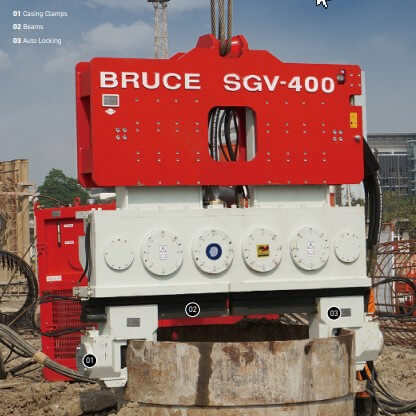
The clamp is the interface that transmits hammer vibration into the pile. If the clamp does not match the pile or cannot maintain proper engagement, the hammer cannot transmit its designed vibration effectively.
Sheet-pile work generally uses a suitable sheet or universal clamp. Pipe and casing piles can require double-clamp assemblies or other arrangements matched to pile geometry.
9. Hydraulic Power Must Match the Hammer
A hydraulic vibratory hammer cannot deliver its specified performance unless the hydraulic source provides the required flow and pressure.
Crane-suspended vibratory hammers normally operate with an external hydraulic power pack. The power pack, hose size, hose length, cooling capacity and operating environment all affect the complete system.
For excavator-mounted equipment, carrier operating weight alone does not confirm compatibility. Auxiliary hydraulic pressure, available oil flow, return circuit requirements and attachment weight must also be reviewed.
10. What Should U.S. Contractors Record During Vibratory Driving?
Field records help separate equipment problems from changes in ground resistance. A useful record follows the pile through the complete installation rather than documenting only final depth.
11. Practical Vibratory Hammer Selection Workflow
The correct starting point is the pile and project data, not a preferred hammer model. The equipment should be selected only after the basic installation conditions are known.
| Step | Information Required | Reason |
|---|---|---|
| 1 | Pile profile, dimensions, length and weight | Defines the physical system being driven. |
| 2 | Soil profile and boring information | Identifies expected installation resistance. |
| 3 | Target penetration or extraction depth | Defines installation objective. |
| 4 | Clamp configuration | Ensures effective transfer between hammer and pile. |
| 5 | Hammer force, frequency and amplitude | Defines major vibratory operating parameters. |
| 6 | Hydraulic flow and pressure | Ensures power-source compatibility. |
| 7 | Crane or excavator data | Confirms lifting and carrier compatibility. |
| 8 | Site constraints | Identifies nearby structures, access and vibration concerns. |
12. Limitations of Vibratory Pile Driving
Vibratory pile driving is not the correct installation method for every pile, soil condition or acceptance requirement. Its suitability must be evaluated against the actual project.
Difficult ground, obstructions, hard layers or project-specific requirements can make another method necessary. Conventional vibratory driving is also not an automatic substitute for impact driving where structural or geotechnical verification requires impact-based analysis or field testing.
Ground vibration is another project consideration. The vibration experienced by nearby structures depends on more than the hammer itself and can vary with ground conditions, pile type, installation resistance, operating condition and distance.
Do not select a hammer only by centrifugal-force rating or pile weight. Site-specific geotechnical, structural and equipment requirements remain necessary for final selection.
13. Vibratory Hammer FAQ for U.S. Projects
Can one vibratory hammer drive both sheet piles and pipe piles?
Possibly. The hammer capacity, pile mass, geometry, soil conditions and clamp configuration must be checked for each pile type.
Does slow penetration prove that the pile has reached bearing capacity?
No. Slow vibratory penetration shows that installation resistance has increased or another limitation exists, but it does not independently establish geotechnical capacity.
Can a vibratory hammer extract sheet piles?
Yes. Many hydraulic vibratory hammers are designed for both installation and extraction, but line pull, crane capacity, embedded length and pile condition must be reviewed.
When should an impact hammer be considered?
An impact hammer may be considered where vibratory penetration becomes inadequate or when the project requires impact-driving criteria, driveability analysis or another approved verification method.
What information is needed before requesting a hammer recommendation?
Provide pile type, section or diameter, pile length and weight, target depth, available geotechnical data, carrier or crane information, project location and whether extraction is required.
Planning a Sheet Pile or Pipe Pile Project?
BRUCE provides technical pile-driving resources for contractors, equipment distributors and project buyers. For a useful equipment review, prepare the actual pile dimensions, soil information, target depth and carrier or crane data before submitting an inquiry.
Technical References
- BRUCE Piling Equipment — official SGV hydraulic vibratory hammer specifications and published operating parameters.
- BRUCE Pile Driving Knowledge Center — technical information covering pile-driving equipment, pile interfaces and project selection.
- U.S. Federal Highway Administration — Design and Construction of Driven Pile Foundations.