Hydraulic Pile Hammer for U.S. Bridge & Deep Foundation Projects
A practical U.S. guide to hydraulic pile hammer selection covering impact energy, pile matching, driving stresses, WEAP, dynamic pile testing, hydraulic requirements and bridge foundation applications.
A hydraulic pile hammer uses hydraulic power to operate a ram that delivers repeated impact energy to a pile. Correct selection requires more than rated impact energy: pile type, soil resistance, permissible driving stress, drive-cap configuration, hydraulic flow and pressure, and project driving criteria all have to be evaluated together.
1. Hydraulic Pile Hammer vs. Hydraulic Impact Hammer
Hydraulic pile hammer and hydraulic impact hammer commonly describe the same general equipment category: a hydraulically powered pile-driving hammer that transfers repeated impact energy to a pile.
The term “impact” is useful because it distinguishes this equipment from a vibratory hammer. A vibratory hammer generates continuous oscillation, while an impact hammer produces individual ram blows.
Both systems can be important on foundation projects, but they are evaluated using different operating parameters and may be selected for different stages of pile installation.
2. Impact Energy Is Important — But It Is Not the Whole Selection
Rated potential energy describes the hammer’s energy capability, but it should not be treated as the only criterion for hammer selection.
The pile-driving system also contains a ram, helmet or drive cap, cushion where applicable, pile head and pile body. The energy reaching the pile depends on the complete driving system, while ground resistance changes as installation progresses.
Two hammers with similar catalogue energy ratings can therefore perform differently when their operating characteristics, energy transfer and hammer-pile system are different.
3. Why U.S. Buyers Should Compare ft-lb, psi, gpm and lb
U.S. contractors can evaluate hydraulic impact equipment more easily when manufacturer specifications include both SI and U.S. customary units.
The BRUCE SGH-0212 provides a useful verified example.
| Parameter | Published SGH-0212 Value |
|---|---|
| Maximum potential energy | 24 kNm / 17,359 lb-ft |
| Blow rate | 40–60 bpm |
| Operating pressure | 230 bar / 3,337 psi |
| Required oil flow | 100 lpm / 26 gpm |
| Weight with drive cap | 4,300 kg / 9,480 lb |
| Suitable power pack | PQ-150 |
4. What Determines Hydraulic Pile Hammer Size?
The correct hammer must be capable of driving the specified pile through the anticipated soil profile without causing unacceptable pile-driving stresses.
These variables explain why pile weight alone is not a reliable hammer selection rule.
Additional technical resources covering piling equipment and project selection are available through the BRUCE Pile Driving Knowledge Center .
5. Why WEAP Matters on U.S. Driven Pile Projects
Wave Equation Analysis of Piles can be used to evaluate the proposed hammer-pile-soil system before or during construction.
FHWA project guidance describes WEAP as a method that estimates hammer performance, pile-driving stresses and driving resistance using an assumed hammer configuration, pile type and soil profile.
This allows engineers to evaluate whether the proposed system is capable of driving the pile to the required resistance or tip elevation while maintaining acceptable stresses.
This does not mean every U.S. project uses identical WEAP requirements. The governing project specification determines whether analysis is required and which acceptance criteria apply.
6. A Hammer Can Be Too Small — or Too Aggressive
An undersized hammer can produce excessive blow counts or fail to advance a pile efficiently, while an overly aggressive system can generate unacceptable driving stress.
FHWA driveability guidance recommends comparing stresses predicted by wave-equation analysis with allowable driving stresses for the selected pile.
If predicted driving resistance is too high and stress remains low, a different hammer may be considered. Conversely, if predicted stress exceeds the allowable limit, simply increasing energy is not an appropriate solution.
7. What Is Pile-Driving Stress?
Every impact blow creates a stress wave that travels through the pile. The magnitude and behavior of this wave depend on the hammer, ram, drive cap, cushion, pile material, pile cross section and soil resistance.
Steel and concrete piles therefore require different attention to compression, tension, pile-head protection and allowable driving stress.
The fact that a hammer can physically move a pile does not by itself demonstrate that the resulting pile stress is acceptable.
8. The Drive Cap Is Part of the Pile-Driving System
The drive cap transfers impact energy from the hammer into the pile head while maintaining the intended alignment and interface.
Steel pipe, H-pile and concrete pile applications can require different drive caps or inserts. Cushion systems may also form part of the pile-driving assembly depending on pile type and hammer configuration.
A poor interface can waste energy or damage the pile head even if the hammer itself has been correctly selected.
9. What Is PDA Testing?
Pile Driving Analyzer testing uses dynamic measurements taken during impact pile driving to evaluate the response of the hammer-pile system.
In FHWA field research, strain and acceleration measurements were used by PDA systems to calculate transferred hammer energy, compression stress and estimates of pile capacity for individual blows.
PDA data can therefore provide field information about actual driving performance that cannot be obtained from a catalogue energy rating alone.
10. WEAP and PDA Are Related but Not Identical
WEAP is an analytical model of the hammer-pile-soil system, whereas PDA uses field measurements taken during actual impact driving.
Wave-equation analysis can be used during design or construction planning to evaluate driveability and predicted stresses. Dynamic monitoring can then provide measurements from the installed pile.
Some projects use the two together to refine or verify the driving system and project criteria.
11. Hydraulic Pressure and Flow Are Part of Hammer Selection
A hydraulic pile hammer requires a hydraulic supply capable of delivering the specified operating pressure and oil flow.
The BRUCE SGH-0212, for example, is published at 230 bar (3,337 psi) operating pressure and 100 lpm (26 gpm) required flow. The matched power pack is listed as PQ-150.
As hammer capacity increases, power-pack requirements, hydraulic flow, hose system, cooling, transport weight and jobsite layout can all become more significant.
12. Blow Rate and Impact Energy Are Different Specifications
Impact energy per blow and the number of blows delivered per minute are separate operating characteristics.
A high-energy hammer does not automatically have a high blow rate, and productivity cannot be predicted from either number alone.
Actual production also depends on penetration per blow, pile handling, splicing, alignment, setup time and delays.
13. Hydraulic Pile Hammers in U.S. Bridge Foundations
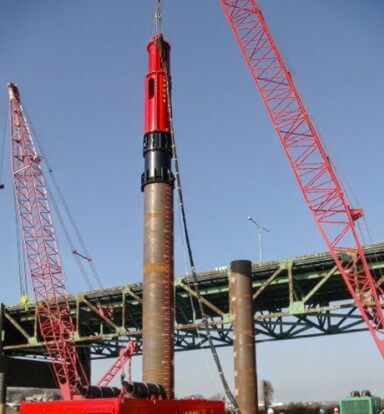
Driven piles are used in bridge foundations to transfer loads through near-surface materials into deeper supporting soils or rock, depending on the foundation design.
Steel H-piles, steel pipe piles and precast piles are among the pile types encountered in U.S. bridge work.
Each creates a different hammer-selection problem. An H-pile driven toward dense material or rock does not have the same driveability characteristics as a large marine pipe pile or a precast concrete pile.
The project pile and soil profile must therefore remain the basis for hammer selection.
14. Hydraulic Impact Hammer vs. Vibratory Hammer
A hydraulic impact hammer delivers discrete blows, while a vibratory hammer applies continuous oscillation. This fundamental difference affects both equipment ratings and field acceptance methods.
| Factor | Hydraulic Impact Hammer | Vibratory Hammer |
|---|---|---|
| Primary action | Individual impact blows | Continuous vibration |
| Typical main ratings | Impact energy, ram, blow rate | Centrifugal force, eccentric moment, frequency, amplitude |
| Driving record | Blow count can form part of project criteria | Penetration behavior is monitored differently |
| Extraction | Not the principal function | Common application for suitable systems |
Some foundation projects can use both methods, with vibratory equipment performing initial installation and impact equipment used later when project conditions or acceptance criteria require it.
For the vibratory side of this comparison, see the BRUCE Vibratory Hammer Technical Guide & FAQ .
15. What Does Refusal Mean With a Hydraulic Impact Hammer?
Impact-hammer refusal should be defined by the project’s approved driving criteria rather than by one universal blow-count number.
Blow counts can be expressed over an inch or another penetration interval, but the acceptable value depends on pile type, hammer system, required resistance and project specification.
A very high blow count is not automatically desirable. If continued driving creates excessive predicted or measured pile stress, the driving system may need to be reviewed.
16. What Should Be Included in a Pile-Driving Record?
Good pile-driving records document the installation system and how driving resistance changes with depth.
17. Practical Hydraulic Pile Hammer Selection Workflow
| Stage | Review | Purpose |
|---|---|---|
| 1 | Pile type and section | Establish the pile system to be driven. |
| 2 | Pile length and required depth | Establish expected driveability demand. |
| 3 | Soil profile | Estimate resistance with depth. |
| 4 | Required capacity or driving criterion | Define project installation objective. |
| 5 | Trial hammer characteristics | Evaluate energy, ram and blow rate. |
| 6 | WEAP where applicable | Evaluate driveability and predicted stress. |
| 7 | Drive cap and cushion | Match hammer to pile interface. |
| 8 | Hydraulic power | Verify pressure, flow and power-pack compatibility. |
| 9 | Dynamic testing where specified | Assess actual field driving performance. |
18. Hydraulic Pile Hammer FAQ
Is a hydraulic pile hammer the same as a hydraulic impact hammer?
The terms are commonly used for the same general equipment category: a hydraulically operated impact hammer that drives a pile through repeated ram blows.
Is the hammer with the highest impact energy always the best choice?
No. Hammer selection also depends on pile type, soil resistance, driveability, allowable driving stress, drive-cap configuration and hydraulic requirements.
What is WEAP used for?
Wave Equation Analysis of Piles can be used to model the hammer-pile-soil system and evaluate predicted hammer performance, driving resistance and pile-driving stresses.
What does a PDA measure during pile driving?
Dynamic pile measurements can be used to evaluate parameters including transferred hammer energy, pile stresses and driving-system performance, with additional analysis used where required by the project.
Can a hydraulic impact hammer and vibratory hammer be used on the same project?
Yes. Some projects use vibratory driving for initial installation and impact driving for later penetration or project-specific final driving requirements. The correct sequence depends on the design and site conditions.
What should be provided when requesting a hydraulic pile hammer quotation?
Provide pile material, section or diameter, pile length and weight, target penetration, available soil information, required driving criteria, crane or piling-rig details and project location.
Need a Hydraulic Pile Hammer Recommendation?
Contractors, equipment distributors and project buyers should provide the actual pile and project data before selecting an impact hammer. BRUCE technical resources can be used to organize the information needed for project-specific equipment review.
Technical References
- BRUCE Piling Equipment — official SGH hydraulic pile hammer specifications, including energy, blow rate, hydraulic pressure, flow rate and equipment weight.
- U.S. Federal Highway Administration — driven pile foundation guidance covering pile driveability, wave-equation analysis and driving stresses.
- U.S. Federal Highway Administration — dynamic pile monitoring research covering measured hammer energy, pile stress and pile-driving system performance.