Vibratory Hammer Ground Vibration in U.S. Urban Projects
A practical guide for contractors, engineers and project teams managing ground vibration from vibratory pile driving near buildings, utilities, transport infrastructure and other vibration-sensitive assets in the United States.
Vibratory pile driving generates continuous ground vibration that can be measured with field instrumentation. The most common vibration indicator is peak particle velocity, or PPV, but a safe project criterion cannot be chosen from PPV alone. Frequency, soil conditions, pile type, distance, structure condition and the governing project specification must also be considered.
1. Why Does Pile Driving Create Ground Vibration?
Pile driving transfers mechanical energy into both the pile and the surrounding ground, so some level of ground vibration is normally expected during installation. The magnitude measured at a nearby location depends on much more than the hammer model.
Soil type, pile material, pile section, driving resistance, penetration depth, installation method and distance from the pile can all influence the measured ground response.
This is why a published hammer force or impact-energy rating cannot be converted directly into one universal “safe distance.”
FHWA guidance identifies soil type, pile type and section, pile-driving equipment, installation procedure, penetration resistance, pile-toe depth and distance from the operation among the variables that influence pile-driving vibration.
2. Vibratory and Impact Hammers Produce Different Vibration Patterns
A vibratory hammer produces a relatively continuous vibration signal, while an impact pile hammer produces repeated transient events associated with individual blows.
This distinction matters because two sites with similar peak vibration values may still have different vibration frequencies, durations and time histories.
| Characteristic | Vibratory Hammer | Impact Hammer |
|---|---|---|
| Primary input | Continuous oscillation | Individual ram impacts |
| Typical signal character | Steady or near-steady while operating | Repeated transient pulses |
| Main hammer ratings | Centrifugal force, frequency, eccentric moment, amplitude | Impact energy, ram characteristics, blow rate |
| Field monitoring | PPV and frequency can be monitored during driving | PPV and frequency can also be monitored during individual blows |
For a detailed explanation of the equipment differences, see the BRUCE Vibratory Hammer Technical Guide & FAQ .
3. What Is Peak Particle Velocity (PPV)?
Peak particle velocity is a measure of the maximum speed at which a particle of ground moves during a vibration event. PPV is commonly expressed in inches per second in U.S. practice or millimeters per second in SI units.
PPV is useful because it provides a repeatable quantity that can be measured by vibration-monitoring equipment and compared with project criteria.
However, PPV should not be confused with pile penetration speed, acceleration or structural displacement. These are different quantities.
Historical U.S. construction references sometimes used simple PPV values such as 4 in/s for commercial structures and 2 in/s for residential structures. Transportation research notes that these older limits did not account adequately for vibration frequency and were superseded by more refined criteria.
For a real project, use the vibration criterion established by the project specification, engineer, owner or applicable authority rather than copying a PPV value from another job.
4. Why Vibration Frequency Matters
The same PPV does not necessarily produce the same response at every frequency. Structure response depends partly on the frequency content of the vibration, which is one reason modern assessment methods should not rely only on one PPV number.
Vibratory hammers operate at model-specific frequencies. The actual vibration measured at a nearby building is affected by both the source and the way the ground transmits the vibration.
This means hammer operating frequency and structural vibration frequency should not be assumed to be identical at every measurement point.
A field vibration monitor can record both vibration amplitude and frequency information. These measurements provide more useful evidence than estimating risk from hammer size alone.
5. How Far From Pile Driving Should Structures Be Evaluated?
There is no universal safe distance that applies to every pile-driving site. The appropriate survey and monitoring radius depends on ground conditions, pile type, hammer, installation procedure and nearby assets.
FHWA guidance provides a useful planning reference. For many routine pile-driving projects, a preconstruction and post-construction condition survey combined with vibration monitoring within approximately 200 ft of the operation may be sufficient.
The same FHWA guidance states that this range may need to be extended to approximately 500 ft where older structures, structures or utilities in poor condition, or highly vibration-sensitive equipment are present.
200 ft and 500 ft are planning references from FHWA guidance, not universal damage boundaries, legal limits or guarantees of safety. The appropriate survey area must be determined for the individual project.
6. Why Perform a Preconstruction Condition Survey?
A preconstruction survey creates a documented baseline of existing conditions before pile driving begins. This allows later observations to be compared with conditions that existed before construction.
Cracks, previous repairs, settlement, façade conditions and other visible defects should be documented clearly where the project requires such a survey.
The survey area should not be selected only by drawing an arbitrary circle around the hammer. Nearby older buildings, utilities, historic assets and vibration-sensitive facilities may justify additional investigation.
7. How Is Pile-Driving Vibration Monitored?
Ground vibration is commonly monitored using instruments placed at selected locations between the pile-driving operation and nearby receptors. The monitoring plan should identify where the instruments are installed, which quantities are recorded and what action is taken when project criteria are approached or exceeded.
Monitoring locations can include the ground adjacent to buildings, sensitive utilities or other assets selected by the project team.
Document the existing condition of sensitive structures and assets.
Install suitable vibration monitoring equipment at planned locations.
Record vibration while pile driving progresses through changing soil layers.
Follow the project action plan if monitoring criteria are approached.
Specialized pile-monitoring systems can also evaluate pile and hammer behavior during installation. Engineering firms such as GRL report that dynamic measurements can be obtained on vibratory-installed piles and sheet piles to investigate installation issues and pile stresses.
8. Nearby Utilities Can Be as Important as Buildings
A vibration review should include buried infrastructure as well as visible structures. Water lines, gas lines, utilities, tunnels and other underground assets may be relevant depending on their condition, material and distance from the pile-driving operation.
Recent geotechnical research continues to investigate vibration transmitted from vibratory sheet-pile driving to underground infrastructure, showing that buried services are a legitimate engineering consideration rather than only a building-damage issue.
Do not assume that a vibration criterion intended for a conventional building automatically applies to a buried pipeline, historic structure or precision instrument. Different assets can require different evaluation criteria.
9. Does Hammer Size Alone Determine Ground Vibration?
No. Hammer specification influences the vibration source, but measured ground vibration depends on the complete hammer-pile-soil system.
For a vibratory hammer, relevant equipment parameters can include centrifugal force, operating frequency, eccentric moment and amplitude. Pile section, mass and penetration resistance then influence the way that energy enters the ground.
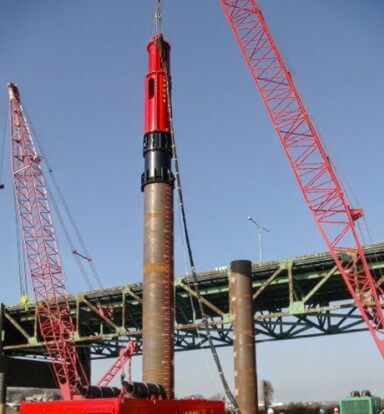
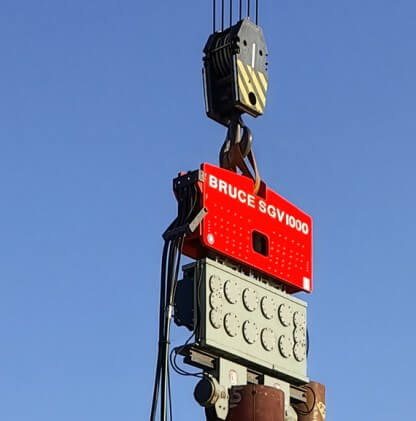
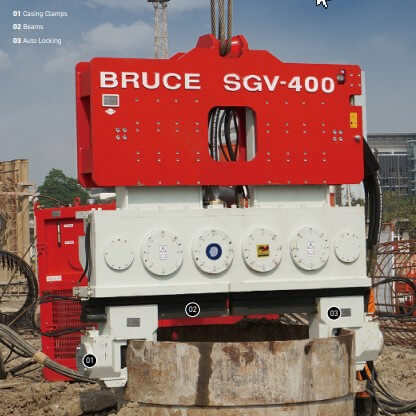
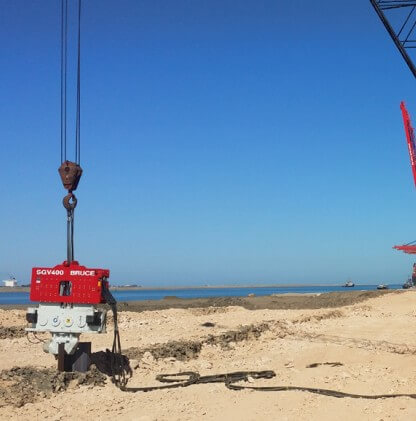
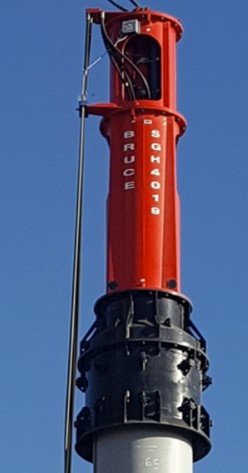
BRUCE SGV hydraulic vibratory hammers, for example, span a published centrifugal-force range from 510 kN to 4,610 kN depending on model. That range demonstrates why hammer selection must be project-specific rather than assuming that all vibratory hammers represent the same vibration source.
Technical information covering vibratory hammer sizing, pile interfaces and equipment selection is available through the BRUCE Pile Driving Knowledge Center .
10. What Role Does the Vibratory Hammer Suppressor Play?
The suppressor is designed to reduce the amount of hammer vibration transmitted upward toward the lifting crane or pile-driving rig. It should not be confused with a system that eliminates ground vibration around the pile.
BRUCE crane-suspended vibratory hammers use elastomer elements in the suppressor between the vibrating assembly and suspension system. Their function is to isolate part of the vibration transmitted toward the lifting equipment.
A hammer suppressor protects the equipment interface from vibration transmission. It does not mean that ground-borne vibration around the driven pile has been eliminated.
11. How Can Pile-Driving Vibration Risk Be Managed?
Vibration management should begin with project planning rather than waiting for a monitoring alarm during production driving.
Possible project responses depend on the source of the vibration and the installation requirement. There is no single mitigation method that works for every pile and soil profile.
| Possible Measure | Purpose | Important Limitation |
|---|---|---|
| Preconstruction survey | Document existing structure conditions. | Does not itself reduce vibration. |
| Field vibration monitoring | Measure actual project vibration. | Monitoring data still require project-specific interpretation. |
| Operating adjustment | Change hammer operating conditions where equipment allows. | Must remain within manufacturer and project requirements. |
| Alternative hammer or installation method | Change the way energy is delivered to the pile. | Driveability and final acceptance must still be satisfied. |
| Trial pile or test section | Collect site-specific performance data before production work. | Results apply to the tested conditions and should be interpreted accordingly. |
12. A Monitoring Plan Should Include a Response Procedure
A vibration monitor is most useful when the project team already knows what to do with the measurements. The monitoring plan should therefore identify project criteria, reporting responsibility and the actions required when specified levels are approached.
A practical plan can use multiple response levels rather than treating the project as only “safe” or “unsafe.”
Continue work while monitoring according to the approved plan.
Review data when vibration begins approaching the project action criterion.
Modify the operating or installation plan when required by project procedures.
Stop or seek engineering review where the approved project plan requires it.
The actual numerical action levels should come from the approved project documents or responsible engineer. This guide intentionally does not assign one universal PPV stop-work value.
13. What Information Should Be Reviewed Before Urban Pile Driving?
For vibration-sensitive work, equipment selection should begin with the site and nearby assets rather than only the hammer model.
14. Vibratory Hammer Ground Vibration FAQ
Does a vibratory hammer create ground vibration?
Yes. Vibratory pile driving transfers mechanical energy through the pile into surrounding soil, producing measurable ground vibration while the hammer is operating.
Is a vibratory hammer always lower vibration than an impact hammer?
No universal statement applies to every project. Vibratory and impact hammers produce different vibration time histories, and measured response depends on the hammer, pile, soil, driving resistance and distance.
What is PPV in pile-driving vibration monitoring?
PPV means peak particle velocity. It describes the maximum particle velocity measured in the ground during a vibration event and is commonly used as one parameter in construction vibration assessment.
What PPV value is safe for every building?
There is no single PPV value that should automatically be applied to every building. Frequency, structure type and condition, soil, project requirements and the applicable vibration criterion must also be considered.
How far from pile driving should vibration be monitored?
The appropriate distance is project-specific. FHWA guidance states that monitoring and condition surveys within approximately 200 ft may be sufficient for many routine cases, while the area may extend to approximately 500 ft for older structures, poor-condition assets or highly vibration-sensitive equipment.
Does a vibratory hammer suppressor eliminate ground vibration?
No. A hammer suppressor is intended to reduce vibration transmitted toward the crane or piling rig. It does not eliminate vibration entering the ground through the driven pile.
Should nearby utilities be included in vibration planning?
Yes. Buried utilities and other sensitive infrastructure should be considered where their location, condition or sensitivity makes them relevant to the pile-driving operation.
Planning a Vibration-Sensitive Pile Driving Project?
Contractors, distributors and project teams can review BRUCE technical resources or submit pile, soil and project information for equipment discussion. Ground-vibration criteria and monitoring plans should remain project-specific and be established by the responsible project team.
Technical References
- U.S. Federal Highway Administration — Design and Construction of Driven Pile Foundations. Guidance on pile-driving vibration, condition surveys, monitoring and nearby structures.
- Michigan Department of Transportation — Effect of Pile-Driving Induced Vibrations on Nearby Structures and Other Assets. Technical review of construction vibration criteria and PPV.
- GRL Engineers — Dynamic Pile Monitoring and vibratory-installed pile measurement guidance.
- BRUCE Piling Equipment — official vibratory hammer specifications and technical product information.