Sheet Pile Shoring for Urban Rail and Basement Projects: Australia 2026 Guide
AS 2159 compliance, DIN 4150-3 vibration limits, and reactive clay field protocol for Sydney, Melbourne, and Brisbane contractors
Temporary Works Piling on Australian Urban Rail and Basement Sites
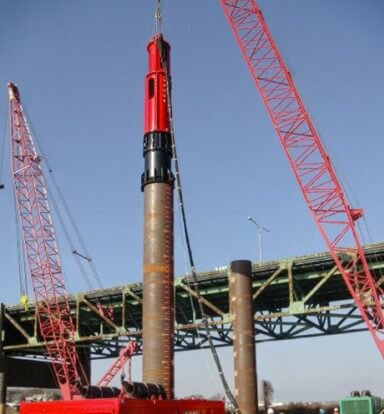
Australia’s major cities are in a sustained cycle of urban rail expansion and dense basement-level development, including metro tunnel and station box construction in Sydney and Melbourne, and high-density residential and commercial basement excavation across the eastern seaboard capitals. Sheet pile shoring — installed by vibratory hammer and typically extracted after the permanent structure achieves sufficient strength — is the standard temporary works method for station boxes, cut-and-cover sections, and basement excavations on constrained inner-city sites where conventional battered excavation is not feasible.
All piled foundations and temporary works piling on Australian projects are designed and installed in accordance with AS 2159, Piling — Design and Installation, the mandatory national standard referenced in the National Construction Code. For temporary sheet pile shoring specifically, AS 2159 provides the framework for geotechnical investigation, structural verification, and installation quality control that underpins the construction methodology submitted to the principal contractor and, where relevant, the rail network authority.
Regional Soil Conditions — Reactive Clay to Sandstone
Vibratory hammer selection for Australian urban shoring projects must reflect substantial variation in soil and rock conditions between capital cities. Melbourne and Adelaide sit on extensive deposits of highly reactive clay — Coode Island Silt in Melbourne’s inner west and docklands areas, and Keswick Clay in parts of Adelaide — where high plasticity and moisture-sensitive volume change behaviour require careful amplitude management during driving to limit disturbance to the surrounding soil mass and adjacent shallow footings.
Sydney’s geology is dominated by Hawkesbury Sandstone at shallow to moderate depth across much of the basin, overlain by residual clay and, in low-lying areas, estuarine alluvium along the harbour foreshore and river corridors. Where sheet pile shoring must achieve embedment into weathered or fresh sandstone, vibratory driving typically reaches practical refusal at the rock interface, and the field methodology must plan for a transition to rock socketing, pre-drilling, or hydraulic impact methods to achieve design toe level — a sequencing decision that should be confirmed against the geotechnical report before mobilisation rather than assumed from regional experience alone. Brisbane’s basement and shoring projects encounter a mix of Brisbane Tuff, weathered phyllite, and alluvial soils along the Brisbane River corridor, presenting a similarly variable profile across relatively short distances.
Vibration and Noise Compliance on Inner-City Sites
Urban rail and basement shoring projects adjacent to occupied buildings, heritage structures, and operating rail corridors are typically subject to construction noise and vibration conditions set out in the project’s environmental management plan, most commonly referencing DIN 4150-3 and BS 7385-2 for cosmetic building damage risk, alongside AS 2436 for management process. Transport for NSW’s Construction Noise and Vibration Guideline is a widely referenced example of this framework in practice, setting minimum working distances for vibration-intensive plant from sensitive receivers and requiring continuous monitoring where those distances cannot be achieved.
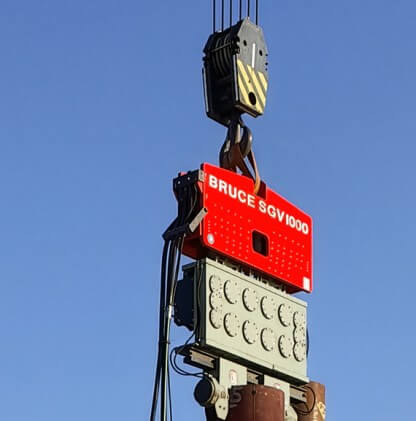
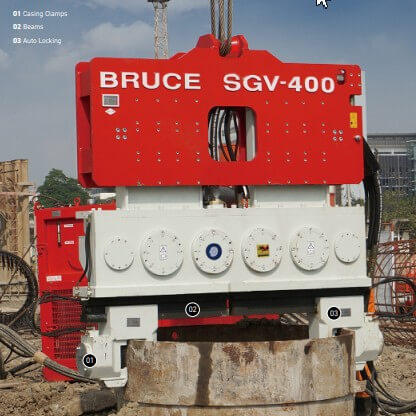
The remote control pendant’s real-time flow adjust allows the operator to reduce centrifugal force and amplitude when continuous PPV monitoring at a nearby heritage building, rail structure, or residential receiver approaches the project’s trigger level, without halting the vibration cycle. This proportional control is the practical mechanism by which urban shoring contractors maintain both installation productivity and compliance with DIN 4150-3 or BS 7385-2 limits written into the environmental management plan and, on many metro and rail authority projects, into the construction contract itself.
Full SGV series technical specifications are available at powerquip.co.kr/products/vibro-hammer/features-2/.
Access Constraints and Carrier Configuration
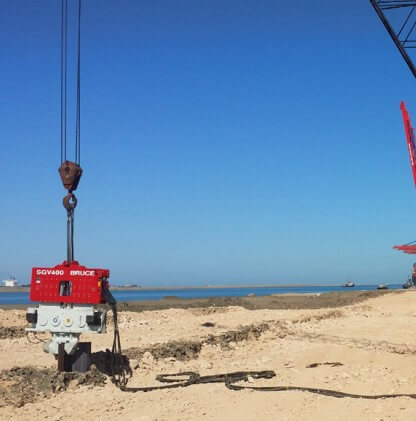
Inner-city Australian shoring sites — particularly CBD basement excavations in Sydney, Melbourne, and Brisbane, and confined station box footprints on metro rail projects — frequently present overhead clearance, laneway access, and live-traffic constraints that favour excavator-mounted vibratory hammer configurations over crane-suspended alternatives. The excavator-mounted SGV series eliminates the separate crane and power pack mobilisation requirement, connecting directly to the host excavator’s auxiliary hydraulic circuit, which reduces both the equipment footprint and the number of plant movements required on sites where laneway or lane closure permits are tightly restricted.
For pre-mobilisation model selection against your project’s geotechnical report, AS 2159 documentation support, and DIN 4150-3 vibration assessment input, contact the BRUCE engineering desk at powerquip.co.kr/contact-us/.
Urban Shoring Piling FAQ
Q: What Australian standard governs sheet pile shoring design and installation?
AS 2159, Piling — Design and Installation, is the mandatory national standard referenced in the National Construction Code, covering geotechnical investigation, structural design, and installation and testing requirements for all pile types including temporary sheet pile shoring.
Q: Why does Sydney sandstone require a different piling approach than Melbourne’s reactive clay?
Sydney’s Hawkesbury Sandstone typically causes vibratory driving to reach practical refusal at the rock interface, requiring a planned transition to rock socketing or impact methods. Melbourne’s reactive clay requires careful amplitude management to limit disturbance to moisture-sensitive, high-plasticity soil near shallow footings.
Q: What vibration standards are referenced in Australian urban shoring environmental management plans?
DIN 4150-3 and BS 7385-2 are the most commonly applied reference frameworks for cosmetic building damage risk, used alongside AS 2436 process guidance. Transport for NSW’s Construction Noise and Vibration Guideline is a widely referenced example setting working distances and monitoring requirements.
Q: Why are excavator-mounted vibratory hammers preferred on Australian CBD basement sites?
Overhead clearance, laneway access, and live-traffic constraints favour excavator-mounted configurations, which eliminate the separate crane and power pack mobilisation requirement and reduce the number of plant movements needed on tightly permitted inner-city sites.