Vibro Hammer for Australian Port and Harbour Construction:
2026 Contractor Technical Guide
“AS 2159 PILE DESIGN, TROPICAL MARINE SOILS, AND ENVIRONMENTAL PERMIT PROTOCOL FOR AUSTRALIAN PORT PILING”
01. Australian Port Infrastructure — The Piling Demand Driver
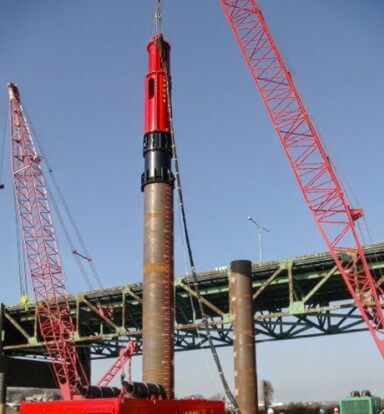
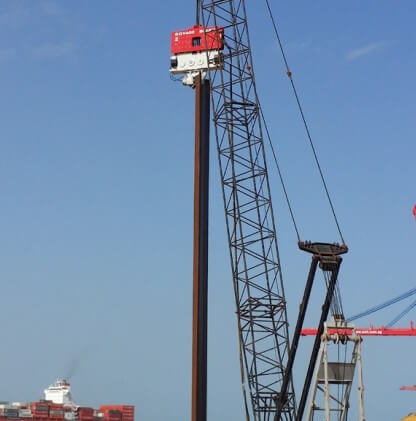
Australia’s export-driven economy has created sustained capital investment in port and harbour infrastructure across the northern and eastern seaboard. The Pilbara iron ore ports of Port Hedland and Dampier in Western Australia, the coal export terminals at Newcastle and Hay Point in Queensland and New South Wales, and the container port expansions at Brisbane, Melbourne, and Fremantle represent multi-billion dollar infrastructure programmes where deep foundation piling — including steel sheet pile cofferdam construction for wharf and berth extensions — is a central construction activity. Vibratory hammers are the primary installation method for temporary cofferdam sheet piling on Australian port projects, where the combination of marine soil conditions, tidal construction constraints, and state environmental permit requirements favours vibratory methods over impact alternatives in the initial penetration phase.
The Infrastructure Australia pipeline for port and logistics infrastructure includes significant investment in the Northern Territory (Darwin’s East Arm Port redevelopment), Queensland (Port of Townsville Channel Capacity Upgrade), and Western Australia (Onslow Marine Support Base and Pilbara port capacity expansion) — all of which involve marine foundation piling in conditions ranging from coral limestone near-surface rock to very deep soft marine calcareous sands. Understanding the specific soil and rock conditions at each Australian port location is the starting point for vibratory hammer selection, as the geological variability between Australian port sites is far greater than the variability between comparable European or North American port environments.
Temporary Cofferdam vs. Permanent Wharf Piling — Australian Port Context
On Australian port construction projects, vibratory hammers serve two distinct functions that are often deployed sequentially on the same project. Temporary steel sheet pile cofferdams protect in-water work areas during wharf and berth concrete substructure construction — the vibratory hammer installs the temporary cofferdam, it is maintained while the permanent wharf structure is cast, and then the same hammer extracts the temporary sheet piles for recovery and reuse on subsequent port projects. For the permanent steel bearing piles supporting the wharf deck — typically large-diameter steel tube piles or H-beam piles — vibratory hammers handle initial penetration through the soft upper marine sediments, with hydraulic impact hammers taking over for final set in the denser sand, clay, or weathered rock horizon at design tip elevation. This combined vibratory and impact approach is standard protocol on Australian port projects and is reflected in the typical equipment mobilisation schedule submitted to the port authority and state environmental regulator as part of the construction environmental management plan (CEMP).
02. Tropical and Subtropical Marine Soil Conditions
Australian port and harbour piling encounters geological conditions that differ fundamentally from the cohesive clay and dense sand profiles dominant in US and UK marine environments. The northern Australian coastline — covering the ports of Darwin, Broome, Port Hedland, and Dampier — presents tropical marine soil profiles characterised by very soft calcareous silts and skeletal marine sands in the upper horizon, transitioning to weakly cemented calcarenite (limestone) and dense calcareous sand at depth. Calcareous soils present particular challenges for vibratory pile installation because the calcium carbonate grain structure is crushable under repeated vibration loading — the eccentric force that temporarily liquefies siliceous granular soils can progressively crush calcareous grains and create a densified collar around the pile shaft that actually increases skin friction during driving rather than reducing it, a phenomenon known as pile whispering or friction fatigue in calcareous soil piling literature.
The practical implication for vibratory hammer selection on Northern Australian port projects is that the centrifugal force must be sized to overcome the progressively increasing skin friction generated by calcareous grain crushing, not just the initial in-situ SPT N-value of the formation. The standard selection rule of centrifugal force at least 15 times the pile weight should be treated as a conservative starting point on calcareous profiles, with upward adjustment based on the specific calcareous soil classification from the geotechnical report. Additionally, the operating frequency should be moderated in highly crushable calcareous formations to reduce the rate of grain crushing around the pile shaft — a balance between maintaining adequate penetration rate and limiting the densification effect that increases driving resistance with depth.
Eastern Seaboard — Estuarine Mud and Weathered Rock
Port and harbour piling on the Queensland and New South Wales eastern seaboard encounters estuarine mud, marine silt, and soft organic clay in the upper horizon above deeply weathered granite, phyllite, or sedimentary rock at depth. The Moreton Bay and Brisbane River port environment presents soft Holocene estuarine deposits of 10 to 25 metres thickness overlying weathered metamorphic rock — a profile where vibratory hammers achieve rapid penetration through the soft upper horizon but encounter near-refusal conditions in the weathered rock at depth that require transition to hydraulic impact for final set and bearing capacity verification. The Port of Newcastle and Hunter River tidal zone similarly present soft alluvial and estuarine deposits overlying Permian coal measures and sandstone — where the transition from vibratory to impact at the rock head is the standard protocol for permanent bearing pile installation on Newcastle port and industrial waterfront projects.
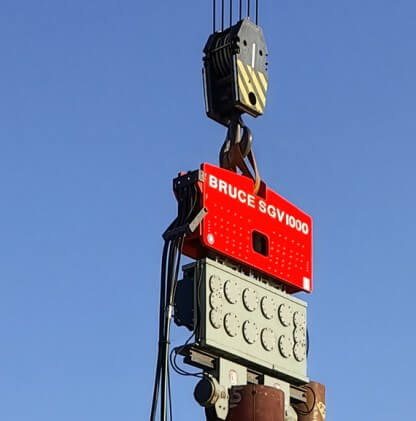
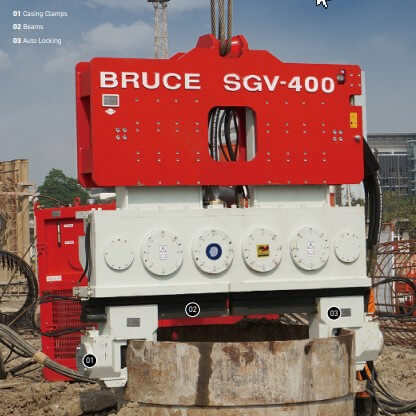
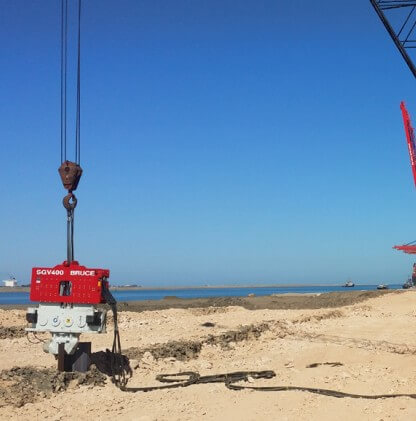
For temporary cofferdam sheet piling on eastern seaboard port projects — which typically does not require penetration into the weathered rock horizon — vibratory driving through the soft to medium-stiff estuarine and alluvial upper horizon is generally achievable with mid-range crane-suspended SGV models, provided the pile is designed to achieve adequate passive earth pressure resistance within the penetrable stratum. The BRUCE engineering desk provides pre-mobilisation model selection based on site-specific geotechnical data — a recommended step before equipment procurement on any Australian port project given the geological variability between eastern and northern seaboard port environments.
03. AS 2159 Compliance and Pile Testing Requirements
Australian pile design and installation is governed by AS 2159-2009 (Piling — Design and Installation), which sets the technical standard for driven pile installation on Australian construction projects. AS 2159 requires that pile driving be monitored and documented using a pile driving record (PDR) for each pile installed, with records of the driving equipment, set per blow or penetration per unit time at design tip elevation, and any anomalies encountered during driving. For vibratory hammer installation of temporary cofferdam sheet piles, the PDR requirements under AS 2159 are less prescriptive than for permanent bearing piles — vibratory installation of sheet piles is typically assessed on penetration rate records rather than blow count per set — but the records must still be sufficient to demonstrate to the geotechnical engineer of record that design embedment was achieved at each pile location.
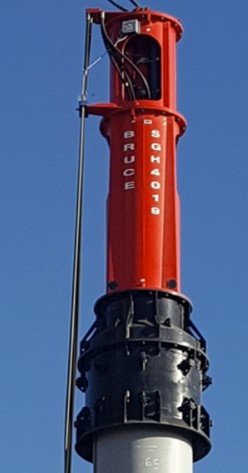
For permanent bearing piles on Australian port projects where AS 2159 requires pile load testing to confirm design capacity, the optional IEA (Impact Energy Analysis) System on the BRUCE SGH hydraulic impact hammer series provides the dynamic pile testing data support required for high-strain dynamic testing under AS 2159 Clause 8. The IEA system records real-time energy at every blow of the hydraulic impact hammer during initial drive and restrike testing, providing the energy transfer data that the geotechnical engineer requires to assess pile capacity through CAPWAP or equivalent signal matching analysis. This IEA system has been adopted as a standard monitoring tool by the Hong Kong Housing Government on major infrastructure projects — a reference from a high-compliance regulatory environment comparable to Australian state government infrastructure standards.
State Variations — Queensland, WA, and NSW Pile Installation Requirements
While AS 2159 sets the national baseline standard, individual Australian state and territory governments impose additional requirements through state building codes, port authority technical specifications, and infrastructure agency project-specific requirements. Queensland’s Department of Transport and Main Roads (TMR) and the Queensland Ports Corporation impose project-specific pile installation requirements on port and wharf contracts that supplement AS 2159 with additional monitoring, documentation, and quality assurance obligations. In Western Australia, Main Roads WA and the Pilbara Ports Authority impose similar project-specific requirements on port infrastructure contracts in the Pilbara, where the combination of cyclone-category structural design loads and calcareous soil conditions makes pile installation documentation and testing requirements among the most stringent in Australia. Pre-mobilisation confirmation with the project geotechnical engineer and the relevant state authority of the specific pile installation documentation format required — beyond the AS 2159 PDR baseline — is a recommended step for any contractor mobilising piling equipment to an Australian port project for the first time.
04. Environmental Permit Protocol — State EPA and EPBC Act
Australian port construction piling is subject to environmental regulation at both federal and state levels. The Environment Protection and Biodiversity Conservation Act 1999 (EPBC Act) applies where port construction activities may affect matters of national environmental significance — including listed marine species, migratory species, and Commonwealth marine areas. Port projects in proximity to the Great Barrier Reef Marine Park require referral to the federal Department of Climate Change, Energy, the Environment and Water (DCCEEW) under EPBC Act section 12, and the Great Barrier Reef Marine Park Authority (GBRMPA) imposes specific conditions on in-water works including piling that may generate underwater noise affecting marine mammals and fish species within the Marine Park boundary.
At state level, environmental impact assessment and construction environmental management plan (CEMP) approval is required from the relevant state EPA before in-water piling commences on port construction projects across all Australian states and territories. State EPA conditions for in-water piling commonly include requirements for biodegradable hydraulic fluids in all plant operating within the marine environment, underwater noise monitoring during impact piling operations in proximity to sensitive marine habitat, turbidity monitoring and silt curtain deployment during sheet pile installation in tidal and estuarine zones, and seasonal work exclusion zones during marine fauna breeding and aggregation periods. All BRUCE SGV series hydraulic components and PQ-V power packs are confirmed compatible with biodegradable hydraulic oils — satisfying state EPA CEMP conditions for in-water plant operation on Australian port projects without hydraulic circuit modification.
Underwater Noise Management — Vibratory vs. Impact for Marine Fauna Protection
EPBC Act conditions and GBRMPA permit conditions for port piling in or adjacent to the Great Barrier Reef Marine Park increasingly impose underwater noise limits during in-water construction activities to protect marine mammals and acoustic fish species. Vibratory hammers generate significantly lower underwater acoustic pressure levels than hydraulic impact hammers at equivalent penetration depths — a measurable advantage that is documented in the piling noise literature and referenced in GBRMPA technical guidance on underwater construction noise management. Where the EPBC or GBRMPA conditions require the use of low-noise piling methods for initial pile penetration, vibratory driving through the soft upper marine sediments followed by impact final set in the harder lower horizon provides the lowest total underwater noise exposure approach while still achieving the bearing capacity verification required under AS 2159 for permanent port infrastructure piles.
For AS 2159 documentation support, CEMP equipment specification preparation, and pre-mobilisation model selection for your Australian port project, contact the BRUCE engineering desk at powerquip.co.kr/contact-us/. Full SGV and SGH technical specifications are at powerquip.co.kr/products/vibro-hammer/features-2/.
Australian Port Piling FAQ
Q: Why do calcareous soils in northern Australia create unique challenges for vibratory pile installation?
“Calcareous grain structures are crushable under vibration loading — progressive grain crushing around the pile shaft increases skin friction with depth rather than reducing it, as occurs in siliceous granular soils.”
This friction fatigue effect in calcareous soils means that centrifugal force selection must account for progressively increasing skin friction during the drive, not just the initial SPT N-value of the formation. Model selection should be confirmed with a geotechnical engineer experienced in calcareous soil piling before mobilisation to northern Australian port sites.Q: What does AS 2159-2009 require for vibratory hammer installation records on Australian port projects?
“AS 2159 requires a pile driving record (PDR) for each pile, documenting the driving equipment, penetration per unit time at design tip elevation, and any anomalies encountered during driving.”
For vibratory installation of temporary cofferdam sheet piles, penetration rate records rather than blow count per set are typically used to demonstrate design embedment achievement. The BRUCE SGV technical specification sheets provide all required equipment parameters for AS 2159 PDR documentation.Q: Does the EPBC Act apply to vibratory sheet pile installation on Australian port projects?
“Yes — port construction piling that may affect listed marine species, migratory species, or Commonwealth marine areas requires EPBC Act referral to DCCEEW, and projects near the Great Barrier Reef also require GBRMPA permit conditions.”
Vibratory hammers generate lower underwater acoustic pressure than impact methods — an advantage under EPBC and GBRMPA underwater noise management conditions. Biodegradable hydraulic oil compatibility is a standard CEMP condition for all in-water plant on EPBC-referred port construction projects.Q: Is the combined vibratory and hydraulic impact approach standard practice for permanent bearing pile installation on Australian port projects?
“Yes — vibratory hammers handle initial penetration through soft upper marine sediments, with hydraulic impact hammers completing final set in denser sand, weathered rock, or calcarenite at depth where AS 2159 bearing capacity verification by blow count is required.”
BRUCE supplies both SGV vibratory and SGH impact series from a single manufacturer, with the optional IEA energy monitoring system on the SGH providing the dynamic pile testing data support required for AS 2159 Clause 8 high-strain dynamic testing on Australian port infrastructure projects.