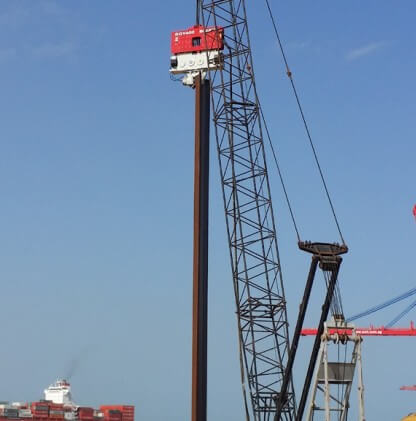
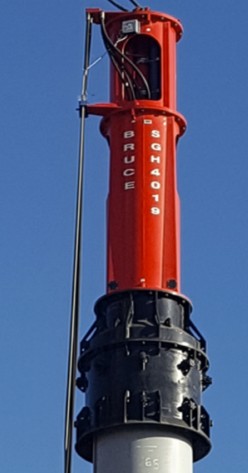
Vibro Hammer for Sale:
2026 Vibratory Hammer Price Guide
“WHAT DRIVES THE PRICE — AND WHAT TO VERIFY BEFORE YOU BUY”
“The vibratory hammer price you see in a quotation is the starting number — not the final cost. The real price of a poorly specified or pre-owned unit is calculated on site, in downtime, in re-testing fees, and in the project delays that follow frequency drop under load.”
01. What Determines Vibratory Hammer Price in 2026
When searching for a vibro hammer for sale, the first question most buyers ask is about price. However, the vibratory hammer price reflects a combination of engineering decisions — not a commodity rate that can be compared across manufacturers without understanding what each figure covers. Three primary variables drive the price of a new vibratory hammer in 2026: centrifugal force capacity, the matched hydraulic power pack specification, and the clamp configuration required for your specific pile profile.
Centrifugal Force and Eccentric Moment — The Core Price Driver
As centrifugal force increases across the SGV model range — from 510 kN (SGV-80) to 4,610 kN (SGV-2000) — the price scales accordingly. Higher centrifugal force requires precision-machined alloy steel eccentric weights, a larger-displacement hydraulic motor, and a matched higher-output PQ-V power pack. Consequently, the single most important specification decision before requesting a price is confirming the required centrifugal force against the project pile weight. As a documented selection rule, centrifugal force should be at least 15 times the pile weight. Over-specifying centrifugal force increases the price without delivering additional performance benefit for your actual soil conditions and pile type.
The Complete Package — What Must Be Included in Any Price Comparison
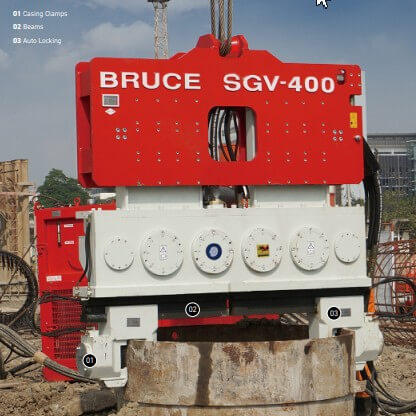
A vibratory hammer price that excludes the matched power pack, clamp type, and hose bundle significantly understates the true procurement cost. For crane-suspended SGV models, the matched PQ-V power pack (PQ-200V to PQ-1600V at 320 bar) is a mandatory component — the hammer cannot operate without it. For excavator-mounted SGV models (SGV-40, SGV-60, SGV-80E), no separate power pack is required, as the hammer connects directly to the host excavator’s auxiliary hydraulic circuit. Furthermore, clamp jaw selection — Universal Sheet Pile Clamps (60U to 320U) for sheet piles and H-beams, or Casing Pile Clamps (2x40D to 4x160D) for round pipe piles — must be confirmed at order stage to prevent compatibility issues on first deployment. Before comparing any two vibro hammers for sale, confirm that both quotations cover the same complete package.
BEFORE YOU REQUEST A PRICE
To receive an accurate vibratory hammer price, you need to provide: pile type, pile weight and dimensions, soil SPT N-values at design tip elevation, and host carrier hydraulic output (for excavator-mounted models). Without this data, any price you receive is an estimate — not a confirmed specification. Review our Master Bidding Strategy & Cost Estimate Guide for full detail on how to structure your procurement inquiry.
02. SGV Model Range — Price by Centrifugal Force Class
The BRUCE SGV series covers the full range of global vibratory hammer applications — from urban sheet piling and cofferdam construction to heavy offshore and marine foundation work. Understanding which model class applies to your project is the first step in obtaining a meaningful vibratory hammer price. For a comprehensive review of how these models rank against other manufacturers’ products, see the Best Vibratory Hammer Brands 2026 User Reviews & Ratings.
Light to Medium Class — Urban and Cofferdam Applications
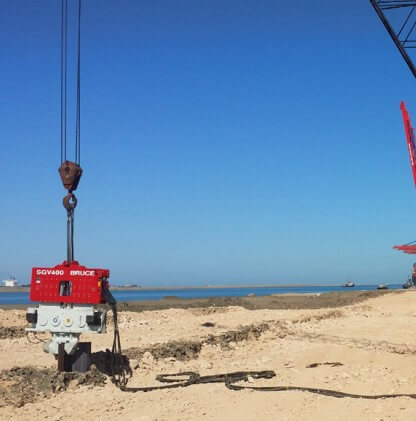
Models in the SGV-80 to SGV-300 range (centrifugal force 510 kN to 920 kN) are typically deployed for sheet pile cofferdam construction, flood defence wall installation, and temporary shoring in granular soils. These models are the most common class of vibro hammer for sale in the urban construction equipment market. For example, a 3.5-ton sheet pile driven to 20m in medium-dense sand corresponds to the SGV-300 with 92 tons of centrifugal force and a PQ-400V power pack. The clamp jaw type — Universal (60U to 320U) for Larssen and Z-profile sections — must be confirmed at order stage against the specific pile section in the project schedule. Excavator-mounted models in this class (SGV-40, SGV-60) connect directly to the host machine’s auxiliary circuit, with required oil flow from 210 lpm to 350 lpm depending on the model.
Heavy to Ultra-Heavy Class — Bridge and Offshore Applications
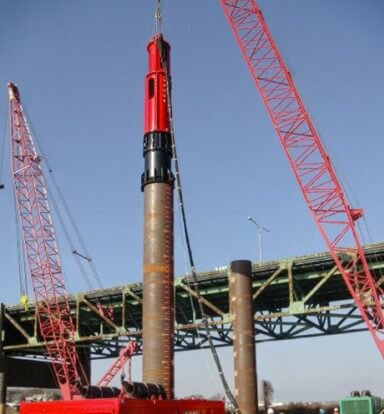
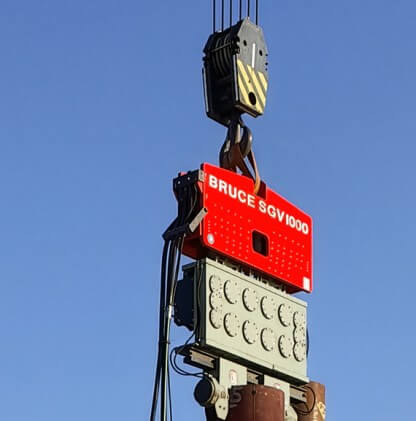
Models in the SGV-500 to SGV-2000 range (centrifugal force 1,340 kN to 4,610 kN) are deployed for large-diameter steel casing piles on bridge foundations, offshore platform structures, and major port expansion projects. The vibratory hammer price for this class reflects the significantly larger hydraulic motor, matched high-output PQ-V power pack, and the casing pile clamp configuration (2x40D to 4x160D with hydraulic auto-locking beams). Furthermore, this class covers the application range where the price difference between a correctly specified new unit and a used unit with undocumented maintenance history is most consequential — gearbox harmonic drift in pre-owned high-capacity models causes frequency drop under the heavy marine soil loads that these models are designed to overcome, leading to pile stall on high-value offshore projects where daily cost exposure is significant. Additionally, the SGV-1000 and SGV-2000 models include mechanical stops in the suppressor assembly that prevent elastomers from over-stretching during extraction of heavy casing piles — extending service life under the highest extraction loads in the full range.
SGV Technical Specification Highlights by Class:
- SGV-80 to SGV-300: Centrifugal force 510–920 kN / Eccentric moment 11.5–39 kgm / Matched PQ-200V to PQ-400V / Universal clamps 60U–320U
- SGV-400 to SGV-600: Centrifugal force 1,020–1,340 kN / Eccentric moment 52–79 kgm / Matched PQ-500V to PQ-700V / Universal + Casing clamp options
- SGV-800 to SGV-2000: Centrifugal force 1,870–4,610 kN / Eccentric moment 110–220 kgm / Matched PQ-900V to PQ-1600V / Full casing clamp range 2x40D–4x160D
- Excavator series (SGV-40/60/80E): 20–50 ton carrier / 210–350 lpm oil flow / No separate power pack required / Tilting models (40T/60T) with 360° rotation and 90° tilt
Understanding how the mechanical architecture of the vibro hammer drives both performance and price is essential before comparing quotations. For a deeper look at the internal mechanics that separate premium from budget-tier products, see our guide on the technical pile driver machine mechanism and hydraulic power unit specifications.
03. Compliance Add-Ons That Affect Final Price
When evaluating a vibro hammer for sale for deployment on regulated infrastructure contracts, the final price must include the compliance-specific components required by the project’s regulatory framework. These are not optional extras — they are procurement requirements that determine whether the equipment can be used on the project at all. Including them in the initial price request prevents budget surprises after contract award.
US Market — IEA Energy Monitoring System
For vibro hammers deployed on US federally funded bridge and highway projects requiring ASTM D4945 compliance, the optional IEA (Impact Energy Analysis) System must be included in the price request from the outset. Developed by BRUCE and adopted as a standard energy monitoring system by the Hong Kong Housing Government, the IEA records real-time energy at every blow — providing the verifiable energy transfer log required by DOT structural auditors. Including it in the initial package cost eliminates the need to source separate third-party dynamic monitoring equipment after contract award — which typically costs more and introduces additional logistics complexity on active project sites. Furthermore, field measurements on SGH-1015 and SGH-1415 deployments confirmed energy transfer rates of up to 90%, providing the quantitative baseline that procurement teams can reference in their ASTM compliance submissions.
UK Market — Silence Cap Housing and Biodegradable Oil Specification
For vibro hammers sold into the UK urban construction market where BS 5228 Section 61 noise consent applies, the optional Silence Cap Housing Kit on the SGH series addresses the most stringent noise ordinance requirements. It is specified at factory order stage — not as a post-purchase field retrofit — ensuring the noise reduction performance is verified before site deployment. Additionally, biodegradable hydraulic oil compatibility — confirmed across all BRUCE hydraulic components — satisfies UK Environment Agency permit conditions for piling near watercourses without post-procurement equipment modification. Consequently, both items affect the final price and must be included in the initial vibratory hammer price request for UK urban and riverside project deployments.
Compliance Items to Include in Your Price Request:
- IEA Energy Monitoring System (US): Required for ASTM D4945 compliance on federally funded DOT contracts
- Silence Cap Housing Kit (UK): Required for BS 5228 Section 61 urban noise consent on SGH series
- Biodegradable Oil Specification: Required for EPA (US) and Environment Agency (UK) coastal and riverside permits
- CIF or FOB Shipping Terms: Confirmed at order stage — must be included for accurate landed cost calculation
04. New vs. Used — The True Cost Comparison
The most common reason buyers search for a vibro hammer for sale at a lower price point is the used equipment market. Pre-owned vibratory hammers are typically listed at significantly lower prices than new factory-certified units — a price difference that appears attractive until the hidden costs are factored into the total project financial model. We specialize exclusively in new equipment, and the reasoning is grounded in the specific failure modes that make pre-owned vibratory hammers a liability on regulated infrastructure projects.
Harmonic Drift — The Invisible Cost of Pre-Owned Equipment
In used vibratory hammers, worn bearings and degraded gear tooth profiles cause harmonic drift — the operating frequency drops progressively under soil load. When frequency drops below the threshold required for soil liquefaction, the pile stalls and the operator increases crane line pull to compensate. This combination of reduced vibration and increased static tension is the primary cause of pile fracture at weld joints during extraction on pre-owned equipment. On a marine barge or offshore project site, a single such incident stops the project, requiring crane repositioning, pile assessment, and potentially replacement procurement — costs that individually far exceed the initial price saving of a used unit. Furthermore, gearbox inspection sufficient to identify these defects requires full disassembly — a cost and logistics burden that pre-purchase surveys rarely include.
Compliance Documentation — What Used Equipment Cannot Provide
Pre-owned vibratory hammers without documented energy transfer history cannot satisfy ASTM D4945 energy verification requirements on US federally funded projects, and cannot provide the verifiable compliance documentation that UK ICE specification and Environment Agency permits increasingly require. New equipment from a factory-certified manufacturer ships with ISO 9001 certification documents, technical specification sheets, and operation manuals — the compliance package that engineering procurement teams require to approve equipment on government-funded contracts. Additionally, new equipment purchased through established distributor partnerships provides access to direct engineering desk support for commissioning, troubleshooting, and consumable parts ordering — after-sales capabilities that the used equipment market cannot offer. For companies building a long-term piling equipment business, a distributor or dealer partnership provides a more sustainable procurement channel than the spot used market. See our Global Dealer & Distributor Opportunities page for details on structured equipment access programs.
“We do not sell used equipment because the true vibratory hammer price comparison is not unit cost versus unit cost — it is total project cost versus total project cost. A new factory-certified unit eliminates the failure modes that make pre-owned equipment a variable liability rather than a fixed asset.”
What New Equipment Price Includes That Used Does Not
- Factory-verified centrifugal force and frequency specifications — confirmed against the carrier and pile profile at order stage
- ISO 9001 certification documentation — covering the full manufacturing process from gearbox assembly to hydraulic circuit testing
- Known consumable parts schedule — elastomers, clamp seals, hydraulic fittings, and gearbox lubricant all specified by part number from day one
- Gearbox service life over 20 years with correct maintenance — documented from BRUCE SGV field deployments, driven by alloy steel eccentric weight construction
- Built-in clamp check valve — maintaining clamping pressure even in case of hose damage, preventing pile drop on marine and tidal project sites
- Suppressor elastomers with mechanical stops — preventing over-stretching during extraction, extending service life under the highest operating loads
Vibratory Hammer Price & Purchase FAQ
Q: What information do I need to get an accurate vibratory hammer price?
“Provide pile type, pile weight and dimensions, soil SPT N-values at the design tip elevation, and — for excavator-mounted models — the host machine’s auxiliary hydraulic flow and pressure output.”
This data allows the engineering desk to confirm the correct SGV model, matched PQ-V power pack, clamp jaw type, and any compliance add-ons required for the specific project. Without this information, any price you receive reflects a generic model assumption rather than a specification confirmed against your actual project conditions — and the risk of ordering the wrong model falls on the buyer.Q: Why does vibratory hammer price vary so much between manufacturers?
“Price variation reflects gearbox engineering quality, suppressor elastomer specification, hydraulic motor grade, and whether the manufacturer holds ISO 9001 certification and documented project performance references.”
Budget-tier manufacturers typically use standard steel components rather than alloy steel eccentrics, omit mechanical stops in the suppressor design, and cannot provide independently verified project references for engineering procurement teams. These differences are not visible in the headline centrifugal force figure — they only become apparent under sustained load in resistive strata, where harmonic drift in lower-grade gearboxes causes frequency drop that premium units maintain.Q: Is global shipping included in the vibro hammer for sale price?
“Factory-direct quotations from Siheung, Korea are provided on CIF or FOB terms confirmed at order stage — providing transparent landed cost calculation for project budget submission.”
Shipping documentation, certificates of origin, and compliance technical documents are prepared as part of the export process. BRUCE has established logistics channels to major ports across the Americas, Europe, the Middle East, and Asia — including documented deliveries to US DOT bridge projects in Rhode Island, Florida, and Virginia.Q: What is the replacement parts availability and ongoing cost after purchasing a vibro hammer?
“All BRUCE SGV models use consumable parts specified by part number in the operation manual — elastomers, clamp cylinder seals, hydraulic fittings, and gearbox lubricant are all available from qualified suppliers with known replacement intervals.”
For vibratory hammers, the primary wear items are suppressor elastomers, clamp cylinder seals, and hydraulic filter elements — all replaced at hours-based intervals specified in the operation manual. Gearbox lubricant is replaced on a scheduled cycle. Consequently, fleet managers can pre-order sufficient consumable stock before project mobilization, eliminating unplanned downtime from consumable depletion that is the most common source of schedule delays in extended piling operations.