Sheet Pile Vibratory Hammer:
What to Know Before You Buy
Equipment types, soil compatibility, key specs, and a step-by-step buying process for contractors and importers worldwide.
If you are looking to buy a sheet pile vibratory hammer, the options on the market range from lightweight excavator-mounted units for urban retrofits to high-moment crane-suspended machines for large marine and infrastructure projects. Getting the selection wrong — even by one size class — means equipment that underperforms in the field or overloads the carrier machine.
This guide is written for contractors, equipment dealers, and importers making a purchase decision in 2026. It covers the full buying process: from understanding what a sheet pile vibratory hammer does, to confirming specs with the manufacturer, to placing an order with confidence.
1What Is a Sheet Pile Vibratory Hammer?
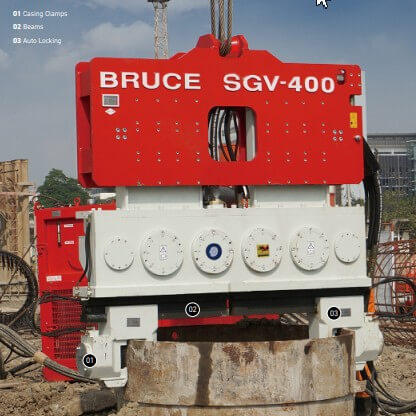
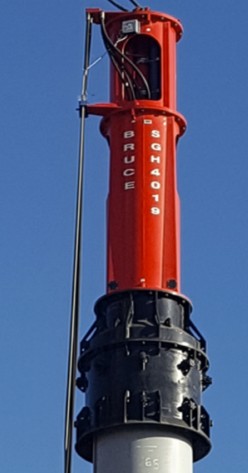
A sheet pile vibratory hammer is a hydraulically powered piling machine that installs or extracts sheet piles by transmitting high-frequency vertical oscillations directly into the pile. Unlike an impact hammer that drives piles through repeated blows, a vibratory hammer reduces soil resistance around the pile shaft — allowing the pile to penetrate under its own weight combined with the machine’s downward static force.
The core mechanism relies on counter-rotating eccentric weights driven by hydraulic motors. As the weights rotate, they generate a vertical centrifugal force that vibrates the entire clamp-and-pile assembly at frequencies typically between 23 and 50 Hz.
Sheet piles commonly installed with vibratory hammers include Z-piles (Larssen sections), U-piles, H-piles used as king piles in combi-wall systems, and lightweight vinyl or fiberglass sheet piles for environmental and landscaping applications.
2Equipment Types: Crane-Suspended vs. Excavator-Mounted
The first major decision when buying a sheet pile vibratory hammer is the carrier configuration. Both types install sheet piles effectively — the right choice depends on site access, pile dimensions, and available carrier equipment.
Crane-Suspended Vibratory Hammer
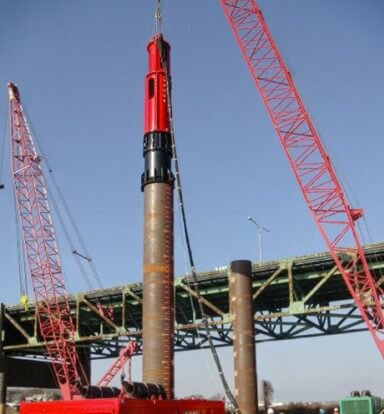
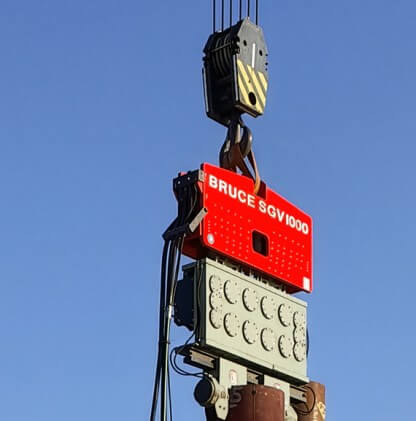
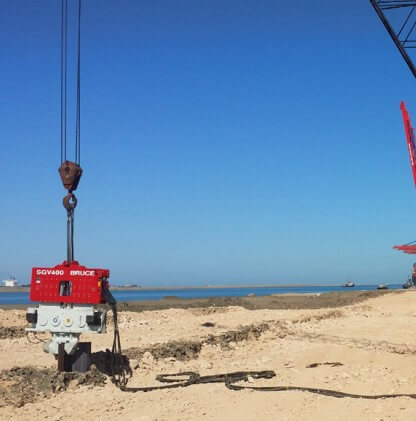
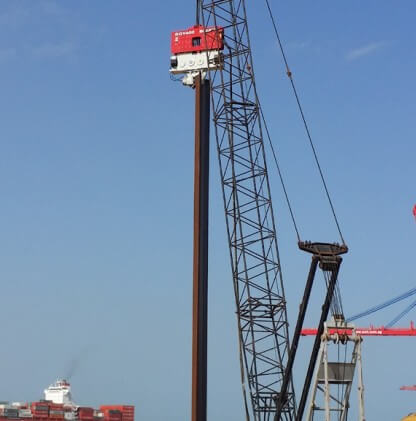
Hung from a crane or piling leader via a suppressor assembly. Best for large-format sheet piles (AZ, AU series), high eccentric moment requirements, and open-site marine or infrastructure work.
Excavator-Mounted (Side-Grip)
Attaches to the arm of a standard excavator via a bracket. Ideal for restricted-access urban sites, sheet pile extraction, and projects where crane mobilization is cost-prohibitive.
High-Frequency Variable Moment
Allows the operator to reduce eccentric moment to near-zero before and after driving — the “resonance-free” start/stop method that protects adjacent structures from resonance damage.
Hydraulic Power Pack (HPU)
Standalone power unit matched to the vibratory hammer’s flow and pressure specs. Required when the carrier’s onboard hydraulics are insufficient for the hammer’s rated output.
3Soil Compatibility — Does a Vibratory Hammer Suit Your Site?
Before committing to a purchase, confirm that a vibratory hammer is the right tool for the dominant soil conditions at your project site. The table below summarizes typical performance by soil type.
| Soil Type | Vibro Hammer Performance | Suitability | Notes |
|---|---|---|---|
| Loose to medium sand | Excellent — rapid penetration | ✅ Ideal | Liquefaction effect maximizes speed |
| Saturated silt | Very good | ✅ Ideal | Standard application for sheet piling |
| Soft to medium clay | Good with adequate moment | ✅ Good | Higher moment model may be needed |
| Stiff clay / firm clay | Marginal — slow penetration | ⚠️ Marginal | Pre-augering or impact assist recommended |
| Dense gravel / cobbles | Poor — refusal risk | ❌ Limited | Use hydraulic impact hammer or pre-drill |
| Bedrock / hard rock | Not suitable | ❌ Not suitable | Impact hammer or rock socket required |
4Key Specs to Confirm Before Buying
These are the parameters that must be matched between the vibratory hammer, the sheet pile section, and the carrier machine. Mismatches here are the primary cause of equipment underperformance and warranty disputes.
| Specification | What to Verify | Consequences of Mismatch |
|---|---|---|
| Eccentric Moment (kN·m) | Match to pile section and soil resistance | Refusal or insufficient penetration rate |
| Operating Frequency (Hz / rpm) | Standard (23–35 Hz) or high-frequency (40–50 Hz) | Resonance damage to adjacent structures |
| Max Centrifugal Force (kN) | Confirm against pile shaft friction estimate | Pile won’t drive to design depth |
| Required Hydraulic Flow (L/min) | Must match carrier HPU output | Motor cavitation, early seal failure |
| Max Operating Pressure (bar) | Verify against carrier’s relief valve setting | Hose and motor damage |
| Clamp Jaw Geometry | Match to pile web width and thickness | Inadequate grip — pile drop hazard |
| Clamp Force (kN) | Sufficient for extraction torque | Jaw slip during pile extraction |
| Total Suspended Weight (kg) | Within crane/excavator lift capacity | Structural overload, site safety violation |
5Step-by-Step Buying Process
For importers and distributors placing an order for the first time, the process from initial inquiry to delivery involves several verification stages. Following these steps reduces the risk of specification mismatches, import documentation issues, and delivery delays.
-
1
Define your project requirements
Pile type and section, site soil profile (borehole/CPT data if available), carrier machine specs, and target delivery country. The more detail you provide, the faster the manufacturer can size the correct model.
-
2
Request a technical proposal and quote
Submit your project details to the manufacturer. A credible supplier will respond with a model recommendation, technical datasheet, and commercial quotation — not just a price per unit.
-
3
Verify certifications and factory credentials
Request the CE Declaration of Conformity, ISO certificates, and any project reference documentation. Cross-check CE certificates against the issuing notified body registry.
-
4
Confirm export documentation requirements
Depending on your import country, you may need CO (Certificate of Origin), packing list, commercial invoice with HS code, and in some cases an import license for construction machinery. Confirm these with your freight forwarder before order placement.
-
5
Place purchase order and confirm production schedule
Standard vibratory hammer models typically have a 6–10 week production lead time. Confirm a delivery milestone plan in writing with the purchase order.
-
6
Arrange pre-shipment inspection (optional but recommended)
For large orders or first-time purchases, a pre-shipment inspection at the factory by a third-party inspector provides quality assurance before the equipment leaves the production facility.
63 Costly Buying Mistakes to Avoid
7Pre-Purchase Checklist
- ✓Pile section confirmed (e.g., AZ 26, PU 12, HZ) Clamp geometry is pile-section specific. Confirm before order.
- ✓Soil profile data provided to manufacturer Borehole logs or CPT data allow accurate eccentric moment sizing.
- ✓Carrier machine hydraulic specs confirmed Max flow (L/min) and relief pressure (bar) must match hammer requirements.
- ✓CE Declaration of Conformity requested Verify against notified body registry — not just a scanned copy.
- ✓Spare parts availability confirmed High-wear items (bearings, seals, jaw inserts) should be in stock, not made-to-order.
- ✓Export documentation package confirmed CO, commercial invoice, packing list, HS code — country-specific requirements checked.
- ✓Delivery lead time and milestones in writing Production schedule agreed and documented in the purchase order.
- ✓Technical support contact confirmed Named in-house engineer, not a general inquiry email.
- ✓Warranty terms reviewed and accepted Coverage period, exclusions, and claim process clearly defined.
- ✓Remote commissioning support arranged Especially important for importers deploying in markets without local service infrastructure.
8Frequently Asked Questions
Ready to Buy a Sheet Pile Vibratory Hammer?
Tell us your pile section, soil conditions, and target market. BRUCE Piling Equipment will respond within 24 hours with a model recommendation and commercial quotation — no obligation.