Vibro Hammer for Marine Seawall and Breakwater Construction: 2026 Guide
PIANC coastal structure guidance, wave loading considerations, and global soil planning for seawall and breakwater contractors
Sheet Pile Seawalls vs. Rubble Mound Breakwaters
Coastal protection structures fall broadly into two categories, and the distinction matters for piling scope. Rubble mound breakwaters — layered rock or concrete armour units dissipating wave energy through mass and permeability — typically require limited piling, generally confined to a toe structure or a crown wall foundation. Sheet pile and combi-wall seawalls, by contrast, are vertical or near-vertical retaining structures that both resist wave loading directly and retain reclaimed or existing land behind the wall line, and represent the majority of piling-intensive coastal protection work globally, from urban waterfront seawalls to industrial coastal facility protection.
PIANC publishes internationally referenced guidance on coastal and port structure performance, including seismic and wave-loading design criteria that inform sheet pile seawall design in combination with national codes such as EN 1997 (Eurocode 7) in Europe, and equivalent national geotechnical design standards elsewhere. Vibratory hammers are the standard installation method for sheet pile seawall construction in the granular and soft cohesive coastal soils typical of these projects, chosen for the combination of penetration rate in saturated coastal sand, low disturbance to adjacent structures on urban waterfront sites, and extraction capability where temporary works cofferdams are required during the construction sequence.
Wave Loading and Toe Scour — Why Embedment Depth Is Non-Negotiable
A sheet pile seawall’s structural performance under design wave loading depends directly on achieving the passive embedment depth specified in the geotechnical design — the depth at which the soil in front of the wall provides sufficient passive resistance to balance the active earth pressure and wave force acting on the exposed face. Unlike a retaining wall in a benign inland setting, a seawall’s toe is also subject to progressive scour from wave-induced sediment transport, which can reduce the effective embedment depth over the structure’s service life if the design toe level does not include an adequate allowance for anticipated scour.
This makes confirming that design toe elevation has actually been reached during installation — rather than stopping at a penetration rate that appears to indicate refusal — a critical quality control step on seawall projects. Under-driven sheet piles that stop short of design toe due to an under-specified hammer stalling in a dense sub-layer represent a structural risk that may not become apparent until a design storm event tests the wall’s passive resistance years after construction. Confirming vibratory hammer selection against the full soil bore log at the design toe elevation, not just the soil conditions in the upper driving zone, is standard practice for reputable seawall contractors.
Global Soil and Climate Conditions for Seawall Projects
Seawall and coastal protection projects span an unusually wide range of soil and climatic conditions globally. Pacific island and Southeast Asian coastal protection projects frequently encounter soft coral sand and reef-derived carbonate soils, which, similar to calcareous sand in other regions, are prone to particle crushing under vibration and require careful amplitude management to avoid over-driving. Northern European and North American seawall projects more commonly encounter glacially deposited till or dense sand requiring higher centrifugal force models, while Middle Eastern coastal protection works frequently involve cemented sabkha horizons that can require a transition to pre-drilling or impact methods for final embedment.
Tropical cyclone and typhoon-exposed coastal regions across the Asia-Pacific and Gulf Coast typically impose seasonal construction windows on seawall projects, similar to the seasonal constraints seen on flood defense projects in temperate river catchments, requiring contractors to plan mobilisation and completion of exposed foundation work outside the peak storm season wherever the programme allows. Equipment reliability from first mobilisation is consequently a significant driver of whether a seawall foundation package completes within the available weather window.
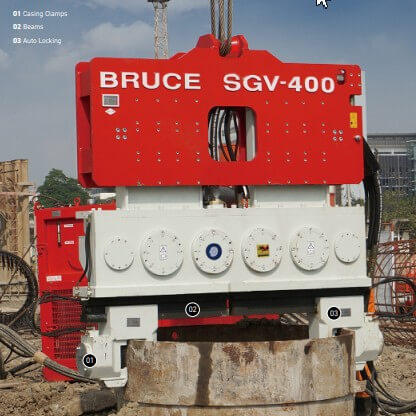
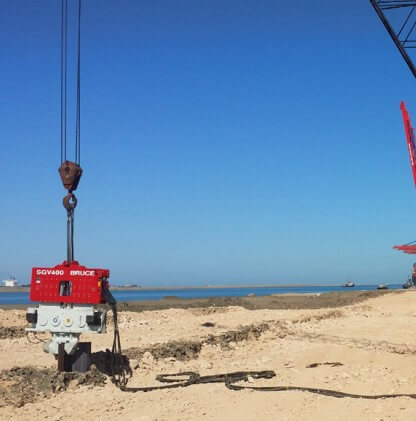
Full technical specifications for the SGV crane-suspended and excavator-mounted series across the full centrifugal force range are available at powerquip.co.kr/products/vibro-hammer/features-2/.
Combi-Wall Seawalls for High Wave-Loading Sites
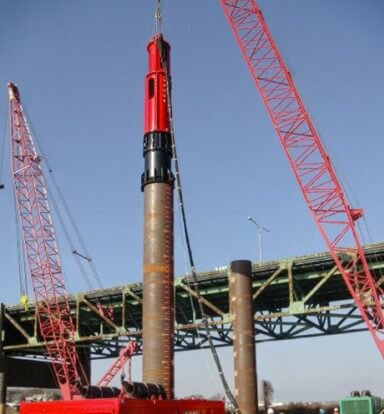
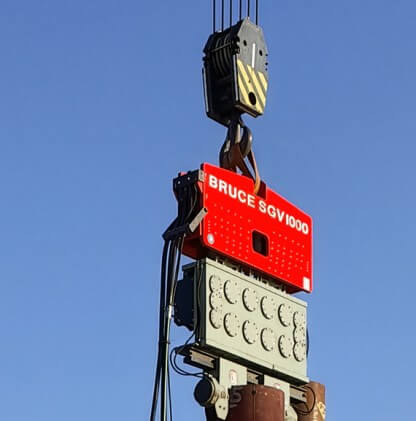
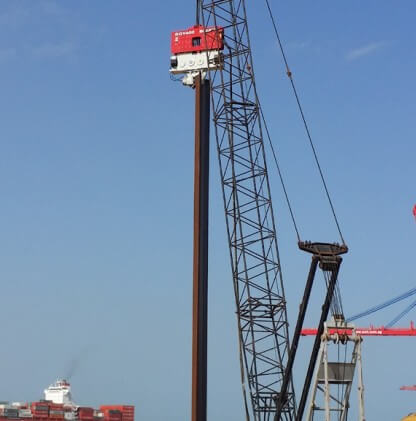
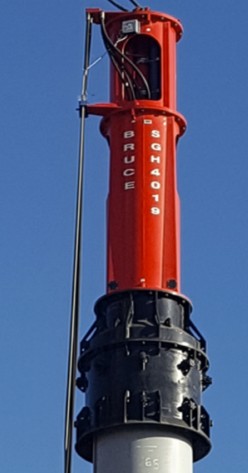
On exposed coastal seawall sites subject to significant design wave heights, a sheet pile-only wall section can reach practical structural limits, prompting the same combi-wall approach used on deep port berths — larger-diameter primary tubular piles carrying the majority of the bending moment, with intermediate sheet pile infill panels providing the retained soil barrier between them. Installing the primary tubular piles for a high wave-loading combi-wall seawall requires the higher end of the vibratory hammer capacity range, and the BRUCE SGV crane-suspended series’ span from 510 kN to 4,610 kN centrifugal force allows a single contractor fleet to cover both the primary piles and lighter infill sections on the same seawall project.
For pre-mobilisation model selection against your seawall or breakwater project’s soil data, design toe elevation, and seasonal construction window, contact the BRUCE engineering desk at powerquip.co.kr/contact-us/.
Seawall and Breakwater Piling FAQ
Q: What’s the difference in piling scope between a rubble mound breakwater and a sheet pile seawall?
Rubble mound breakwaters dissipate wave energy through rock or concrete armour mass and typically require limited piling, confined to toe or crown wall foundations. Sheet pile seawalls are vertical retaining structures that require full-depth piling to resist both wave loading and retained earth pressure.
Q: Why is toe scour a specific design concern for sheet pile seawalls?
Wave-induced sediment transport can progressively reduce the effective embedment depth at a seawall’s toe over its service life. Design toe elevation must include an allowance for anticipated scour, and confirming that piles actually reach this depth during installation is a critical quality control step.
Q: Why does coral sand present a similar challenge to calcareous sand for vibratory pile driving?
Both coral sand and calcareous sand are prone to particle crushing under vibratory loading, which reduces effective friction angle. Operators manage amplitude carefully to avoid over-driving in these soil types.
Q: When is a combi-wall approach used instead of a sheet pile-only seawall?
On exposed sites with significant design wave heights, a sheet pile-only wall can reach structural limits. Combi-wall construction uses larger-diameter primary tubular piles to carry the majority of the bending moment, with sheet pile infill between them.
Vibro Hammer for Marine Seawall and Breakwater Construction: 2026 Guide
PIANC coastal structure guidance, wave loading considerations, and global soil planning for seawall and breakwater contractors
Sheet Pile Seawalls vs. Rubble Mound Breakwaters
Coastal protection structures fall broadly into two categories, and the distinction matters for piling scope. Rubble mound breakwaters, layered rock or concrete armour units dissipating wave energy through mass and permeability, typically require limited piling, generally confined to a toe structure or a crown wall foundation. Sheet pile and combi-wall seawalls, by contrast, are vertical or near-vertical retaining structures that both resist wave loading directly and retain reclaimed or existing land behind the wall line, and represent the majority of piling-intensive coastal protection work globally, from urban waterfront seawalls to industrial coastal facility protection.
PIANC publishes internationally referenced guidance on coastal and port structure performance, including seismic and wave-loading design criteria that inform sheet pile seawall design in combination with national codes such as Eurocode 7 in Europe, and equivalent national geotechnical design standards elsewhere. Vibratory hammers are the standard installation method for sheet pile seawall construction in the granular and soft cohesive coastal soils typical of these projects, chosen for the combination of penetration rate in saturated coastal sand, low disturbance to adjacent structures on urban waterfront sites, and extraction capability where temporary works cofferdams are required during the construction sequence.
Wave Loading and Toe Scour: Why Embedment Depth Is Non-Negotiable
A sheet pile seawall’s structural performance under design wave loading depends directly on achieving the passive embedment depth specified in the geotechnical design, the depth at which the soil in front of the wall provides sufficient passive resistance to balance the active earth pressure and wave force acting on the exposed face. Unlike a retaining wall in a benign inland setting, a seawall’s toe is also subject to progressive scour from wave-induced sediment transport, which can reduce the effective embedment depth over the structure’s service life if the design toe level does not include an adequate allowance for anticipated scour.
This makes confirming that design toe elevation has actually been reached during installation, rather than stopping at a penetration rate that appears to indicate refusal, a critical quality control step on seawall projects. Under-driven sheet piles that stop short of design toe due to an under-specified hammer stalling in a dense sub-layer represent a structural risk that may not become apparent until a design storm event tests the wall’s passive resistance years after construction. Confirming vibratory hammer selection against the full soil bore log at the design toe elevation, not just the soil conditions in the upper driving zone, is standard practice for reputable seawall contractors.
Global Soil and Climate Conditions for Seawall Projects
Seawall and coastal protection projects span an unusually wide range of soil and climatic conditions globally. Pacific island and Southeast Asian coastal protection projects frequently encounter soft coral sand and reef-derived carbonate soils, which, similar to calcareous sand in other regions, are prone to particle crushing under vibration and require careful amplitude management to avoid over-driving. Northern European and North American seawall projects more commonly encounter glacially deposited till or dense sand requiring higher centrifugal force models, while Middle Eastern coastal protection works frequently involve cemented sabkha horizons that can require a transition to pre-drilling or impact methods for final embedment.
Tropical cyclone and typhoon-exposed coastal regions across the Asia-Pacific and Gulf Coast typically impose seasonal construction windows on seawall projects, similar to the seasonal constraints seen on flood defense projects in temperate river catchments, requiring contractors to plan mobilisation and completion of exposed foundation work outside the peak storm season wherever the programme allows. Equipment reliability from first mobilisation is consequently a significant driver of whether a seawall foundation package completes within the available weather window.
Full technical specifications for the SGV crane-suspended and excavator-mounted series across the full centrifugal force range are available at powerquip.co.kr/products/vibro-hammer/features-2/.
Combi-Wall Seawalls for High Wave-Loading Sites
On exposed coastal seawall sites subject to significant design wave heights, a sheet pile-only wall section can reach practical structural limits, prompting the same combi-wall approach used on deep port berths: larger-diameter primary tubular piles carrying the majority of the bending moment, with intermediate sheet pile infill panels providing the retained soil barrier between them. Installing the primary tubular piles for a high wave-loading combi-wall seawall requires the higher end of the vibratory hammer capacity range, and the BRUCE SGV crane-suspended series’ span from 510 kN to 4,610 kN centrifugal force allows a single contractor fleet to cover both the primary piles and lighter infill sections on the same seawall project.
For pre-mobilisation model selection against your seawall or breakwater project’s soil data, design toe elevation, and seasonal construction window, contact the BRUCE engineering desk at powerquip.co.kr/contact-us/.
Seawall and Breakwater Piling FAQ
Q: What’s the difference in piling scope between a rubble mound breakwater and a sheet pile seawall?
Rubble mound breakwaters dissipate wave energy through rock or concrete armour mass and typically require limited piling, confined to toe or crown wall foundations. Sheet pile seawalls are vertical retaining structures that require full-depth piling to resist both wave loading and retained earth pressure.
Q: Why is toe scour a specific design concern for sheet pile seawalls?
Wave-induced sediment transport can progressively reduce the effective embedment depth at a seawall’s toe over its service life. Design toe elevation must include an allowance for anticipated scour, and confirming that piles actually reach this depth during installation is a critical quality control step.
Q: Why does coral sand present a similar challenge to calcareous sand for vibratory pile driving?
Both coral sand and calcareous sand are prone to particle crushing under vibratory loading, which reduces effective friction angle. Operators manage amplitude carefully to avoid over-driving in these soil types.
Q: When is a combi-wall approach used instead of a sheet pile-only seawall?
On exposed sites with significant design wave heights, a sheet pile-only wall can reach structural limits. Combi-wall construction uses larger-diameter primary tubular piles to carry the majority of the bending moment, with sheet pile infill between them.