Offshore Wind Monopile and Jacket Foundation Piling: 2026 Guide
Where vibro hammers fit in monopile and jacket pin pile installation, water depth thresholds, and 2026 project scale
Monopile vs. Jacket — Choosing the Foundation Type
Monopile foundations — a single large-diameter steel tube driven directly into the seabed — remain the dominant fixed-bottom offshore wind foundation type, accounting for roughly 70 to 80 percent of installed capacity in water depths up to around 40 metres. As turbine capacity has increased toward and beyond 15 MW, monopile diameters have grown correspondingly: recent projects such as the 1.1 GW Inch Cape offshore wind farm off the Scottish coast have installed monopiles reaching 11.5 metres in diameter, up to 102 metres in length, and around 2,300 tonnes in weight — among the largest installed in the industry to date.
Jacket foundations — lattice steel structures secured to the seabed by pin piles at three or four legs — become the preferred solution as water depth increases beyond roughly 40 to 50 metres, where a monopile’s diameter and wall thickness would otherwise need to grow uneconomically to resist the increased environmental loading. Jackets also suit sites with seabed conditions unsuitable for large-diameter monopile driving, including shallow bedrock or highly variable soil profiles, since the pin piles at each leg are considerably smaller in diameter and can be installed with a more forgiving driving tolerance than a single large monopile.
Where Vibratory Hammers Fit in the Installation Sequence
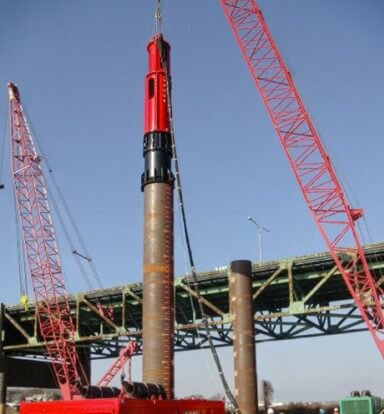
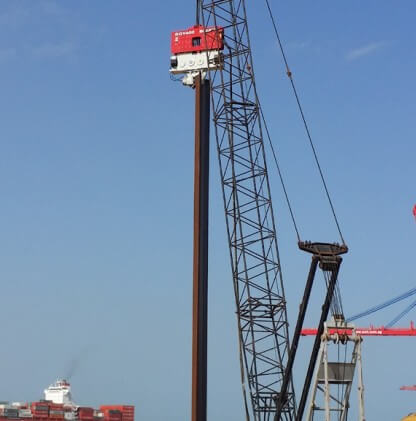
For XXL monopiles in the 6 to 12 metre diameter range now common on major offshore wind projects, final penetration to design toe elevation is achieved predominantly by large hydraulic impact hammers, which deliver the blow energy required to overcome end-bearing resistance in dense sand or till at the base of a structure this size. Vibratory hammers play a supporting but operationally important role earlier in the sequence — upending and pitching the monopile into a stable, verified position before impact driving begins, and performing initial self-weight or low-energy penetration through the soft upper seabed sediment to establish verticality before the impact hammer takes over for the higher-resistance lower section of the drive.
Jacket pin piles, by contrast, are considerably smaller in diameter than monopiles — typically in the 1.5 to 2.5 metre range — and vibratory installation plays a larger proportional role in their driving sequence, particularly for initial penetration and positioning, with impact hammers again typically completing final set where required bearing capacity demands it. This distinction between monopile and jacket pin pile installation sequencing is a frequent point of confusion in project planning, and confirming the intended equipment role for each foundation type with the installation contractor’s marine engineer before mobilisation prevents scope and equipment specification mismatches.
Standards Framework — IEC 61400-3 and DNV Guidance
Offshore wind turbine foundation design is governed internationally by IEC 61400-3, Wind Energy Generation Systems — Design Requirements for Offshore Wind Turbines, alongside recommended practice documents published by DNV covering the design of offshore steel structures and support structures for wind turbines. These frameworks set the structural and geotechnical basis that foundation installation contractors work to, including the driving criteria and verticality tolerances that determine acceptable performance during pin pile and monopile installation.
Underwater noise generated during offshore wind foundation installation is subject to increasingly specific regulatory attention in European, US, and Asia-Pacific project consenting processes, given its potential effect on marine mammals and fish. Vibratory hammers generate substantially lower underwater acoustic pressure than impact hammers, which is the primary reason vibratory pre-piling and positioning work is specified as standard practice ahead of impact driving on offshore wind projects, and why bubble curtain noise mitigation systems are typically deployed specifically around the impact hammer driving phase rather than the vibratory phase of the sequence.
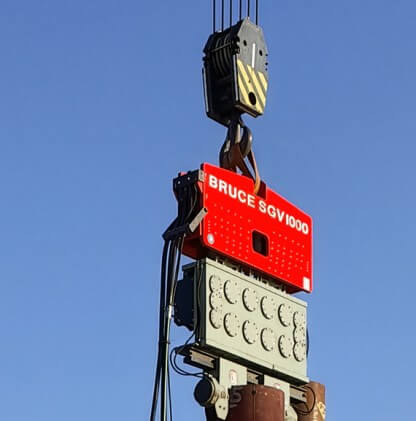
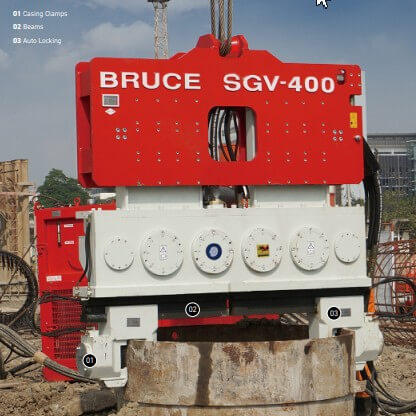
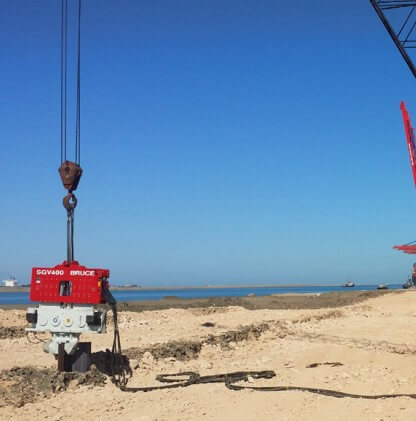
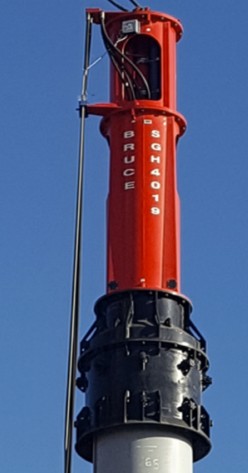
Full technical specifications for the SGV crane-suspended series suited to jacket pin pile and monopile pre-piling applications are available at powerquip.co.kr/products/vibro-hammer/features-2/.
Global Project Scale Heading Into 2026
Europe remains the largest offshore wind installation market by cumulative capacity, but the geographic base is broadening. Taiwan, Japan, South Korea, and Vietnam are each developing domestic offshore wind supply chains, and the United States has leased significant offshore acreage under Bureau of Ocean Energy Management programmes, with monopile foundations expected to represent the large majority of planned fixed-bottom projects in US waters, where average monopile length frequently exceeds 85 metres due to deeper coastal conditions. This geographic diversification is increasing demand for foundation installation contractors and equipment capable of operating reliably across varied seabed conditions and mobilisation logistics outside the established North Sea supply chain.
For technical consultation on jacket pin pile and monopile pre-piling equipment selection for your offshore wind project, contact the BRUCE engineering desk at powerquip.co.kr/contact-us/.
Offshore Wind Foundation Piling FAQ
Q: Do vibratory hammers drive full-size offshore wind monopiles to final depth?
Generally no. For XXL monopiles in the 6 to 12 metre diameter range, final penetration is achieved predominantly by large hydraulic impact hammers. Vibratory hammers perform upending, positioning, and initial low-resistance penetration before impact driving takes over.
Q: At what water depth do jacket foundations typically replace monopiles?
Jackets typically become the preferred foundation type beyond roughly 40 to 50 metres water depth, where a monopile’s required diameter and wall thickness would grow uneconomically to resist environmental loading.
Q: What standards govern offshore wind foundation design?
IEC 61400-3, Design Requirements for Offshore Wind Turbines, is the primary international standard, alongside DNV recommended practice documents covering offshore steel structures and wind turbine support structures.
Q: Why is vibratory pre-piling specified ahead of impact driving on offshore wind projects?
Vibratory hammers generate substantially lower underwater acoustic pressure than impact hammers. Using vibratory equipment for initial positioning and penetration reduces the duration of high-noise impact driving, which is the phase where bubble curtain mitigation is typically deployed.