Port and Harbor Foundation Piling: Global Contractor Guide 2026
PIANC quay wall design principles, vibro hammer selection, and regional soil planning for marine foundation contractors
Sheet Pile Quay Walls as the Global Standard for Port Expansion
Sheet pile quay walls — anchored or gravity-embedded steel walls that retain the backfill behind a berth face while providing a vertical mooring line for vessels — are one of the most widely used port structure types worldwide, alongside caisson gravity walls and piled deck structures. The World Association for Waterborne Transport Infrastructure (PIANC) publishes the primary international guidance referenced by port authorities and marine engineers for quay wall design, including seismic performance criteria for sheet pile and caisson quay walls that inform the geotechnical and structural checks applied on new port construction and berth deepening projects globally.
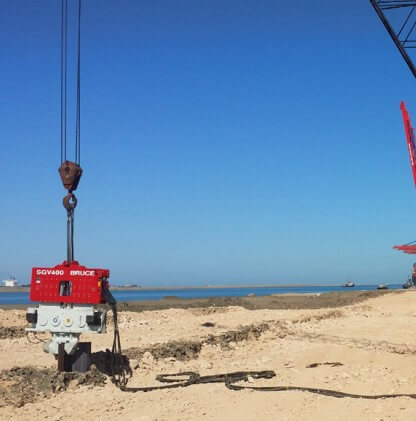
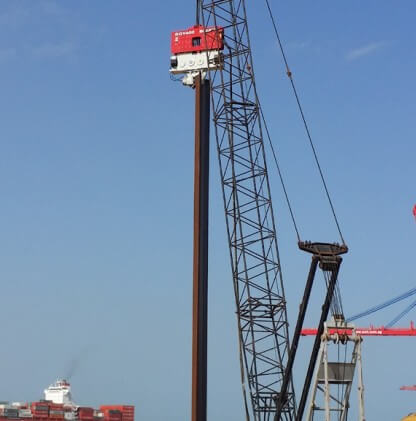
Vibratory hammers are the standard installation method for sheet pile quay wall and combi-wall construction in the granular and soft cohesive soils typical of port and estuarine environments. The combination of high penetration rate, low disturbance to adjacent existing berth structures, and extraction capability for temporary works cofferdams makes vibratory installation the default choice on port projects from container terminal expansion to bulk cargo berth construction, reserving hydraulic impact methods for final set in dense or cohesive strata where vibratory penetration reaches practical refusal.
Regional Soil Variability — Why a Single Global Hammer Spec Doesn’t Exist
Port foundation soil conditions vary enormously by region, and vibratory hammer selection must be confirmed against the specific site geotechnical report rather than a generic international default. Southeast Asian delta ports — including major river-mouth terminals in Vietnam, Indonesia, and the Bangladesh coast — typically present very soft marine and deltaic clay with low undrained shear strength to significant depth, where amplitude control to prevent excessive lateral soil displacement is the dominant selection concern. Middle Eastern Gulf ports, by contrast, frequently encounter dense calcareous sand and cemented sabkha deposits, where particle crushing under vibration and the presence of shallow cemented horizons can require a transition to pre-augering or impact methods to achieve design embedment.
West African and South American port expansion projects commonly encounter laterite residual soils and variable alluvial deposits along river-mouth terminal locations, where the driving resistance profile can change significantly within a single berth length. The baseline centrifugal force selection rule — at least 15 times the pile weight — remains the starting reference point across all these environments, but the BRUCE engineering desk confirms specific model selection against each project’s soil bore log and sheet pile section before mobilisation, given how substantially the required eccentric moment and frequency can vary between port locations even within the same country.
Combi-Wall and Deep Berth Construction
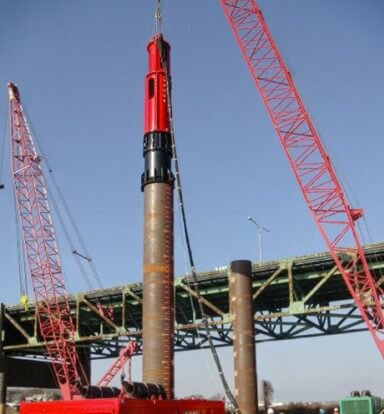
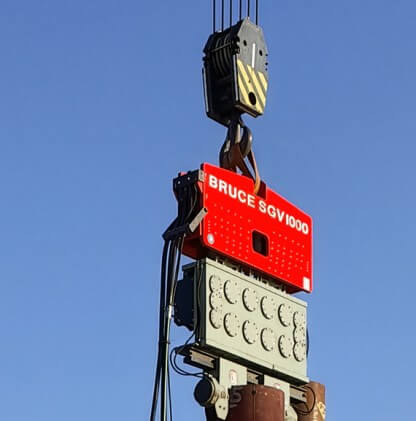
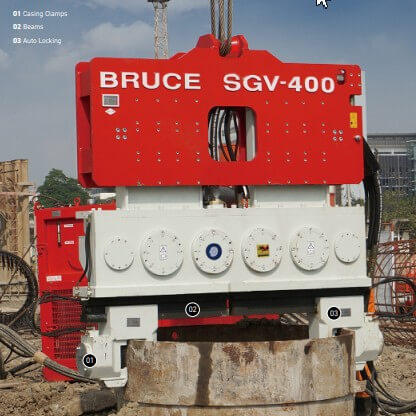
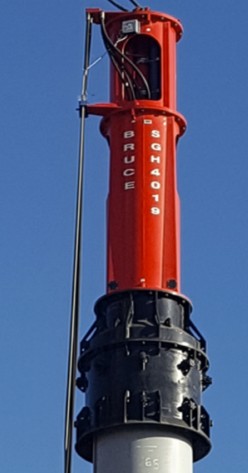
Modern container and bulk terminal berths increasingly use combi-wall construction — large-diameter steel tubular piles installed at regular intervals with intermediate sheet pile infill panels — to achieve the deep water depths required by ultra-large container vessels while managing the bending moment and anchor load demands that a sheet pile-only wall cannot economically resist at depth. Installing the primary tubular piles for a combi-wall requires significantly higher centrifugal force than standard sheet pile sections, and the BRUCE SGV crane-suspended series, covering centrifugal forces from 510 kN to 4,610 kN across the SGV-80 to SGV-2000 model range, provides the capacity span required to move between the large tubular primary piles and the lighter intermediate sheet pile infill on a single combi-wall project without changing equipment.
For deep berth construction where design toe elevation extends well below existing seabed level, maintaining pile verticality throughout an extended drive sequence is critical to combi-wall structural performance, since even small verticality deviation compounds significantly over a long embedment length and can affect both the primary pile’s bending capacity and the interlock alignment with the adjacent infill panels. Balanced eccentric weight configuration in the hammer gearbox, producing purely vertical oscillation without lateral force components, is the mechanical basis for maintaining this tolerance across the full drive length.
Full technical specifications for the SGV crane-suspended and excavator-mounted series are available at powerquip.co.kr/products/vibro-hammer/features-2/.
Live Port Operations and Extraction Economics
A significant share of global port piling work takes place within operational terminals, where berth downtime, adjacent live cargo handling, and restricted crane working windows around scheduled vessel calls all constrain the piling programme. Extraction capability is a particular economic driver on port projects, where temporary sheet pile cofferdams for caisson or deep foundation construction represent a substantial material cost that contractors recover through repeated reuse across a multi-berth programme or across successive port projects for the same contractor.
For technical consultation on model selection against your port project’s soil data, combi-wall pile schedule, and berth access constraints, contact the BRUCE engineering desk at powerquip.co.kr/contact-us/.
Port and Harbor Piling FAQ
Q: What international standard is most widely referenced for quay wall design?
PIANC (the World Association for Waterborne Transport Infrastructure) publishes the primary international guidance referenced by port authorities globally, including seismic performance criteria for sheet pile and caisson quay walls.
Q: Why can’t a single vibratory hammer specification be used across all global port projects?
Soil conditions vary enormously by region — from soft deltaic clay in Southeast Asia to dense calcareous sand and cemented sabkha in Gulf ports to laterite residual soils in West Africa and South America. Model selection must be confirmed against each project’s specific soil bore log.
Q: What is a combi-wall and why does it require a different piling approach?
A combi-wall uses large-diameter primary tubular piles with intermediate sheet pile infill panels to achieve the deep water depths required by ultra-large container vessels. The primary piles require significantly higher centrifugal force than standard sheet pile sections.
Q: Why is pile extraction capability economically significant on port projects?
Temporary sheet pile cofferdams used for caisson or deep foundation construction represent a substantial material cost. Extraction capability allows contractors to recover and reuse this stock across multiple berths or projects.