Piling Equipment Middle East Supplier:
What Procurement Teams Need to Know
A practical guide for contractors, project managers, and equipment importers sourcing vibratory piling equipment for Middle East construction projects in 2026.
For contractors and procurement teams sourcing a piling equipment Middle East supplier, the market presents specific characteristics that differ significantly from Europe or North America. Project scales are large, contract timelines are tight, and the combination of aggressive coastal conditions, sandy soil profiles, and high-temperature operation puts real demand on equipment quality and after-sales support.
This guide covers the full supplier evaluation process for the Middle East market — from understanding which equipment configurations are most in demand, to regional import compliance requirements, to the questions every procurement team should ask before signing a supply agreement.
1. Middle East Piling Market Overview
The Middle East is one of the most active markets globally for large-scale foundation and piling work. Saudi Arabia, UAE, Qatar, Kuwait, Oman, and Bahrain are all running significant infrastructure programmes — spanning port development, urban master planning, coastal reclamation, transport corridors, and industrial zone development.
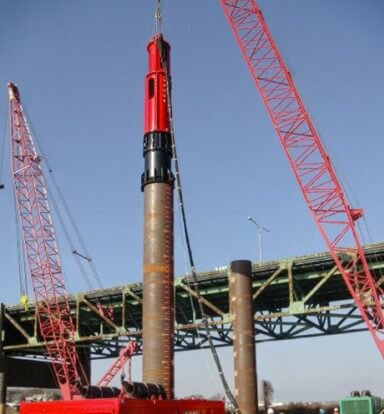
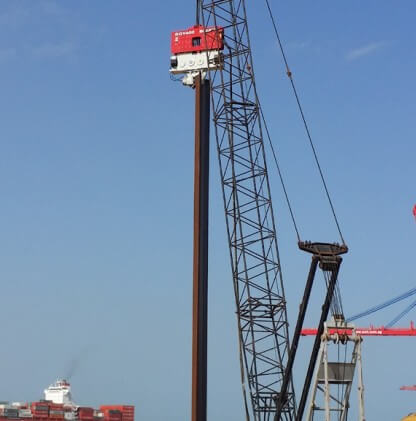
The demand profile for piling equipment in the Middle East skews toward heavy-duty, high-capacity machines. Projects in the region frequently involve large-diameter pipe piles for marine structures, heavy sheet piling for coastal protection, and deep foundation systems for high-rise and infrastructure work. This means the typical Middle East buyer is not looking for entry-level or lightweight equipment — they need machines with meaningful eccentric moment output, marine-grade durability, and the support infrastructure to keep them operational in remote or logistically challenging sites.
2. Dominant Project Types & Equipment Required
| Project Type | Primary Pile Type | Equipment Configuration |
|---|---|---|
| Port & marine expansion | Steel pipe pile, H-pile | Heavy crane-suspended vibro hammer, high eccentric moment |
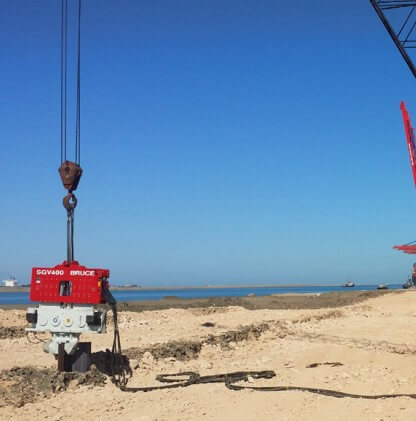
| Coastal reclamation | Sheet pile (cofferdam) | Large crane-suspended vibro hammer + HPU |
| Urban retaining walls | Sheet pile (Z/U profile) | Crane or excavator-mounted vibro hammer |
| Bridge & road infrastructure | HP section, pipe pile | Crane-suspended, medium-to-heavy eccentric moment |
| Desalination / utility plant | Sheet pile (cofferdam) | Medium crane-suspended vibro hammer |
| High-rise foundation | Bored/CFA pile (vibro for cofferdam only) | Sheet pile vibro hammer for perimeter cofferdam |
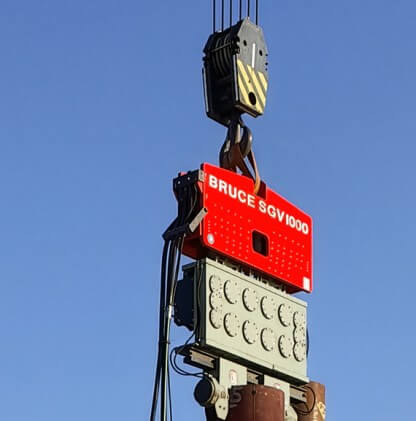
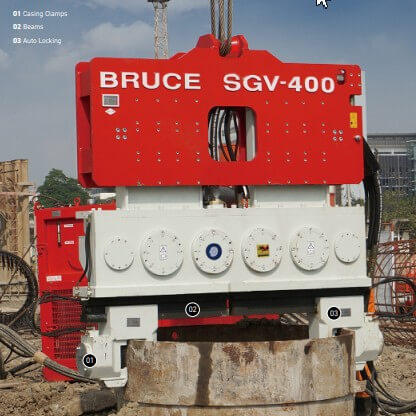
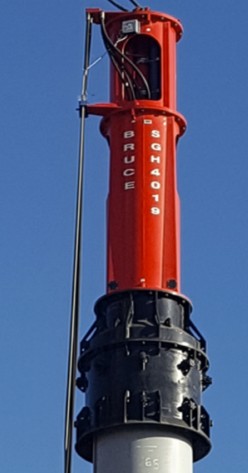
The most commonly specified configuration in the Middle East is a crane-suspended vibratory hammer in the mid-to-heavy eccentric moment range, paired with a matched hydraulic power pack. Marine and coastal projects dominate, which means corrosion protection specification is a consistent procurement requirement — marine-grade paint systems and stainless or coated hydraulic fittings should be standard, not optional.
3. What Makes a Reliable Piling Equipment Supplier for the Middle East
Procurement teams in the Middle East — whether working for a large EPC contractor, a government agency, or a regional equipment dealer — apply consistent evaluation criteria when qualifying piling equipment suppliers. The following factors are consistently cited as decision-drivers in this market.
Manufacturing Track Record
Middle East procurement teams strongly prefer suppliers with a documented history of supplying equipment that has performed on comparable projects. Project references from marine, port, or large infrastructure applications carry significant weight. References from other GCC countries are particularly persuasive — they demonstrate familiarity with the operating environment.
Marine-Grade Equipment Specification
Equipment operating in coastal and marine environments in the Gulf faces aggressive corrosion conditions — salt air, high humidity, and temperature extremes. A supplier who offers marine-grade corrosion protection as a standard specification option (not a custom upcharge) signals genuine experience with this market. Specify marine-grade paint systems, protective coatings on eccentric weight assemblies, and corrosion-resistant hydraulic fittings as baseline requirements for any Gulf Coast application.
Spare Parts Availability in the Region
This is the most commonly cited after-sales friction point in the Middle East market. When a vibratory hammer bearing fails on an active port project, contractors need replacement parts within days — not the 4–8 weeks that international air freight from Europe or Asia can take if the parts are not in stock regionally. Suppliers who can demonstrate in-region spare parts availability, or who have a nominated local service partner with parts stock, have a significant advantage in repeat business and long-term relationships.
Arabic Documentation Capability
While English is widely used in GCC construction management, Arabic-language operator manuals and maintenance guides are a requirement on many government and public sector projects, and they significantly improve adoption and correct operation by site crews. Confirm Arabic documentation availability with any supplier before contract award.
4. Import & Compliance Requirements by Country
| Country | Key Import Requirement | Notes |
|---|---|---|
| Saudi Arabia | SASO conformity; customs clearance via FASAH portal | Construction machinery may require SASO certificate of conformity for import; confirm product category with Saudi customs agent |
| UAE | Standard GCC customs tariff (5% on most goods) | Free zone import (JAFZA, KIZAD etc.) may offer duty suspension; confirm with UAE customs broker |
| Qatar | GCC common external tariff; QR supplier registration for public projects | Government project suppliers may require Qatar Chamber of Commerce registration |
| Kuwait | Standard GCC customs tariff; PACI agent registration for commercial entities | Some public works contracts require local agent involvement |
| Oman | GCC common external tariff; Oman customs registration for regular importers | Straightforward import process for capital equipment |
| Bahrain | GCC common external tariff; low bureaucratic overhead | Often used as regional hub for GCC equipment distribution |
5. Key Equipment Specs for Middle East Projects
When specifying vibratory piling equipment for Middle East projects, procurement teams and project engineers should define the following parameters in the equipment specification or tender document. Vague specifications result in non-comparable supplier quotations and post-delivery disputes.
| Parameter | Middle East Typical Requirement | Why It Matters |
|---|---|---|
| Eccentric moment (kN·m) | Medium-heavy (100–400+ kN·m for marine work) | Determines pile penetration capacity in sand and coastal soils |
| Operating frequency (Hz) | Standard 23–35 Hz for most open-site marine work | High-frequency less commonly specified in the region vs. European urban sites |
| Centrifugal force (kN) | Matched to pile shaft friction estimate from soil report | Must exceed calculated friction to achieve design depth |
| Hydraulic flow (L/min) | Match to carrier HPU specification | Mismatch causes motor cavitation and early failure — common in field |
| Corrosion protection | Marine-grade paint; stainless/coated fittings | Gulf Coast salt environment degrades standard paint within one season |
| Operating temperature range | Up to +55°C ambient for Gulf summer conditions | Hydraulic fluid specification and seal material must be rated for high ambient temperatures |
| Clamp configuration | Match to pile section — pipe OD or sheet pile profile | Wrong clamp = zero penetration capacity |
6. Common Procurement Mistakes in the Middle East Market
7. Procurement Checklist — Piling Equipment Middle East
- Project soil profile and pile specification defined Soil report (borehole/CPT), pile type and section, design depth — provided to supplier for equipment sizing.
- Marine-grade corrosion protection specified Paint system grade, dry film thickness, stainless or coated fittings — required for any coastal or offshore application.
- High-temperature hydraulic rating confirmed Seal material and hydraulic fluid specification rated for maximum ambient operating temperature in the Gulf.
- Arabic-language documentation confirmed Operator manual and maintenance guide available in Arabic — required for government and public sector projects.
- Spare parts lead time commitment obtained in writing High-wear items (bearings, seals, clamp inserts) — confirmed lead time from manufacturer or regional stock.
- SASO / country-specific import compliance confirmed Customs agent engaged in destination country; compliance process started at PO stage.
- Payment terms agreed — LC or T/T with correct documentation package CO, commercial invoice, packing list, BL, inspection certificate as required for LC negotiation.
- Supplier project references from comparable GCC or marine applications At minimum 2–3 verifiable references from marine, port, or coastal infrastructure projects.
- Warranty terms and after-sales support documented Coverage period, spare parts commitment, technical support contact — all in writing before PO.
8. Frequently Asked Questions
Sourcing Piling Equipment for a Middle East Project?
BRUCE Piling Equipment supplies vibratory hammers and pile driving systems to contractors, dealers, and importers across the Middle East. Marine-grade specs, Arabic documentation, and 24-hour inquiry response.