Importing a Vibratory Hammer
into the USA: The Complete
Buyer’s Guide 2026
OSHA compliance, HS codes, import duties, supplier qualification, and how to source a vibratory hammer directly from a verified manufacturer — written for US-market importers.
- The US Vibratory Hammer Market in 2026
- HS Code & Import Duty for the USA
- OSHA Requirements Every Importer Must Know
- Equipment Types in Demand in the US Market
- Specs US Contractors Typically Specify
- How to Qualify an Overseas Vibratory Hammer Supplier
- The Import Process: Step by Step
- 4 Mistakes US Importers Make
- US Importer Checklist
- FAQ
For companies importing a vibratory hammer into the USA, the process involves more than simply finding a supplier and placing an order. US construction equipment importers face a specific set of considerations: correct HS code classification, applicable import duty rates, OSHA operational compliance, contractor documentation expectations, and supplier qualification criteria that are meaningfully different from other global markets.
This guide is written specifically for US-market importers — whether you are a piling equipment dealer establishing a new product line, a rental fleet operator sourcing additional units, or a contractor importing equipment for direct project deployment. Every section addresses a real decision or requirement that arises in the US import process.
1The US Vibratory Hammer Market in 2026
The United States is one of the largest markets globally for foundation and piling equipment. Demand is driven by a diverse mix of project types — coastal and marine infrastructure, bridge construction, river flood protection, urban retaining structures, and industrial facility foundations — each with distinct pile type and equipment configuration requirements.
Marine & Port Projects
Dock reconstruction, port expansion, and coastal erosion protection account for a significant share of vibratory hammer deployments, concentrated in Gulf Coast, East Coast, and Pacific Northwest markets.
Bridge & Highway
Cofferdam installation for bridge pier construction and sheet pile retaining walls along highway corridors represent consistent, long-cycle procurement from state DOTs and large civil contractors.
Urban Excavation Support
Sheet pile retaining walls for deep basement excavations in dense urban environments — particularly in cities with soft ground conditions — require low-vibration driving equipment.
Renewable Energy
Foundation piling for onshore wind turbine access roads and substation structures is an emerging application segment, driving demand for mid-range crane-suspended vibratory hammer configurations.
2HS Code & Import Duty for Vibratory Hammers into the USA
Correct HS (Harmonized System) tariff code classification is the foundation of any import transaction. Misclassification creates customs delays, potential penalty exposure, and may result in incorrect duty payment — either overpaying or triggering post-entry audit.
| Equipment Type | HS Code (US HTS) | Description | General Duty Rate |
|---|---|---|---|
| Vibratory hammer (pile driver) | 8430.31.0000 | Pile drivers, not self-propelled | Free (0%) |
| Hydraulic power pack (HPU) | 8412.21.0075 | Hydraulic power units for machinery | Free (0%) |
| Piling accessories (clamps, leaders) | 8431.49.9095 | Parts for pile driving / boring machinery | Free (0%) |
3OSHA Requirements Every Vibratory Hammer Importer Must Know
The United States does not have a mandatory federal product certification requirement for vibratory piling equipment equivalent to CE marking in the EU. However, equipment deployed on US construction sites must be safe and compliant under OSHA 29 CFR 1926 — Construction Industry Safety Standards. Importers who sell or rent equipment that creates OSHA violations for the end contractor face significant liability exposure.
Key OSHA Provisions for Piling Equipment
| OSHA Standard | Provision | Importer / Equipment Implication |
|---|---|---|
| 29 CFR 1926.603 | Pile driving equipment — general | Equipment must be in good repair; rated capacity must be posted and legible on the machine |
| 29 CFR 1926.603(a)(1) | Manufacturer’s operating instructions | Operator manual must be available on-site and in English; importer responsible for translation |
| 29 CFR 1926.603(b) | Leads and equipment stability | Equipment used in leader systems must be rated and documented for the configuration |
| 29 CFR 1926.550 / 1926.1400 | Crane operations | Crane-suspended vibratory hammers subject to full crane safety standard; lift capacity documentation required |
| 29 CFR 1910.147 | Lockout/tagout (LOTO) | Hydraulic system must have documented isolation points for maintenance; importer should include LOTO procedures in manual |
What OSHA Does NOT Require
Unlike CE marking in the EU, OSHA does not require pre-market product testing or certification by a third-party body for vibratory piling equipment. Equipment is not registered or approved before being placed on the market. OSHA compliance is enforced reactively — through site inspections when complaints are filed or incidents occur. This means the importer’s and contractor’s internal documentation and equipment condition standards are the primary compliance mechanism.
4Equipment Types in Demand in the US Market
US piling contractors have specific preferences for equipment configuration that differ from some other global markets. Understanding these preferences before finalising a supplier relationship avoids stocking units that do not match local contractor requirements.
Crane-Suspended Vibratory Hammer
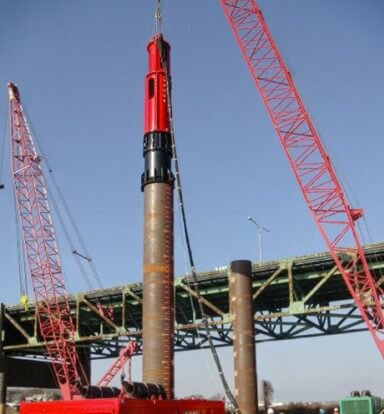
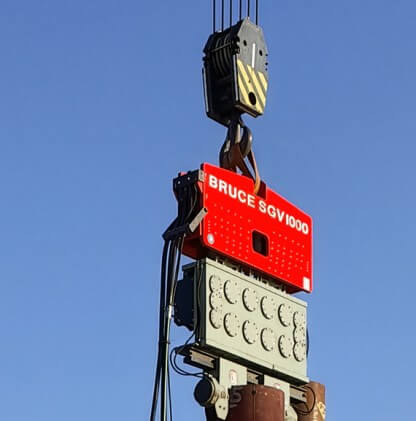
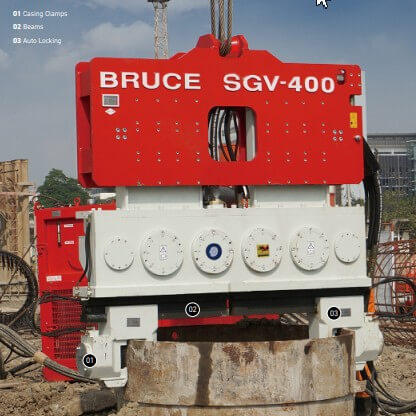
Dominant configuration in the US market. Leader-guided and free-hanging configurations both used. High eccentric moment models preferred for large-format sheet piling and pipe pile applications common in marine and bridge work.
Excavator-Mounted (Side-Grip)
Growing in urban markets where crane mobilisation cost is prohibitive. Used for lighter sheet pile applications and pile extraction. Must be matched carefully to excavator model and arm geometry.
Hydraulic Power Pack (HPU)
Standalone HPU matched to the vibratory hammer is standard for crane-suspended units. US contractors often prefer self-contained HPU on trailer or skid for site mobility.
Variable Moment / High-Frequency
Specified increasingly on projects near sensitive structures. Variable moment (resonance-free start/stop) reduces vibration transmission to adjacent buildings and infrastructure during driving operations.
5Specs US Contractors Typically Specify
When US contractors issue specifications or request quotes for vibratory hammer rental or purchase, these are the parameters they most commonly define. Importers and dealers need to be able to match equipment to these specifications fluently — it is a core part of the sales conversation.
| Specification | Typical US Requirement | Notes for Importers |
|---|---|---|
| Pile type | Z-pile (AZ/PZ series), HP sections, pipe pile (OD 12″–36″) | Confirm clamp jaw compatibility with specific pile sections used in the US |
| Eccentric moment | Stated in ft·lbf or kN·m — confirm unit with manufacturer | Some US engineers specify in ft·lbf; manufacturer must be able to provide both |
| Centrifugal force | Stated in kips (1 kip = 1,000 lbf) or kN | Both unit systems appear in US specs — documentation must be clear |
| Frequency | Standard: 1,200–2,100 rpm; High-freq: 2,400–3,000 rpm | High-frequency increasingly specified in urban / brownfield projects |
| Hydraulic flow | Often stated in GPM (US gallons per minute) | Manufacturer must provide specs in GPM and L/min for US market documentation |
| PDA compatibility | Pile Driving Analyzer (PDA) integration sometimes required on large projects | Confirms pile bearing capacity during driving — confirm sensor mounting points on equipment |
| Weight | Stated in lbs or tons (US short tons) | Critical for crane lift plan calculations — confirm in both metric and imperial |
6How to Qualify an Overseas Vibratory Hammer Supplier
For US-market importers, supplier qualification involves criteria that go beyond general procurement due diligence. The US market’s specific documentation requirements, contractor expectations, and liability environment mean that supplier capability gaps create real commercial problems once equipment reaches the field.
- ✓English-language technical documentation capability Operator manuals, maintenance guides, spare parts catalogues, and datasheets must be available in accurate English. Machine-translated documents with technical errors create OSHA compliance exposure for your customers.
- ✓Imperial unit documentation available Datasheets must be available with GPM, lbf, ft·lbf, lbs, and tons — alongside metric values. This is a basic requirement for US-market contractor acceptance.
- ✓Rated capacity plate / nameplate for US standards Equipment must carry legible rated capacity markings per OSHA 29 CFR 1926.603. Confirm that the manufacturer applies these plates and that they reference the correct rated values for the configuration.
- ✓Spare parts supply with US-accessible logistics Spare parts must be shippable to the US within a commercially reasonable timeframe. Confirm the manufacturer’s export documentation capability for spare parts shipments — including commercial invoice and harmonized code for parts.
- ✓Verifiable project track record in comparable applications Request project references from marine, bridge, or urban piling applications — ideally in English-speaking markets with comparable standards environments.
- ✓Hydraulic system documentation for LOTO compliance Hydraulic isolation points must be identified in the maintenance manual to support contractor LOTO procedures per OSHA 29 CFR 1910.147.
- ✓Lift plan data availability Crane-suspended units must have documented rigging weights, center of gravity data, and lift point specifications to support contractor crane lift plans — required on most US commercial piling projects.
7The Import Process: Step by Step
-
1
Define equipment specification and target application
Pile type, eccentric moment requirement, carrier configuration (crane vs. excavator), and HPU requirement. For dealer importers: confirm what your target contractor base most commonly specifies before ordering inventory.
-
2
Engage a licensed US customs broker before placing the order
Confirm HS classification, current duty rates, any Section 301 applicability (if China-origin), and required import documentation. This step prevents costly post-entry corrections and delays at the port of entry.
-
3
Request a technical proposal and US-market documentation sample
Ask the manufacturer to provide a sample of their English-language operator manual and a datasheet with imperial unit specifications. This is the fastest qualification test for US-market readiness.
-
4
Place purchase order — confirm production schedule and shipping terms
Standard vibratory hammer lead times are 6–10 weeks from order confirmation. Confirm incoterms (FOB or CIF to a US port), confirm the ocean freight routing, and establish the delivery milestone schedule in writing.
-
5
Arrange pre-shipment inspection (recommended for first orders)
A third-party pre-shipment inspection at the factory verifies equipment condition, rated capacity markings, documentation completeness, and compliance with the purchase order specification before the unit leaves the factory.
-
6
Customs clearance at US port of entry
Your customs broker handles formal entry filing, duty payment (if applicable), and CBP release. Ensure you have the commercial invoice, bill of lading, packing list, and any country of origin documentation ready before arrival.
-
7
Commission the equipment and prepare US-market documentation package
Before delivery to your first US customer: confirm English operator manual, rated capacity plate, lift plan data, LOTO documentation, and spare parts initial stock are all in order. This documentation package is what distinguishes a professional US importer from a grey-market supplier.
84 Mistakes US Vibratory Hammer Importers Make
9US Vibratory Hammer Importer Checklist
- ✓HS code confirmed as 8430.31 with licensed customs broker Section 301 applicability verified for country of origin.
- ✓English-language operator manual confirmed with supplier Technical accuracy verified; OSHA references included.
- ✓Imperial unit datasheet available GPM, lbf, ft·lbf, lbs — required for US project submission documentation.
- ✓Rated capacity nameplate on equipment Legible, in English, with correct values for the configuration — per OSHA 29 CFR 1926.603.
- ✓Lift plan data package available Rigging weight, CG location, lift point specifications — for contractor crane lift plans.
- ✓LOTO documentation included in maintenance manual Hydraulic isolation points identified for OSHA 29 CFR 1910.147 compliance.
- ✓Supplier spare parts shipping capability to USA confirmed Lead time for high-wear items; export documentation for international parts shipment.
- ✓Freight forwarder and customs broker engaged Port of entry confirmed; import timeline aligned with project schedule.
- ✓Pre-shipment inspection arranged (first orders) Third-party inspector confirms spec compliance, markings, and documentation completeness at factory.
- ✓Spare parts initial stock ordered Bearings, seals, clamp inserts — in country before first unit reaches a US job site.
10Frequently Asked Questions
Ready to Import a Vibratory Hammer into the USA?
BRUCE Piling Equipment provides US-market importers with English documentation, imperial unit datasheets, OSHA-compliant operator manuals, and direct manufacturer supply — with 24-hour inquiry response.