Sheet Pile Flood Levee Piling for Queensland and NSW: 2026 Contractor Guide
Vibro hammer selection, DIN 4150-3 vibration compliance, and tropical soil field protocol for Australian flood mitigation projects
Flood Mitigation Infrastructure as a Growing Piling Market
Following successive major flood events across the Brisbane River catchment, the Northern Rivers region of NSW, and the Fitzroy and Burnett catchments in Queensland, state and local governments have significantly expanded investment in permanent flood mitigation infrastructure, including steel sheet pile flood walls, levee toe protection, and floodgate structures. These projects are typically delivered through a combination of state government flood resilience programs, local council capital works, and, in several cases, joint Commonwealth-state disaster recovery funding administered under the National Emergency Management Agency framework.
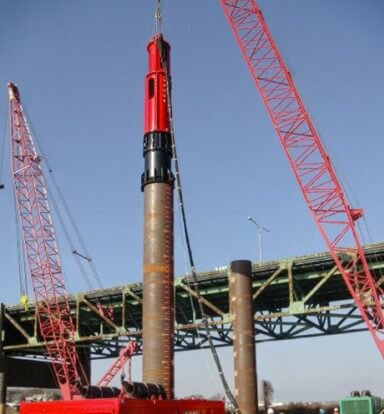
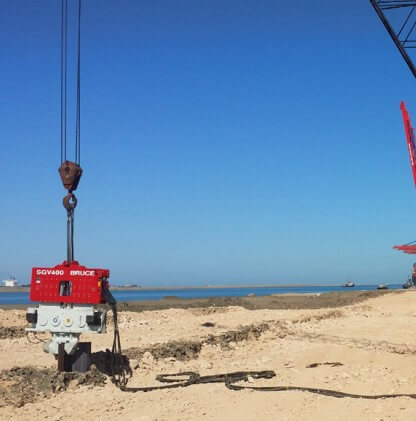
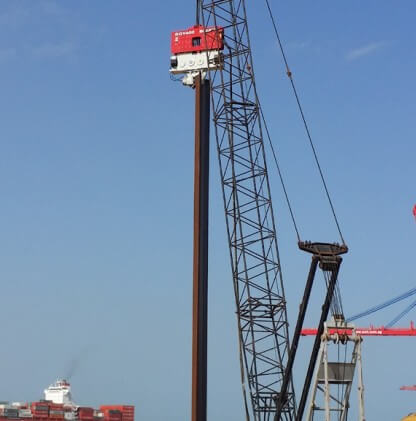
Vibratory hammers are the standard installation method for flood wall and levee sheet piling in Australian conditions, chiefly because of the combination of installation speed in the alluvial and estuarine soils that dominate flood-prone river corridors, low disturbance to adjacent levee embankments and access tracks, and extraction capability for the temporary cofferdams frequently required to construct floodgate and pump station foundations within an active watercourse.
Soil Conditions on Australian Flood Corridors
River floodplain soils on the eastern Australian seaboard typically present soft to firm alluvial clay and silt in the upper horizon, reflecting repeated flood deposition, overlying denser sand or weathered rock at depth. In southeast Queensland’s Brisbane and Bremer River catchments, this alluvium frequently contains soft, high-plasticity clay layers with low undrained shear strength near the surface, which allows rapid initial vibratory penetration but requires careful amplitude control to prevent excessive lateral disturbance to adjacent levee batters during driving.
In the Northern Rivers region of NSW and the tropical river systems of North Queensland, flood corridor soils are further complicated by the presence of soft, compressible marine clay in low-lying coastal floodplains — locally referred to as acid sulfate soil terrain in many mapped areas — where disturbance from construction activity, including piling, is subject to specific management requirements under state acid sulfate soil planning policy to prevent oxidation and downstream water quality impacts. Confirming acid sulfate soil status from the geotechnical and environmental site assessment before piling commences is standard practice on flood corridor projects in these regions.
Vibration Compliance — DIN 4150-3 and BS 7385-2 in Australian Practice
Australia does not have a single dedicated national numerical standard for construction vibration limits. In practice, state agencies and consultants apply the German standard DIN 4150-3 and the British standard BS 7385-2 as the reference frameworks for cosmetic building damage risk, alongside the process guidance in AS 2436, the Australian Guide to Noise and Vibration Control on Construction, Maintenance and Demolition Sites. DIN 4150-3 has become the more frequently specified benchmark in development approval conditions issued by Queensland and NSW authorities, owing to its frequency-dependent limit structure and its specific guide values for heritage and sensitive structures.
For flood levee piling adjacent to existing floodwalls, pump stations, or residential development at the urban-rural fringe, the remote control pendant’s real-time flow adjust function allows the operator to manage centrifugal force against continuous PPV monitoring readings without stopping the vibration cycle — the same operational principle applied on possession- and permit-constrained projects internationally, and directly relevant where DIN 4150-3 or BS 7385-2 trigger levels are written into the construction environmental management plan.
State EPA Approvals and Waterway Works Licensing
In-water and riverbank piling for flood mitigation works in Queensland typically requires assessment under the Planning Act 2016 and, where tidal or navigable waterways are affected, a Resource Allocation Authority or Development Permit for operational works under the state’s coastal and waterway management framework, in addition to environmental authority conditions administered by the Department of Environment, Science and Innovation. In NSW, comparable works are assessed under controlled activity approval requirements administered by the relevant authority for works on waterfront land, alongside conditions set by the NSW Environment Protection Authority for construction noise and water quality.
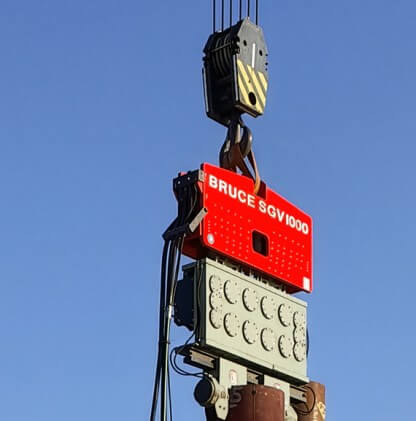
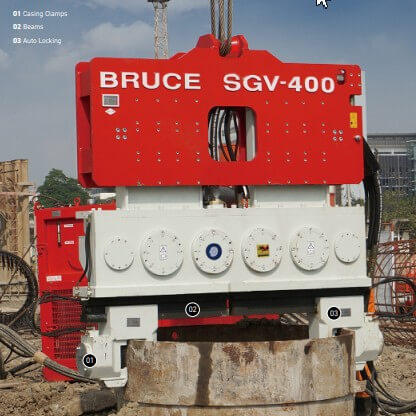
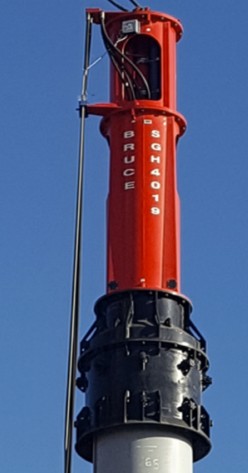
All BRUCE SGV hydraulic components are compatible with biodegradable hydraulic oils, supporting compliance with waterway pollution prevention conditions that commonly apply to plant operating within or adjacent to flood corridors and declared fish habitat areas. Full technical specifications are available at powerquip.co.kr/products/vibro-hammer/features-2/.
Wet Season Planning and Extraction Sequencing
Queensland and northern NSW flood mitigation construction programs are typically sequenced around the November to April wet season, when elevated river levels and renewed flood risk restrict in-water and low-lying floodplain access. Temporary cofferdam sheet piles installed to allow dry construction of floodgate or pump station foundations must generally be planned for extraction and site reinstatement before the following wet season begins, making pile extraction reliability — rather than installation speed alone — a determining factor in program risk for flood infrastructure contractors working to a fixed seasonal construction window.
For pre-mobilisation model selection against your catchment soil data, DIN 4150-3 vibration assessment support, and wet-season programming advice, contact the BRUCE engineering desk at powerquip.co.kr/contact-us/.
Flood Levee Piling FAQ
Q: What vibration standard applies to sheet pile flood levee installation in Australia?
Australia has no single dedicated national numerical vibration standard. DIN 4150-3 and BS 7385-2 are the most commonly applied reference frameworks for cosmetic damage risk, used alongside the process guidance in AS 2436. DIN 4150-3 is increasingly the specified benchmark in Queensland and NSW approval conditions.
Q: Why does acid sulfate soil status matter for flood corridor piling projects?
Low-lying coastal floodplains in NSW and Queensland frequently contain acid sulfate soil terrain, where disturbance from piling is subject to state planning policy requirements to prevent oxidation and downstream water quality impacts. Status should be confirmed from the site assessment before piling begins.
Q: What approvals are required for in-water piling on Queensland flood mitigation works?
Works typically require assessment under the Planning Act 2016, a development permit for operational works where tidal or navigable waterways are affected, and environmental authority conditions from the Department of Environment, Science and Innovation.
Q: How does the wet season affect flood infrastructure piling programs in Queensland and northern NSW?
Construction is typically sequenced around the November to April wet season. Temporary cofferdam sheet piles for floodgate or pump station foundations generally must be extracted and the site reinstated before the following wet season, making extraction reliability a key programming factor.