Sheet Pile Retaining Wall for Australian Mining Infrastructure:
Vibro Hammer Selection Guide 2026
“PILBARA AND BOWEN BASIN SOIL CONDITIONS, SAFEWORK AUSTRALIA COMPLIANCE, AND REMOTE SITE LOGISTICS”
01. Mining Infrastructure Piling — The Australian Resources Sector Context
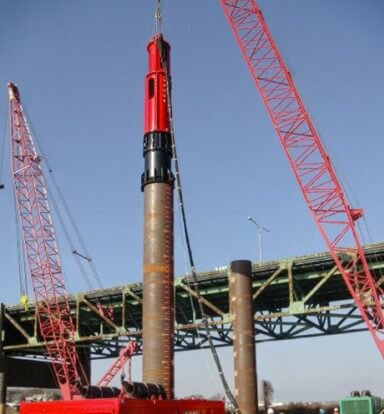
Australia’s resources sector generates a continuous pipeline of civil infrastructure construction work associated with mine development, ore processing facility construction, and mine site service infrastructure. Sheet pile retaining walls and cofferdams are used across the resources sector for creek crossing shoring during haul road and conveyor bridge construction, tailings storage facility (TSF) embankment toe stabilisation, water management dam and sedimentation pond construction, ore processing plant sump and pit shoring, and port loading facility construction at ore export terminals. In the Pilbara region of Western Australia — home to the world’s largest iron ore operations including BHP’s Mining Area C and Rio Tinto’s Brockman and Gudai-Darri mines — the scale of associated civil infrastructure construction creates sustained demand for piling equipment capable of operating in remote high-temperature environments with extended inter-service intervals.
The Bowen Basin in central Queensland, which hosts the majority of Australia’s metallurgical coal production, presents a different but equally demanding environment for mining infrastructure piling. Creek and river crossing shoring for haul road and rail infrastructure in the Bowen Basin involves deeply weathered Permian sedimentary geology with unpredictable rock head depths and variable weathering profiles — conditions where the transition from vibratory driving in the soft weathered overburden to hard rock refusal may occur at very different depths across a single structure, requiring field adaptability and real-time amplitude management capability from the vibratory hammer equipment and its operator.
Tailings Storage Facility Construction — A Growing Piling Application
Tailings storage facility (TSF) construction and remediation has become a major piling application in the Australian resources sector following the Brumadinho dam failure in Brazil in 2019 and the subsequent global resources sector reassessment of TSF stability standards. Australian mining companies operating under the Global Industry Standard on Tailings Management (GISTM) — which became mandatory for ICMM member companies from August 2023 — are investing in TSF embankment toe stabilisation, seepage barrier installation, and dam crest raising works that involve sheet pile installation in the soft alluvial and fill materials characteristic of TSF embankment foundations. Vibratory hammers are the standard installation method for sheet pile seepage cutoff walls and toe stabilisation shoring on Australian TSF projects, where the combination of relatively soft embankment fill and alluvial foundation materials and the requirement for pile extraction after temporary shoring phases makes vibratory methods technically and economically superior to driven alternatives.
02. Pilbara and Bowen Basin Soil and Rock Conditions
The Pilbara region of Western Australia presents soil and rock conditions that are geologically unlike any encountered in US or UK piling environments. The dominant surface geology is Meso- and Neoarchaean banded iron formation (BIF), greenstone, and granite — ancient Precambrian basement rocks that are typically exposed at or near surface across the iron ore mining lease areas. In the creek and river valley systems where sheet pile shoring is required for crossing infrastructure, a veneer of Quaternary alluvium — typically poorly graded gravel and sandy gravels derived from the surrounding BIF and granite terrain — overlies weathered bedrock at shallow depth. The shallow and unpredictable rock head in Pilbara creek crossings means that vibratory sheet pile installation in these locations is constrained to the alluvial overburden thickness, with the design embedment depth confirmed by site investigation to ensure the pile can achieve adequate passive resistance within the penetrable horizon above the hard rock surface.
The extreme ambient temperature environment of the Pilbara — with summer air temperatures regularly exceeding 45°C and ground surface temperatures reaching 60°C or above — places sustained thermal load on hydraulic equipment that standard power packs designed for temperate climate operation cannot sustain. BRUCE PQ-V series power packs are designed for operation in ambient temperatures above 40°C and include hydraulic oil cooling systems sized for continuous operation in high ambient temperature environments. This thermal specification is not a marginal design consideration for Pilbara mining infrastructure piling — it is a primary equipment selection criterion that determines whether the power pack can maintain operating pressure and flow throughout a summer construction shift without hydraulic overtemperature shutdown.
Bowen Basin — Deeply Weathered Permian Sedimentary Profile
The Bowen Basin coal measure geology presents a deeply weathered profile above the competent Permian coal-bearing sedimentary sequence. The weathered zone — comprising highly plastic smectite clay (black soil or Vertosol) in the upper horizon transitioning to saprolite and then weak to moderate-strength rock at depth — is highly variable in thickness and strength across the basin. The smectite-rich black soils of the Bowen Basin are notorious in geotechnical engineering for their high swell-shrink behaviour, very high plasticity, and tendency to exhibit substantial skin adhesion after short installation periods — a set-up behaviour more severe than London Clay and requiring vibratory hammer selection that accounts for significant skin friction increase if driving is interrupted even briefly. The remote pendant’s real-time amplitude control is consequently an operationally critical feature for Bowen Basin piling, where the ability to restart driving at maximum centrifugal force immediately after any interruption is essential for preventing permanent pile stall in the high-set-up smectite clay horizon.
03. SafeWork Australia and State Mines Safety Compliance
Piling operations on Australian mine sites are subject to the Work Health and Safety Act 2011 (WHS Act) as implemented by state and territory WHS regulators — SafeWork NSW, WorkSafe Queensland (Resources Safety and Health Queensland for mining operations), WorkSafe WA (Department of Mines, Industry Regulation and Safety for mine site operations), and their equivalents in other jurisdictions. The WHS Act and associated regulations impose specific requirements on the design, inspection, and maintenance of plant and equipment used in construction and mining operations, including hydraulic piling equipment, that are enforced by state WHS regulator inspectors who may conduct unannounced inspections on active mine site construction projects.
For vibratory hammer equipment operating on Australian mine sites, the key WHS compliance requirements include plant design registration (for equipment above specified weight thresholds in some jurisdictions), operator competency documentation, pre-use inspection records, and hydraulic system pressure testing certificates. New factory-certified equipment from an ISO 9001 certified manufacturer with documented design specifications, operation manuals covering plant-specific inspection procedures, and hydraulic circuit design documentation meets all of these requirements from delivery. Pre-owned equipment with incomplete maintenance records and unknown hydraulic circuit history cannot reliably satisfy the plant design registration and inspection documentation requirements imposed by state WHS regulators on Australian mine site construction projects — creating a regulatory compliance risk that is separate from and additional to the performance reliability risk of worn equipment on a remote construction site.
Isolation and Lockout Requirements for Hydraulic Piling Equipment
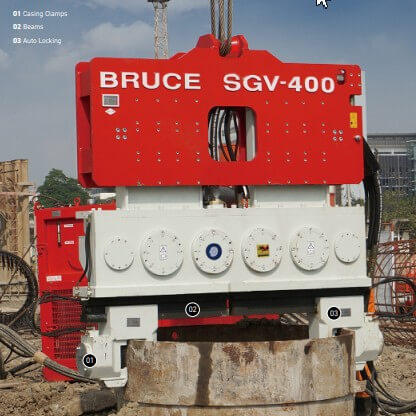
Australian WHS regulations impose strict isolation and lockout/tagout (LOTO) requirements on hydraulic equipment during maintenance and inspection activities on construction and mining sites. The BRUCE SGV and SGH operation manuals include specific isolation procedures, hydraulic pressure release sequences, and lockout point identification for all maintenance activities — documentation that is required by WHS regulators to be available on site at all times when the equipment is in use. This documentation requirement is a practical compliance consideration for Australian mine site piling projects, where the WHS regulator may request sight of the operation manual and maintenance records during a site inspection at any point during the piling programme.
04. Remote Site Logistics — Equipment Reliability as a Programme Priority
The defining characteristic of Australian mining infrastructure piling that distinguishes it from all other project environments covered in this series is the consequence of unplanned equipment downtime. On a piling project in central London or Houston, an equipment failure can typically be resolved within hours through access to local spare parts, OEM technical support, and alternative plant from nearby depots. On a Pilbara or Bowen Basin mining infrastructure project — where the nearest city may be 1,500 kilometres away by road and fly-in fly-out (FIFO) logistics govern all personnel and equipment movements — an unplanned hydraulic seal failure or gearbox component failure can halt the piling programme for days or weeks while replacement parts are sourced, shipped to the nearest regional hub, and transported to site via chartered air freight and remote site logistics.
The financial consequence of this supply chain vulnerability makes new factory-certified equipment with known consumable part specifications and pre-ordered on-site spare parts stock the only commercially rational choice for remote Australian mining infrastructure piling. Pre-ordering sufficient suppressor elastomers, clamp cylinder seals, hydraulic fittings, and gearbox lubricant to cover the anticipated project duration before the equipment leaves the factory eliminates the supply chain risk that represents the primary unplanned cost driver on remote mining infrastructure piling programmes. BRUCE provides consumable part specifications by part number in the operation manual and can advise on recommended on-site stock levels based on the project pile schedule and estimated drive duration before mobilisation.
Factory-Direct Export from Korea — Australian Port Delivery
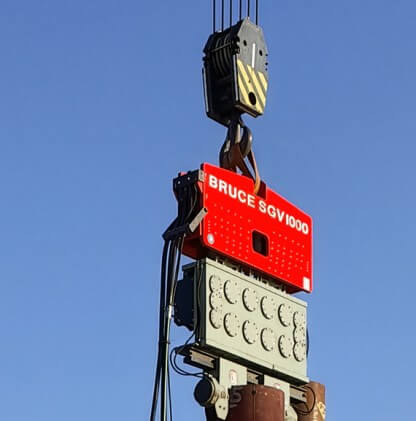
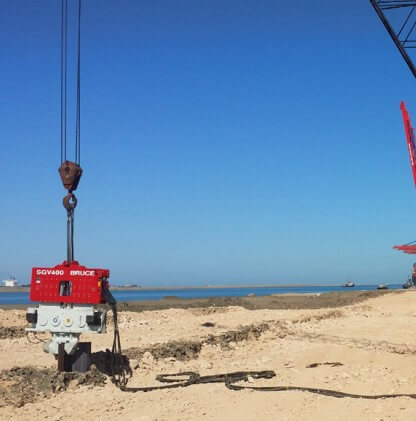
BRUCE exports factory-direct from Siheung, Gyeonggi-do, Korea to Australian ports on CIF or FOB terms. Documented deliveries have been made to projects across Asia-Pacific including New Zealand (Christchurch Public Hospital SGV-40 deployment) and major bridge and port projects across the region. For Australian mining infrastructure projects, delivery to the port of Fremantle (for Pilbara projects), Brisbane (for Bowen Basin projects), or Townsville (for northern Queensland projects) via standard container or flat-rack shipping is the typical logistics route, with heavy haulage from port to mine site arranged by the Australian contractor. All shipping documentation, Australian import compliance certificates, and technical specification sheets required for WHS plant registration are prepared by BRUCE as part of the export process at no additional charge.
For pre-mobilisation model selection, consumable parts stock recommendations, and export logistics planning for your Australian mining infrastructure project, contact the BRUCE engineering desk at powerquip.co.kr/contact-us/. Full product specifications are at powerquip.co.kr/products/vibro-hammer/features-2/.
Australian Mining Infrastructure Piling FAQ
Q: Why is ambient temperature such a critical vibratory hammer specification factor on Pilbara mining sites?
“Pilbara summer air temperatures regularly exceed 45°C — power packs not designed for sustained operation at these ambient temperatures will trigger hydraulic overtemperature shutdown during active piling, halting the programme with no local technical support available.”
BRUCE PQ-V series power packs are designed for operation above 40°C ambient and include hydraulic oil cooling systems sized for continuous high-ambient-temperature operation. Confirming the power pack thermal specification against the anticipated site ambient temperature before order placement is a mandatory pre-mobilisation step for Pilbara piling programmes.Q: What WHS documentation is required for vibratory piling equipment operating on Australian mine sites?
“State WHS regulators require plant design registration documentation, operator competency records, pre-use inspection logs, and hydraulic system pressure certificates — all of which are supported by BRUCE factory documentation for new equipment.”
BRUCE operation manuals include plant-specific inspection procedures, hydraulic circuit design documentation, and isolation and lockout sequences required by Australian WHS regulators. Pre-owned equipment with incomplete maintenance records cannot reliably satisfy these documentation requirements on Australian mine site construction projects.Q: How does Bowen Basin black soil set-up behaviour affect vibratory hammer operation?
“Smectite-rich Vertosols in the Bowen Basin exhibit very rapid skin adhesion set-up after even brief driving interruptions — restarting requires maximum centrifugal force immediately, with no gradual ramp-up option.”
The remote pendant’s flow adjust allows the operator to engage maximum centrifugal force from restart without stopping to reconfigure the hammer. Pre-mobilisation confirmation that the power pack can deliver maximum rated flow immediately on restart — without a warm-up period — is a specific operational requirement for Bowen Basin black soil piling.Q: What is the recommended consumable parts stock approach for a remote Pilbara or Bowen Basin piling programme?
“Pre-order sufficient suppressor elastomers, clamp cylinder seals, hydraulic fittings, and gearbox lubricant to cover the full project duration before the equipment leaves the Korea factory — remote site resupply lead times make mid-project parts ordering commercially unacceptable.”
BRUCE provides consumable part specifications by part number in the operation manual and advises on recommended on-site stock levels based on the project pile schedule before mobilisation. This pre-order approach eliminates the supply chain risk that represents the primary unplanned cost exposure on remote Australian mining infrastructure piling programmes.